
ᐅ Ventilation System in a Single-Family Home Not Working – Planning Mistake?
Created on: 1 Feb 2021 19:35
J
jeti79
Hello everyone,
We have now been living for 2 years (since November 2018) in our detached house with a pitched roof, built according to the 2016 energy saving regulations, equipped with a central ventilation system (Wolf CWL300). Unfortunately, we have not been satisfied with the "performance" of the ventilation system from the start. We repeatedly called our installer in the beginning, but after about the eighth visit, he gave up and simply said, "The building is full of moisture at the beginning, so it’s normal for the air quality to be poor for two years." We consider this a poor excuse.
Our dissatisfaction mainly comes from the fact that we have had the chance to compare with neighboring houses (all in the same development with similar new build standards), where the air quality is usually significantly better than in our house. This means: despite the ventilation system running continuously (on occupancy mode at about 190 m³/h [190 cubic meters per hour]), the air in our house is almost always stuffy, whether we are home or not. Although the installer advised against it, we have actually been leaving the windows open every night lately because the air in the bedroom feels used up after 3-4 hours. It’s the same situation in the children's rooms.
Even when we come to the ground floor in the morning (where nobody has been all night), the air quality is anything but good. So, as we did before, we immediately open the windows in the morning.
Of course, I assume that we might be making some mistakes ourselves, but I would like to find out if there might also be (major?) planning errors in our system? Is it even possible to determine that remotely? What information would you need from us?
I have attached a layout showing how the supply and exhaust valves are installed on the upper and ground floors. The system is installed in the attic. I change the filters regularly every month (because it’s a new development), and the chimneys on the roof are the required >2.5 m (over 8 feet) apart from each other.
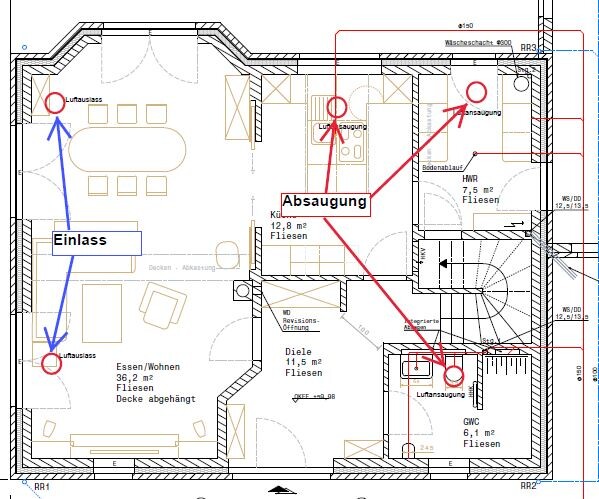
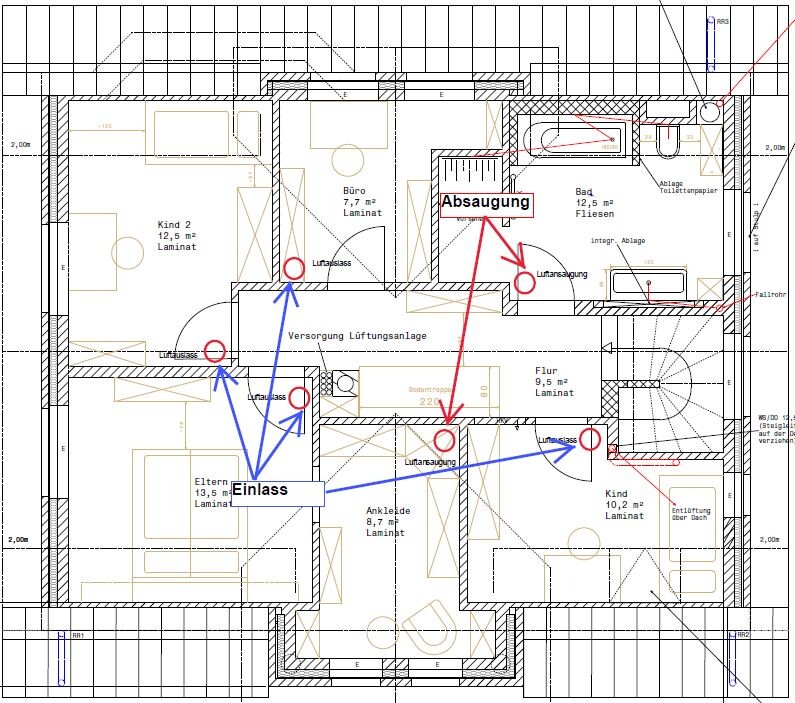
We have now been living for 2 years (since November 2018) in our detached house with a pitched roof, built according to the 2016 energy saving regulations, equipped with a central ventilation system (Wolf CWL300). Unfortunately, we have not been satisfied with the "performance" of the ventilation system from the start. We repeatedly called our installer in the beginning, but after about the eighth visit, he gave up and simply said, "The building is full of moisture at the beginning, so it’s normal for the air quality to be poor for two years." We consider this a poor excuse.
Our dissatisfaction mainly comes from the fact that we have had the chance to compare with neighboring houses (all in the same development with similar new build standards), where the air quality is usually significantly better than in our house. This means: despite the ventilation system running continuously (on occupancy mode at about 190 m³/h [190 cubic meters per hour]), the air in our house is almost always stuffy, whether we are home or not. Although the installer advised against it, we have actually been leaving the windows open every night lately because the air in the bedroom feels used up after 3-4 hours. It’s the same situation in the children's rooms.
Even when we come to the ground floor in the morning (where nobody has been all night), the air quality is anything but good. So, as we did before, we immediately open the windows in the morning.
Of course, I assume that we might be making some mistakes ourselves, but I would like to find out if there might also be (major?) planning errors in our system? Is it even possible to determine that remotely? What information would you need from us?
I have attached a layout showing how the supply and exhaust valves are installed on the upper and ground floors. The system is installed in the attic. I change the filters regularly every month (because it’s a new development), and the chimneys on the roof are the required >2.5 m (over 8 feet) apart from each other.
I wanted to provide a brief interim update: Judging by the fluctuations in air quality on the monitor, I would say the system is doing what it’s supposed to do.
When the system is switched off overnight, the CO2 level rises above 1500 ppm, with a peak of around 1800 ppm.
Now that the system is running at about 190 m³/h (6700 ft³/h), the value drops to 650 ppm within roughly an hour and continues to decline. So that probably isn’t the issue, right?
Here’s something to smile about: I borrowed a fog machine from my neighbor, placed it in the bathroom, and filled the entire room with fog. The fog completely cleared within an hour. That sounds pretty reasonable to me. However, I’m not keen on repeating that in the bedrooms anytime soon ;-)
An appointment with a Wolf sales representative is scheduled for February 18. I’m curious about that, since the issues with dirt and noise are still ongoing.
My construction manager also contacted a trusted HVAC technician friend, who plans to take another look once the “snow chaos” in this area has cleared up.
What does concern me somewhat is that both our (gas condensing) heating system and the ventilation system are currently consuming about 600–800 W of electricity at the low temperatures (-8°C (18°F)). Of course, no one mentioned that before buying. 🙁
When the system is switched off overnight, the CO2 level rises above 1500 ppm, with a peak of around 1800 ppm.
Now that the system is running at about 190 m³/h (6700 ft³/h), the value drops to 650 ppm within roughly an hour and continues to decline. So that probably isn’t the issue, right?
Here’s something to smile about: I borrowed a fog machine from my neighbor, placed it in the bathroom, and filled the entire room with fog. The fog completely cleared within an hour. That sounds pretty reasonable to me. However, I’m not keen on repeating that in the bedrooms anytime soon ;-)
An appointment with a Wolf sales representative is scheduled for February 18. I’m curious about that, since the issues with dirt and noise are still ongoing.
My construction manager also contacted a trusted HVAC technician friend, who plans to take another look once the “snow chaos” in this area has cleared up.
What does concern me somewhat is that both our (gas condensing) heating system and the ventilation system are currently consuming about 600–800 W of electricity at the low temperatures (-8°C (18°F)). Of course, no one mentioned that before buying. 🙁

K
knalltüte10 Feb 2021 07:27jeti79 schrieb:
... What concerns me a bit is that both our (gas condensing) boiler and the ventilation system are currently consuming around 600-800W of electricity at low temperatures (-8°C (17.6°F)). Of course, no one tells you that before buying. 🙁The gas condensing boiler also only uses slightly more electricity than usual because the pump has to work harder (circulation, underfloor heating). Do you have separate measurements for the boiler and the mechanical ventilation system regarding electricity consumption? I think @OWLer is right about the preheating coil...
Similar topics