
ᐅ Ventilation System in a Single-Family Home Not Working – Planning Mistake?
Created on: 1 Feb 2021 19:35
J
jeti79
Hello everyone,
We have now been living for 2 years (since November 2018) in our detached house with a pitched roof, built according to the 2016 energy saving regulations, equipped with a central ventilation system (Wolf CWL300). Unfortunately, we have not been satisfied with the "performance" of the ventilation system from the start. We repeatedly called our installer in the beginning, but after about the eighth visit, he gave up and simply said, "The building is full of moisture at the beginning, so it’s normal for the air quality to be poor for two years." We consider this a poor excuse.
Our dissatisfaction mainly comes from the fact that we have had the chance to compare with neighboring houses (all in the same development with similar new build standards), where the air quality is usually significantly better than in our house. This means: despite the ventilation system running continuously (on occupancy mode at about 190 m³/h [190 cubic meters per hour]), the air in our house is almost always stuffy, whether we are home or not. Although the installer advised against it, we have actually been leaving the windows open every night lately because the air in the bedroom feels used up after 3-4 hours. It’s the same situation in the children's rooms.
Even when we come to the ground floor in the morning (where nobody has been all night), the air quality is anything but good. So, as we did before, we immediately open the windows in the morning.
Of course, I assume that we might be making some mistakes ourselves, but I would like to find out if there might also be (major?) planning errors in our system? Is it even possible to determine that remotely? What information would you need from us?
I have attached a layout showing how the supply and exhaust valves are installed on the upper and ground floors. The system is installed in the attic. I change the filters regularly every month (because it’s a new development), and the chimneys on the roof are the required >2.5 m (over 8 feet) apart from each other.
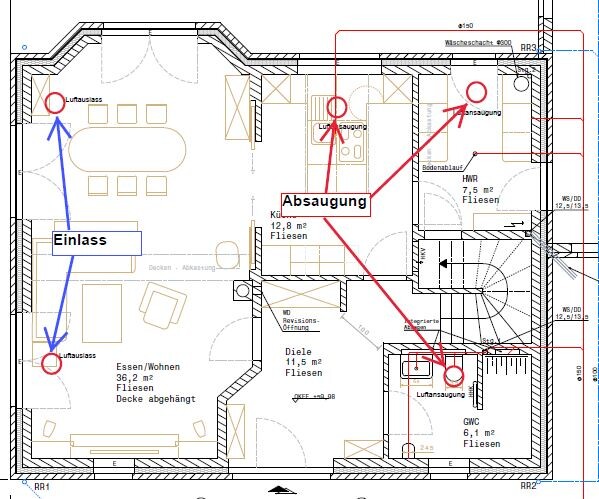
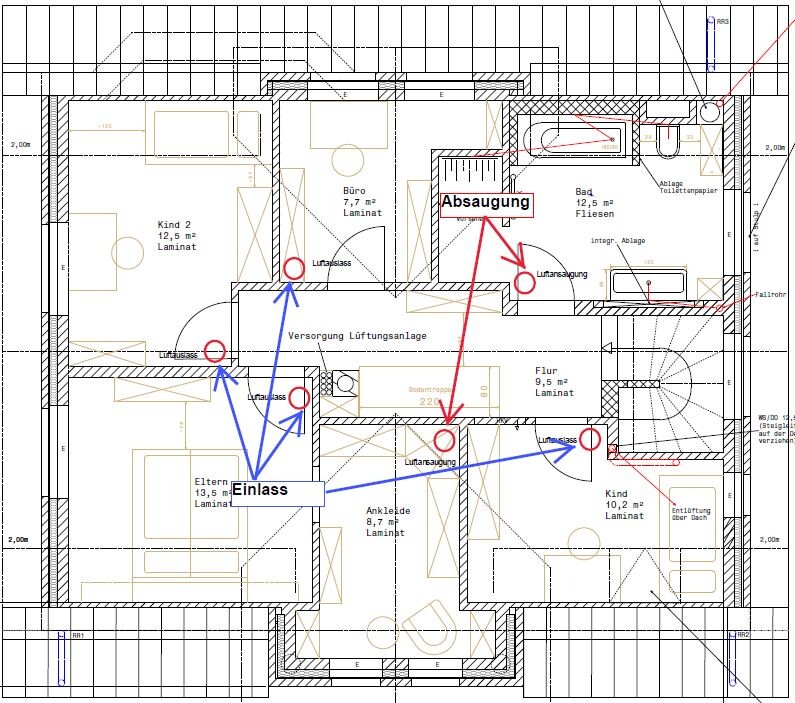
We have now been living for 2 years (since November 2018) in our detached house with a pitched roof, built according to the 2016 energy saving regulations, equipped with a central ventilation system (Wolf CWL300). Unfortunately, we have not been satisfied with the "performance" of the ventilation system from the start. We repeatedly called our installer in the beginning, but after about the eighth visit, he gave up and simply said, "The building is full of moisture at the beginning, so it’s normal for the air quality to be poor for two years." We consider this a poor excuse.
Our dissatisfaction mainly comes from the fact that we have had the chance to compare with neighboring houses (all in the same development with similar new build standards), where the air quality is usually significantly better than in our house. This means: despite the ventilation system running continuously (on occupancy mode at about 190 m³/h [190 cubic meters per hour]), the air in our house is almost always stuffy, whether we are home or not. Although the installer advised against it, we have actually been leaving the windows open every night lately because the air in the bedroom feels used up after 3-4 hours. It’s the same situation in the children's rooms.
Even when we come to the ground floor in the morning (where nobody has been all night), the air quality is anything but good. So, as we did before, we immediately open the windows in the morning.
Of course, I assume that we might be making some mistakes ourselves, but I would like to find out if there might also be (major?) planning errors in our system? Is it even possible to determine that remotely? What information would you need from us?
I have attached a layout showing how the supply and exhaust valves are installed on the upper and ground floors. The system is installed in the attic. I change the filters regularly every month (because it’s a new development), and the chimneys on the roof are the required >2.5 m (over 8 feet) apart from each other.
Bookstar schrieb:
Great! Always position it so that it is not directly at the valve and ideally in the center of the room. The windowsill or furniture are good options. I was thinking of places like, bedroom: middle of the bed, kids' room: bed, office: desk, etc...
dab_dab schrieb:
Supply air, exhaust air, and chimneys all aligned—is that a common and especially practical arrangement?
Even if there isn’t a wood stove connected yet, the chimney is planned for one, right? During the planning phase with the architect, we discussed this: the chimney, ventilation system, and kitchen hood must not run parallel, and there must be a shut-off device.
I am planning to remove the ventilation system’s chimneys anyway to make room for photovoltaic modules. The intake and exhaust will then be relocated to the north wall of the house, so they will also be shaded from the sun.
We also visited a kitchen consultation over the weekend, and we were more or less advised against the combination of exhaust air and a ventilation system.
Is this combination really not advisable?
Do I actually have a significant advantage with exhaust air? I suppose cooking odors won’t really disappear anyway, regardless of whether it’s exhaust air or recirculation.
Is this combination really not advisable?
Do I actually have a significant advantage with exhaust air? I suppose cooking odors won’t really disappear anyway, regardless of whether it’s exhaust air or recirculation.
Regarding the topic of odors from exhaust air, I can only say: my girlfriend is half Portuguese and loves fish dishes, while I hate fish (smell). Thanks to our Berbel range hood, unlike before in our apartment, it doesn’t bother me at all when she cooks fish dishes...
The setup should probably be designed so that the ventilation system is turned off when the range hood is in use or a window is opened. We haven’t activated this so far, but it doesn’t really bother us...
The setup should probably be designed so that the ventilation system is turned off when the range hood is in use or a window is opened. We haven’t activated this so far, but it doesn’t really bother us...
Snowy36 schrieb:
I would only use exhaust air ... Get rid of the smelly air and that’s it ... You probably can’t completely avoid odors, but we are very satisfied with the performance of our "Berbel." Since we have a fairly open kitchen (separated from the living/dining area by a double sliding door), performance was one of our main criteria when choosing it: performance, performance, performance ;-)
But back to the main topic:
Yesterday our site manager, who also works as a building inspector and writes reports, visited us. He is not very familiar with the technical details of ventilation systems but understands the basic principle: he also assumes that the supply and exhaust vents upstairs are poorly positioned. In the coming days, he will come by again with a trusted installer friend who is experienced in designing these systems. (Fortunately, this is all cost-neutral for now.)
Regarding the dust buildup near the supply vents, he thinks that the consistently higher airflow is causing turbulence, which attracts dust through magnetic forces and causes it to settle there. He considers the filters used in the ventilation unit critical because they are not certified. He also believes that the airflows in the system are not properly sized since the airflow is adjusted solely by the diffuser valve. He mentioned so-called throttle valves for regulating airflow.
It has been noticed that rooms with shorter supply duct runs from the air distributor tend to have significantly more dust than those farther away.
I’m curious to see what the next two visits will reveal (the Wolf customer service and the installer).
The CO2 monitor is supposed to arrive today. I will log some data with it and gladly share it here.
Sounds basically reasonable.
The filter inside the unit is not certified, so what? A filter is just resistance; the fan doesn’t care whether the part is certified or not.
Something else: Do you already replace the filters regularly, whether in the unit or at the exhaust vents?
The filter inside the unit is not certified, so what? A filter is just resistance; the fan doesn’t care whether the part is certified or not.
Something else: Do you already replace the filters regularly, whether in the unit or at the exhaust vents?
Similar topics