
Hi,
when we planned the electrical system, we included a 5-core underground cable as a reserve for the garden. It is intended for future garden lighting and power supply. The cable comes out roughly in the middle of the property, under the terrace.

I’m not looking for advice on how to properly connect the cable—that will be done by professionals.
But for my further garden planning, I have the following questions:
when we planned the electrical system, we included a 5-core underground cable as a reserve for the garden. It is intended for future garden lighting and power supply. The cable comes out roughly in the middle of the property, under the terrace.
I’m not looking for advice on how to properly connect the cable—that will be done by professionals.
But for my further garden planning, I have the following questions:
- Can I split this cable into two independent circuits? There is a simple switch inside that is already planned for this purpose. It could later be replaced with a double switch to control each circuit separately.
- Can I then run one circuit to the left side of the garden and the other to the right side? What happens to the green/yellow PE (protective earth) conductor in this case?
Dogma schrieb:
Then you should use 10A for the 10m (33 feet) circuit and 6A for the 50m (164 feet) circuit, but this is already a generous estimation, and for the 50m circuit, it’s almost at the absolute limit!!!
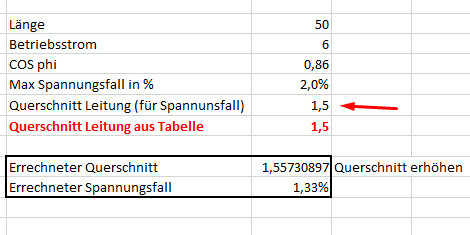
Unfortunately, the calculation is also incorrect. With the given values, the voltage drop is twice as high—2.66%—because the return path was not taken into account.
 Vicky Pedia16 Mar 2020 22:01
Dogma schrieb:
If you want 16A, you need a 10mm² ground cableJust to be clear and because the discussion continues: 10mm² is quite something! That means a lot of copper! It’s millimeters squared.
laley schrieb:
This is intended for later garden lighting/power supply.LED lighting draws very little power, so 100m (330 feet) shouldn't be a problem. But what exactly will be connected to the "power supply"? An electric lawnmower with just over 1000W (1kW) could already be critical.
WingVII schrieb:
Unfortunately, the calculation is also wrong. With the given values, the voltage drop is twice as high—2.66% because the return conductor was not considered. I’ve been waiting for a forum troll like you. If you knew it so precisely, you could have helped instead of whining here.
And just so you know, the result is correct because the formula includes 2 × l (l = length). Maybe you should have asked what the formula includes before complaining.
Oh man, seriously…
P.S. Your claim that 100 m is correct for three-phase current is unfortunately wrong because in the formula, instead of 2 × l, it’s √3 or 1.73 × l.
Dogma schrieb:
I’ve been waiting for a forum troll like you. If you knew it so well, you could have helped him instead of whining here.
And just so you know, the result is correct because the formula includes 2 × l (l = length). Maybe you should have asked what the formula contains before complaining.
Oh man, people these days... Now please stay calm. Sorry if I came across too strongly.
Why am I a troll if I point out an incorrect result? Electrical installations often don’t forgive mistakes.
Look, you only considered the single length.
Dogma schrieb:
P.S. Your statement that 100 m (330 ft) is correct for three-phase power is unfortunately not accurate… because the formula uses √3 or 1.73 × l instead of 2 × l. My statement referred to the conductor length. It is obvious that the line-to-line factor has to be taken into account when dealing with three-phase current.
Dogma schrieb:
If you know it so well, you could have helped him instead of whining here. Yes, it would be helpful if the original poster could summarize exactly what they want to do. Then we could assist further.
H
hampshire17 Mar 2020 07:53Standard LED lighting over 50 m (165 ft) using 1.5 mm² (approximately 16 AWG) wiring is not an issue (of course, not an unlimited number).
For a well pump over 50 m (165 ft) with 1.5 mm² (approximately 16 AWG) wiring, it's better to double-check and recalculate (there are many different models ranging from small pond pumps to those supplying C-pipes).
Place higher power consumers close to the house to use shorter cables.
Make sure to size fuses correctly! You can also consider installing a small sub-distribution board adapted to the usage at the cable branching point.
For a well pump over 50 m (165 ft) with 1.5 mm² (approximately 16 AWG) wiring, it's better to double-check and recalculate (there are many different models ranging from small pond pumps to those supplying C-pipes).
Place higher power consumers close to the house to use shorter cables.
Make sure to size fuses correctly! You can also consider installing a small sub-distribution board adapted to the usage at the cable branching point.
Similar topics