
Hi,
when we planned the electrical system, we included a 5-core underground cable as a reserve for the garden. It is intended for future garden lighting and power supply. The cable comes out roughly in the middle of the property, under the terrace.

I’m not looking for advice on how to properly connect the cable—that will be done by professionals.
But for my further garden planning, I have the following questions:
when we planned the electrical system, we included a 5-core underground cable as a reserve for the garden. It is intended for future garden lighting and power supply. The cable comes out roughly in the middle of the property, under the terrace.
I’m not looking for advice on how to properly connect the cable—that will be done by professionals.
But for my further garden planning, I have the following questions:
- Can I split this cable into two independent circuits? There is a simple switch inside that is already planned for this purpose. It could later be replaced with a double switch to control each circuit separately.
- Can I then run one circuit to the left side of the garden and the other to the right side? What happens to the green/yellow PE (protective earth) conductor in this case?
What kind of protection needs to be installed will surely be known by my electrician.
For me, it’s only important to understand what this means for me.
If we assume 6A, what kind of appliances can I still connect to the circuit?
As I said, lamps and a decorative pump would be enough. So maybe around 50W.
And what would be the maximum load I’m allowed to connect?
Just calculate it? (230V * 6A = 1380W)
At 1380W, the circuit or the breaker would trip, right?
At least this way I can see how close I am to causing a fuse to blow.
If I only connect devices drawing about 100W, I’m on the safe side.
For me, it’s only important to understand what this means for me.
If we assume 6A, what kind of appliances can I still connect to the circuit?
As I said, lamps and a decorative pump would be enough. So maybe around 50W.
And what would be the maximum load I’m allowed to connect?
Just calculate it? (230V * 6A = 1380W)
At 1380W, the circuit or the breaker would trip, right?
At least this way I can see how close I am to causing a fuse to blow.
If I only connect devices drawing about 100W, I’m on the safe side.
 untergasse4316 Mar 2020 15:25
laley schrieb:
If we assume 6A, what kind of appliances can I still connect to the circuit? Appliances up to 6A, what else? That’s why your 1380W calculation is correct (although the cable actually delivers 240V (about 240V)), but due to the circumstances already described here, I would assume a maximum of 1000W (about 1000W), or even less. For some lighting and a decorative pump, that is definitely sufficient. If garden sockets are also connected, you should keep that in mind when you eventually want to use a socket for a hedge trimmer or garden shredder...
Dogma schrieb:
Wow, 100m (330 feet) is quite a length.
If you want 16A, you will need a 10 mm² (12 AWG) underground cable.
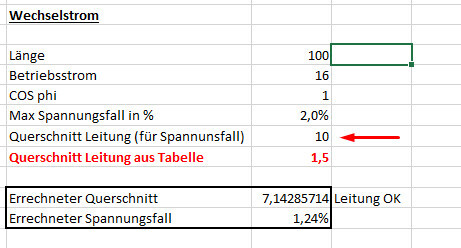
If you are already doing a voltage drop calculation, please do it correctly. For alternating current, you need to consider both the outgoing and return paths. So instead of 100m (330 feet), use 200m (660 feet). If it were three-phase current, then 100m (330 feet) would be correct.
Only ONE fuse should be installed for the cable in any case. Never operate multiple fuses in parallel on a single cable. The only exception is three-phase consumers.
Similar topics