
Hello everyone,
We are about to purchase a plot of land that slopes down from the street. For this reason, we want to first consider what is technically possible before buying it. The biggest challenge seems to be the height of the garage built on the property line if we want to build at street level. Here is a picture of the situation:
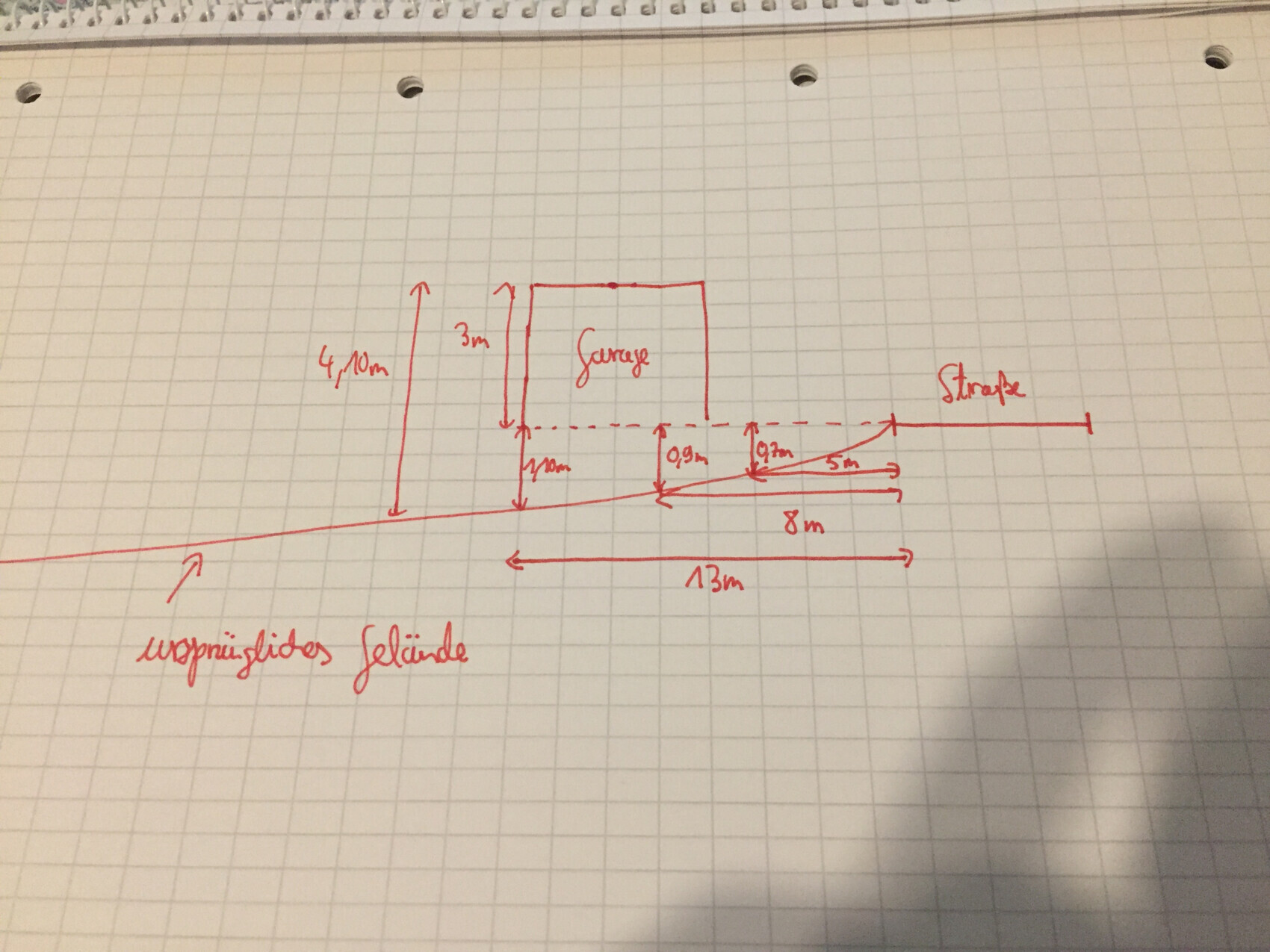
Unfortunately, with a base that raises the ground and a garage height of, let's say, 3 meters (10 feet), the permitted height of 3.20 meters (10.5 feet) required in Rhineland-Palatinate would be exceeded. What possible solutions do you see?
Thank you in advance.
We are about to purchase a plot of land that slopes down from the street. For this reason, we want to first consider what is technically possible before buying it. The biggest challenge seems to be the height of the garage built on the property line if we want to build at street level. Here is a picture of the situation:
Unfortunately, with a base that raises the ground and a garage height of, let's say, 3 meters (10 feet), the permitted height of 3.20 meters (10.5 feet) required in Rhineland-Palatinate would be exceeded. What possible solutions do you see?
Thank you in advance.
The transition involves many detailed questions, and yes, the car industry in Germany could face a huge problem. But instead of ignoring it and acting protectionist—which is globally unrealistic anyway—this should be seen as an opportunity to change and adapt.
Why does the music industry today kick itself for fighting illegal downloads instead of embracing the form of user demand? Then they tried to crush legal streaming, and now they’re upset that someone else is making the profits, because the platforms, the ecosystem, belong to others and they only supply content.
Look at car manufacturers who refuse to accept being mere contract manufacturers. Just wait and see.
The car debate doesn’t have to be reduced to environmental issues. Where highways exist today and are constantly being widened, there should actually be fiber optic cables and power lines instead. Where main roads and parking lots are found in cities, there should be living space. Individual car traffic as we know it today is simply in the way.
Not to mention the tragedies and costs caused by human failure in road traffic.
And to return to the environment: batteries are dirty, but so are combustion engines—just in different ways. Battery technology is still in its early stages; there is more to come. Combustion engines, well.
The most environmentally friendly car is always the one that is never built. That means reducing the number of cars in Germany to one third. That works. For this, Karsten’s usage model is needed.
In 30 years, there will still be cars. VW will still build cars, but maybe their logo will no longer be on the hood.
And if it is, I am quite sure they will no longer sell them to end customers. (High)technology is not sold; usage rights are sold. Moving from ownership of an object to paying for a service.
Why does the music industry today kick itself for fighting illegal downloads instead of embracing the form of user demand? Then they tried to crush legal streaming, and now they’re upset that someone else is making the profits, because the platforms, the ecosystem, belong to others and they only supply content.
Look at car manufacturers who refuse to accept being mere contract manufacturers. Just wait and see.
The car debate doesn’t have to be reduced to environmental issues. Where highways exist today and are constantly being widened, there should actually be fiber optic cables and power lines instead. Where main roads and parking lots are found in cities, there should be living space. Individual car traffic as we know it today is simply in the way.
Not to mention the tragedies and costs caused by human failure in road traffic.
And to return to the environment: batteries are dirty, but so are combustion engines—just in different ways. Battery technology is still in its early stages; there is more to come. Combustion engines, well.
The most environmentally friendly car is always the one that is never built. That means reducing the number of cars in Germany to one third. That works. For this, Karsten’s usage model is needed.
In 30 years, there will still be cars. VW will still build cars, but maybe their logo will no longer be on the hood.
And if it is, I am quite sure they will no longer sell them to end customers. (High)technology is not sold; usage rights are sold. Moving from ownership of an object to paying for a service.
Nordlys schrieb:
The important point is a verifiable parking space. If my garage counts as an additional parking space, then it can also be used as a shed.That’s all true, Karsten. However, nowadays with very small plots, fewer and fewer people have two parking spaces plus a garage. For most, the garage or double garage counts as one or two of the required parking spaces.Our neighbors have used their garages up to about 1.5 meters (5 feet) as storage rooms or tiled them and furnished them with a sofa, bong, and pool table. I wouldn’t want that; I’m really glad I don’t have to get up earlier in the morning to scrape ice.
However, there is no slope here either.
However, there is no slope here either.
We had to submit 2 proofs, and we will receive 8 more.
That doesn’t really help the original poster.
Cars are still necessary here. There is simply too much missing, especially in terms of infrastructure. I wouldn’t even know how to get to work here. You can’t really run a bus from Smallville to Smallville for just one or two people.
However, buses used to run in the past. Directly to Southwest for shift work. Always on time. That could still work now. There are plenty of shift workers.
That doesn’t really help the original poster.
Cars are still necessary here. There is simply too much missing, especially in terms of infrastructure. I wouldn’t even know how to get to work here. You can’t really run a bus from Smallville to Smallville for just one or two people.
However, buses used to run in the past. Directly to Southwest for shift work. Always on time. That could still work now. There are plenty of shift workers.
haydee schrieb:
What will be used to charge all the electric cars?
How will the peak loads be managed?
Every evening between 4 and 6 pm, one to two cars in each garage are connected to the wall box charger. You are misunderstanding the concept of the "transport transition." The transport transition does not simply mean replacing every internal combustion engine vehicle with an electric vehicle.
The mobility transition must integrate all modes of transport, including individual transportation and public transit.
Similar topics