
Hello everyone,
We are about to purchase a plot of land that slopes down from the street. For this reason, we want to first consider what is technically possible before buying it. The biggest challenge seems to be the height of the garage built on the property line if we want to build at street level. Here is a picture of the situation:
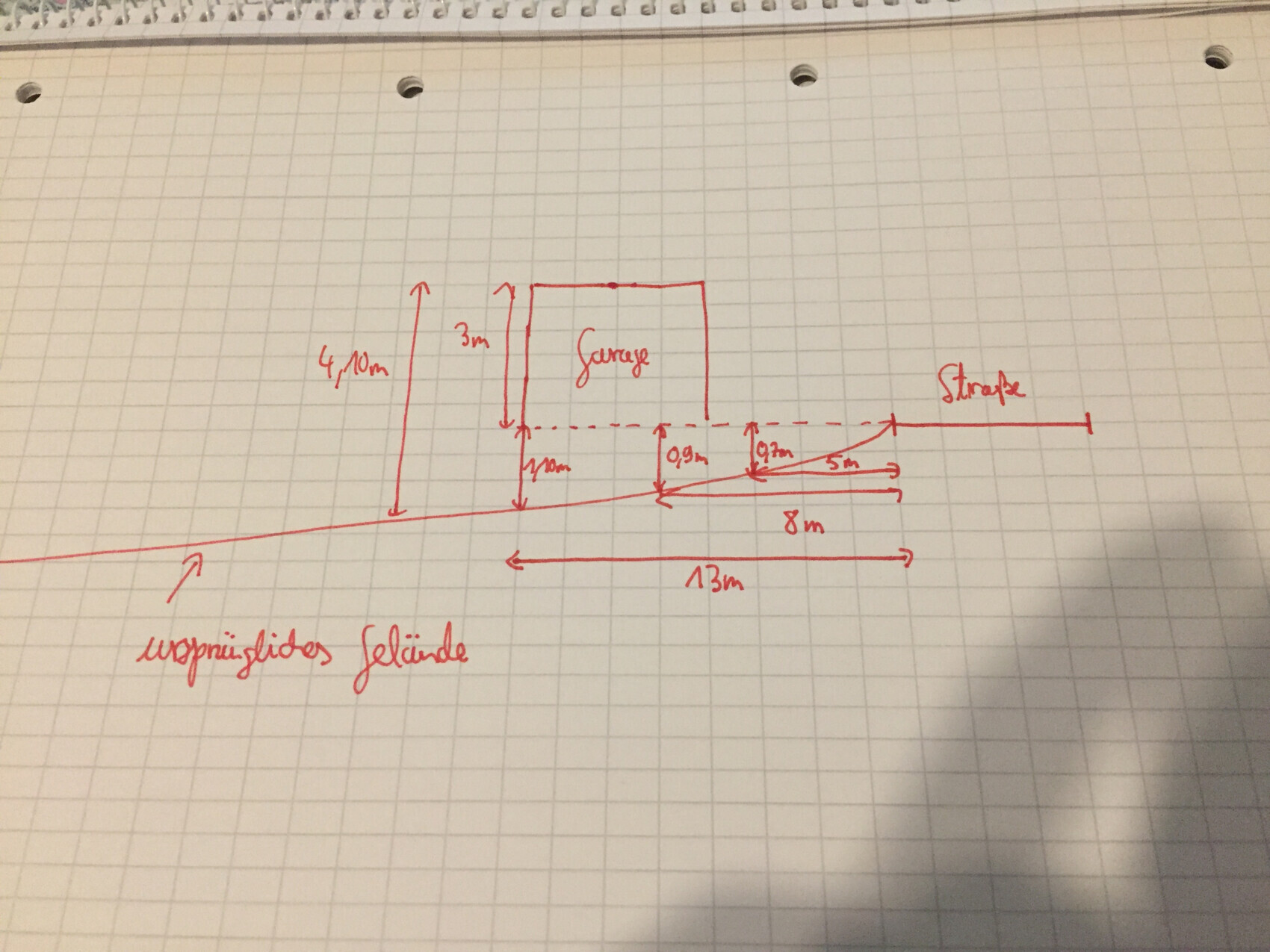
Unfortunately, with a base that raises the ground and a garage height of, let's say, 3 meters (10 feet), the permitted height of 3.20 meters (10.5 feet) required in Rhineland-Palatinate would be exceeded. What possible solutions do you see?
Thank you in advance.
We are about to purchase a plot of land that slopes down from the street. For this reason, we want to first consider what is technically possible before buying it. The biggest challenge seems to be the height of the garage built on the property line if we want to build at street level. Here is a picture of the situation:
Unfortunately, with a base that raises the ground and a garage height of, let's say, 3 meters (10 feet), the permitted height of 3.20 meters (10.5 feet) required in Rhineland-Palatinate would be exceeded. What possible solutions do you see?
Thank you in advance.
What haydee describes is indeed real. In Schleswig-Holstein (SH), and even more so in Mecklenburg-Vorpommern (MVP), there are many villages with fewer than 200 inhabitants, some located 20 km (12 miles) from the nearest store, with work and schools even farther away for many. All of these— and there are quite a few— live in such rural conditions that currently, having no car means things simply don’t work. Without one, these areas would be unlivable. People would starve. Green urban concepts don’t work here. There will always have to be private transport, though it remains to be seen what form that will take. Possibly different from today, but not buses, trains, or metros.
Still, in this forum, I often find the garage question overrated to the point where I sometimes wonder if some thread starters are building a house or a garage with a kitchen. I bet things work differently in these rural areas than building meter-high walls (walls several meters high) directly on the property line. One would need to see a plan of the property, more than the sketch given at the beginning.
Still, in this forum, I often find the garage question overrated to the point where I sometimes wonder if some thread starters are building a house or a garage with a kitchen. I bet things work differently in these rural areas than building meter-high walls (walls several meters high) directly on the property line. One would need to see a plan of the property, more than the sketch given at the beginning.
MayrCh schrieb:
You have the wrong idea about the concept of "transport transition." Transport transition does not simply mean replacing every combustion engine vehicle with an electric car and calling it a day.
A mobility transition must integrate all forms of transportation, including individual motorized traffic as well as public transit. For this to happen, there needs to be public transit.
Nordlys schrieb:
Green urban concepts like this do not work here. No serious “green urban” concept aims to completely eliminate private individual traffic. For the reasons you explained well, this is simply not possible.
Nordlys schrieb:
There are plenty of villages in SH and even more so in MVP. Especially in SH, there is already enough pressure to implement sector coupling approaches or a spatially limited “all-electric society.” You definitely won’t be able to export the green electricity you plan to produce in the coming years via the grid.
haydee schrieb:
For that, there needs to be public transport. Or other concepts. The idea that one combustion engine vehicle equals one electric car is misguided in most areas.
That's nonsense. Electric cars are a supplement and make sense in many areas. However, today's combustion engines are not polluters. The DHU is purely driven by interests, and the Green Party, as with many other areas, consists of school graduates rather than experts and lacks professional competence.
@Mudo1991 could you share a site plan including the building envelope?
Earlier, I saw a different solution with the garage built on the property boundary.
What other concept, for example?
Earlier, I saw a different solution with the garage built on the property boundary.
MayrCh schrieb:
Or other concepts. One combustion engine car = one electric car is mostly an incorrect assumption (thought).
What other concept, for example?
haydee schrieb:
What other concept, for example? Carsharing, carpooling, area-focused public transport, the good old shared ride...
Again: None of these are meant to abolish individual transportation. Rather, they should complement it in a meaningful way. For this, an attractive offer must be created that is economically viable within certain limits.
The problem in Karsten’s sparsely populated "non-urban" areas does not mainly affect the 16-65 age group, but hits those over 70 very hard, who are no longer allowed/can/should participate in individually motorized traffic.
Similar topics