
ᐅ Cat droppings or wildlife scat? Warning: image of animal droppings!
Created on: 10 Jul 2018 13:03
A
andimann
Hello everyone,
(Hope I don’t get banned right away for posting a bunch of crap…)
Some animal is leaving a pile of droppings on our lawn almost every night, strangely always in almost the same spot (plus or minus 2 m (6.5 ft)). At first, I suspected the neighbor’s cat, but the pile seems too large for a cat, right? Also, don’t cats usually go into garden beds rather than right in the middle of the lawn?
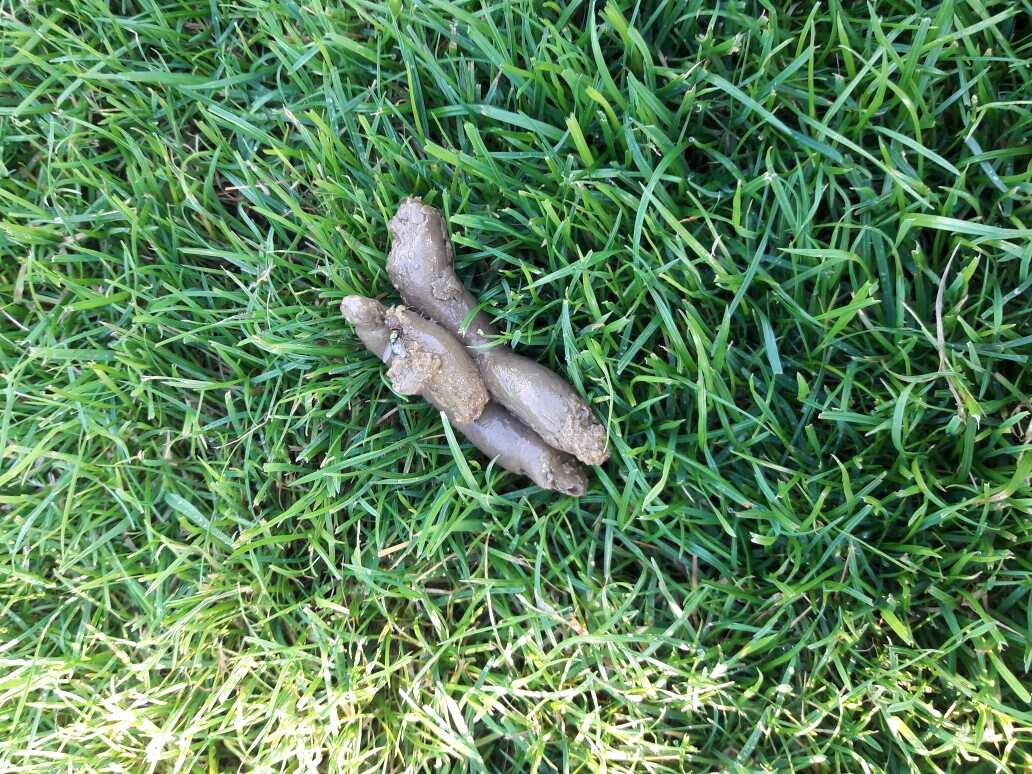
Question: Can anyone tell me if this could still be cat droppings? If so, I guess a conversation with the neighbors is due.
I’m getting tired of cleaning it up every morning, and even more worried that my kids might step in it while playing or that my son might try to taste it. My nephew once caught worms that way, which was quite unpleasant. That really shouldn’t happen.
And if it’s something else: what could it be and, above all, how do I get rid of it?
Barbed wire, spring-loaded traps, anti-aircraft guns, nuclear bomb?
Best regards,
Andreas
(Hope I don’t get banned right away for posting a bunch of crap…)
Some animal is leaving a pile of droppings on our lawn almost every night, strangely always in almost the same spot (plus or minus 2 m (6.5 ft)). At first, I suspected the neighbor’s cat, but the pile seems too large for a cat, right? Also, don’t cats usually go into garden beds rather than right in the middle of the lawn?
Question: Can anyone tell me if this could still be cat droppings? If so, I guess a conversation with the neighbors is due.
I’m getting tired of cleaning it up every morning, and even more worried that my kids might step in it while playing or that my son might try to taste it. My nephew once caught worms that way, which was quite unpleasant. That really shouldn’t happen.
And if it’s something else: what could it be and, above all, how do I get rid of it?
Barbed wire, spring-loaded traps, anti-aircraft guns, nuclear bomb?
Best regards,
Andreas

[QUOTE="Steven, post: 269624, member: 28836"][If you kill a dog or a cat because that is the only way to prevent damage from yourself, it is at most property damage. You have a reason to kill the animal. So animal cruelty is ruled out.]
I don’t think it’s that simple. The principle of proportionality also applies. Killing an animal because it urinates in your garden is disproportionate—even if it happens repeatedly. In that case, you would definitely be committing a criminal offense.
I don’t think it’s that simple. The principle of proportionality also applies. Killing an animal because it urinates in your garden is disproportionate—even if it happens repeatedly. In that case, you would definitely be committing a criminal offense.
kaho674 schrieb:
For every 300 mice caught, I’d estimate there’s one bird. It could of course be due to clumsiness. Hello kaho,
It is quite common for cat owners to greatly overestimate the number of mice caught (or rather, the mice cruelly killed), while shamelessly underestimating the number of birds. The truth is that cats significantly contribute to the decline of wild bird populations. The same applies to hares.
Steven
kaho674 schrieb:
. The principle of proportionality also applies. . No, the "principle of proportionality" does not apply here.
Even in the self-defense courses I occasionally teach, the opinion often comes up that self-defense must be proportional. No, it does not have to be.
Steven
K
Knallkörper11 Jul 2018 12:49Steven, it seems you lack understanding of the legal basis. If you kill or injure a neighbor’s animal improperly, it is considered property damage and animal cruelty in any case. This does not fall under necessity, and certainly not under emergency aid or self-defense. See §34 of the Criminal Code.
Therefore, the original poster will have to find another solution, as if dealing with a wild animal. This could involve technical devices, scents, or simply a water hose. Poison, traps, or weapons are not allowed.
Maybe the cat from andimann’s neighbor is disabled, who knows. Usually, cats cannot be trained to such an extent.
Personally, I have no problem with cats in urban and rural areas. Dogs, however, are more of an issue. But as soon as I see a cat hunting in open fields, there will be trouble. There is no acute health risk from cat feces either. Worm infestations in children are mainly a hygiene issue caused by parents not teaching proper handwashing. The eggs can be caught from various surfaces, but especially from fruits and vegetables.
Therefore, the original poster will have to find another solution, as if dealing with a wild animal. This could involve technical devices, scents, or simply a water hose. Poison, traps, or weapons are not allowed.
Maybe the cat from andimann’s neighbor is disabled, who knows. Usually, cats cannot be trained to such an extent.
Personally, I have no problem with cats in urban and rural areas. Dogs, however, are more of an issue. But as soon as I see a cat hunting in open fields, there will be trouble. There is no acute health risk from cat feces either. Worm infestations in children are mainly a hygiene issue caused by parents not teaching proper handwashing. The eggs can be caught from various surfaces, but especially from fruits and vegetables.
Knallkörper schrieb:
Steven, it seems you don’t fully understand the legal basis. If you kill or injure a neighbor’s animal improperly, it is considered property damage and animal cruelty in any case. This is not covered by necessity, nor by emergency aid or self-defense. See §34 StGB.
. Hello Knallkörper
We are not dealing with hunting law here.
Self-defense or emergency aid generally only apply to people, not to property.
Take a look at court rulings involving cat owners. They clearly set the precedent.
Most lawsuits fail because it is difficult to prove that a specific cat urinated in the garden.
Steven
Similar topics