
Hello,
it is clear that a sealing tape suitable for the purpose should be applied from the frame to the window.
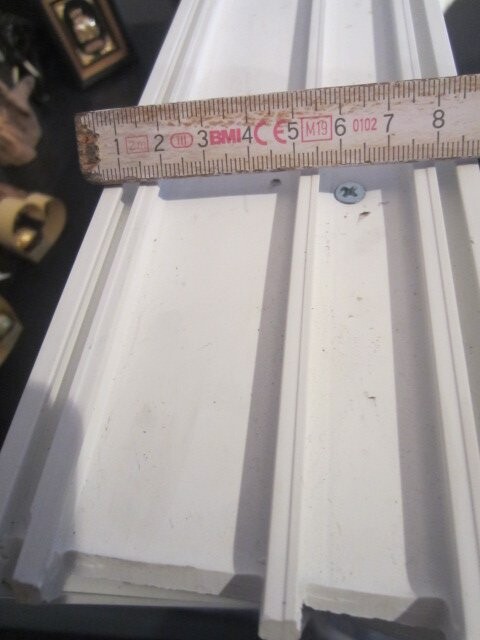
Therefore, my question: the window has a mullion (see photo). Is it better to use one sealing tape or two tapes that are then applied on both sides of the mullion?
Thank you
it is clear that a sealing tape suitable for the purpose should be applied from the frame to the window.
Therefore, my question: the window has a mullion (see photo). Is it better to use one sealing tape or two tapes that are then applied on both sides of the mullion?
Thank you
X
xMisterDx29 Jan 2023 12:50When done correctly, compressible sealing tape (Kompriband) is certainly the better choice. However, the problem is: the more complex and precise the work needs to be, the higher the chance that something will go wrong somewhere. Especially when the tradesperson is working under pressure and everything has to be done "quickly, quickly, we need to finish today, tomorrow we’re at the next site."
I believe that (from inside to outside) using a window connection tape, foam, and then a plaster stop bead with sealing tape is not the worst approach. A common mistake with compressible sealing tape is that the gap is simply too large, or the substrate is not level. In such cases, air whistles through where the foam would have expanded.
I believe that (from inside to outside) using a window connection tape, foam, and then a plaster stop bead with sealing tape is not the worst approach. A common mistake with compressible sealing tape is that the gap is simply too large, or the substrate is not level. In such cases, air whistles through where the foam would have expanded.

In principle, you are generally correct. But not in this case. With the “old” method, there are more steps involved, which are complicated and where things can go wrong. Overall, it also takes longer—even for a professional. That’s why more and more tradespeople are switching to the “new” method. The material is more expensive, but it saves time. In the future, I would always commission work this way and choose my contractor based on their experience with it.
X
xMisterDx30 Jan 2023 00:22Uh, yeah. I once walked through the construction area out of curiosity. About 80% clearly use foam for installation, 20% don’t.
The "complicated" part isn’t the steps themselves, but the fact that the compressible sealing tape requires a perfectly smooth surface. If the “grip pockets” of the aerated concrete blocks aren’t plastered or you still have the grooves from the Poroton blocks in the reveal, or if you have 10mm (0.4 inches) at the top and 20mm (0.8 inches) at the bottom... then your compressible tape won’t seal tightly everywhere...
If you hire the window installer separately and prepare everything perfectly, fine. But this is not the case for 95% of homeowners. No plasterer comes to the site to finish the window opening before the window installation. The window installer will just foam it in if necessary... and if they use compressible sealing tape, they don’t care about the details anymore...
I’d rather have 10 windows that are 90% okay than 9 windows that fit perfectly and 1 window that doesn’t fit at all.
The "complicated" part isn’t the steps themselves, but the fact that the compressible sealing tape requires a perfectly smooth surface. If the “grip pockets” of the aerated concrete blocks aren’t plastered or you still have the grooves from the Poroton blocks in the reveal, or if you have 10mm (0.4 inches) at the top and 20mm (0.8 inches) at the bottom... then your compressible tape won’t seal tightly everywhere...
If you hire the window installer separately and prepare everything perfectly, fine. But this is not the case for 95% of homeowners. No plasterer comes to the site to finish the window opening before the window installation. The window installer will just foam it in if necessary... and if they use compressible sealing tape, they don’t care about the details anymore...
I’d rather have 10 windows that are 90% okay than 9 windows that fit perfectly and 1 window that doesn’t fit at all.
X
xMisterDx30 Jan 2023 00:30Regarding the time factor: that falls on the window installer, that’s true. However, they apply the compression tape without much concern for precision.
In other words, if your window opening isn’t plastered perfectly—smooth, square, and even—you will definitely have spots where the tape doesn’t seal properly.
And that’s where the problems start. The window installer says, “Well, I’ll just stick it on; if it’s not plastered properly, that’s not my problem...”
Meanwhile, the homeowner wasn’t even aware that after the bricklayer, the plasterer has to come back to finish the window openings properly for RAL installation with compression tape…
Or the bricklayer does it. But that costs money and time. Classic case of one hand washing the other. The window installer saves what the plasterer charges extra.
As I mentioned before, this is the more modern way to install windows. But everyone involved in this process must work precisely and know what they’re doing. On today’s construction sites, this can easily go wrong.
In other words, if your window opening isn’t plastered perfectly—smooth, square, and even—you will definitely have spots where the tape doesn’t seal properly.
And that’s where the problems start. The window installer says, “Well, I’ll just stick it on; if it’s not plastered properly, that’s not my problem...”
Meanwhile, the homeowner wasn’t even aware that after the bricklayer, the plasterer has to come back to finish the window openings properly for RAL installation with compression tape…
Or the bricklayer does it. But that costs money and time. Classic case of one hand washing the other. The window installer saves what the plasterer charges extra.
As I mentioned before, this is the more modern way to install windows. But everyone involved in this process must work precisely and know what they’re doing. On today’s construction sites, this can easily go wrong.
porks444 schrieb:
So the question is, the window has a mullion (see photo), is it better to use one sealing tape or two tapes glued between the mullion? Since the question hasn't been answered yet: IF the window fits well, you can use a multifunctional sealing tape to seal the gap. Instead of cutting the tape lengthwise, buy it in a width that covers the full depth of the frame. The term "compression tape" (Kompriband) is used for anything made of PU that can be compressed. Do not simply use the thin tape meant only for the outer weather-resistant sealing of the connection; instead, use the mentioned multifunctional sealing tape applied correctly. For window corners and the bottom, follow the manufacturer’s instructions as always stated in the technical datasheet.
If I were doing it myself, I would use sealing tape on the inside, then foam, and compression tape on the outside at the stop. This way it is easier to detect if anything is leaking.
By the way, the compressible sealing tape (multi-function sealing tape) we used didn’t mind if the wall opening had a gap of 10mm (0.4 inches) at the top, 20mm (0.8 inches) in the middle, and 15mm (0.6 inches) at the bottom. It can easily fill up to 50mm (2 inches).
If it’s cold, it may just take longer.
If it’s cold, it may just take longer.
Similar topics