
 BrosBrosBros11 Sep 2017 09:27
Hello everyone,
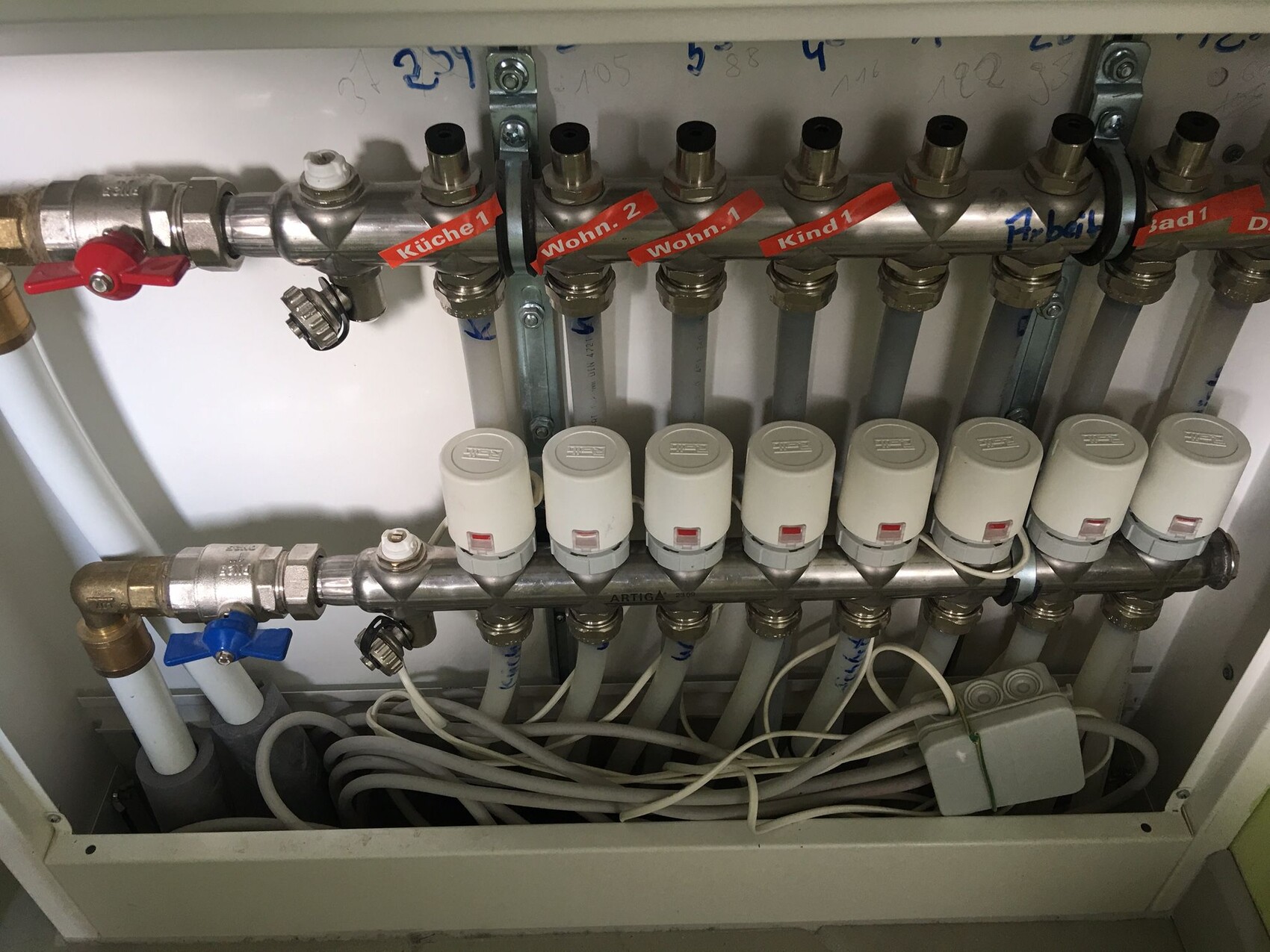
I have to admit that I haven’t really taken care of our 8-year-old heating system (in a newly built single-family house). Last winter, I noticed that one of the two heating circuits in the living room wasn’t getting properly warm. I thought, okay, I’ll deal with it in the summer ^^
Now I’m standing in front of the system and see on the gas boiler (Junkers) that the pressure is almost at 0... I haven’t added any water in 8 years... I had assumed it’s a closed system... we never had freezing issues... The chimney sweep measures everything yearly and never had any complaints...
I’ve attached a photo. I would proceed as follows:
1) Close both ball valves
2) Close all the small black dials at the top
3) Connect the water supply to the connection at the red ball valve
4) Attach a hose to the connection at the blue valve and place the other end in a large bucket
5) Slowly open the water tap and then gradually open each valve at the top slightly, one by one, until only water (and no air) comes out into the bucket...
I have three questions about this:
1. Question: A friend of mine has to screw caps onto the valves on top that he was given. I didn’t receive any caps. Is it enough if I just close the small black dials by hand?
2. Question: The hose for filling should be air-free... Is it sufficient to run water through it completely until a steady, clean stream comes out before briefly bending the hose to connect it?
3. Question: Do I need to remove the actuators (motorized valves) on the lower row, or can they stay on?
Thanks for your tips
I have to admit that I haven’t really taken care of our 8-year-old heating system (in a newly built single-family house). Last winter, I noticed that one of the two heating circuits in the living room wasn’t getting properly warm. I thought, okay, I’ll deal with it in the summer ^^
Now I’m standing in front of the system and see on the gas boiler (Junkers) that the pressure is almost at 0... I haven’t added any water in 8 years... I had assumed it’s a closed system... we never had freezing issues... The chimney sweep measures everything yearly and never had any complaints...
I’ve attached a photo. I would proceed as follows:
1) Close both ball valves
2) Close all the small black dials at the top
3) Connect the water supply to the connection at the red ball valve
4) Attach a hose to the connection at the blue valve and place the other end in a large bucket
5) Slowly open the water tap and then gradually open each valve at the top slightly, one by one, until only water (and no air) comes out into the bucket...
I have three questions about this:
1. Question: A friend of mine has to screw caps onto the valves on top that he was given. I didn’t receive any caps. Is it enough if I just close the small black dials by hand?
2. Question: The hose for filling should be air-free... Is it sufficient to run water through it completely until a steady, clean stream comes out before briefly bending the hose to connect it?
3. Question: Do I need to remove the actuators (motorized valves) on the lower row, or can they stay on?
Thanks for your tips
BrosBrosBros11 Sep 2017 10:03Is flushing and filling not the same when it comes to removing any air from the heating circuits?
No, not really. The heating system operates under pressure, for example 1.5 bar above atmospheric pressure.
You would never achieve overpressure during flushing. The small white valves above the hose connections are used for venting. You open them and the air escapes. Once water comes out, close them again. This only works if there is sufficient overpressure.
You would never achieve overpressure during flushing. The small white valves above the hose connections are used for venting. You open them and the air escapes. Once water comes out, close them again. This only works if there is sufficient overpressure.
BrosBrosBros11 Sep 2017 10:17Ah, okay... since I’m not under any pressure at the moment, it’s sufficient to just refill water until the pressure is correct... then bleed the system and, if necessary, refill a little water again?
Similar topics