
Background:
I own an old house (about 270 years old) where my company and my apartment were located. As the office kept expanding with new employees being hired, I moved into a separate apartment due to space constraints.
However, this was not meant to be permanent. I wanted to have something of my own again, but this time “small but nice.”
After considering various options from tiny houses to mini houses, the decision was made to build a small semi-detached house and use one unit myself (about 65m² (700 sq ft) plus terrace and garden).
My brother is building the other semi-detached house, and both units will then be rented out.
High-quality, ecological, and sustainable construction was important to us from the start. A healthy indoor climate, photovoltaic system, heat pump, and controlled residential ventilation were therefore fixed requirements.
At first, I considered some home automation (implemented, for example, with Shelly devices installed later to control certain functions remotely).
But since our company is involved not only in general IT activities but also in software development, programming, and consulting on IT infrastructure and digitalization for larger organizations such as hospitals, and since my brother is the lead developer of a software that has been on the market for over 20 years and is the market leader in Germany in this field…
Couldn’t we do it ourselves?
Yes, we could!
“Coincidentally,” a bachelor thesis on an open (non-proprietary) smart home system was submitted to my brother (who teaches computer science at FOM among other things).
Based on this and other work that proved certain fundamentals, plus freely available information showing many other possibilities of a smart home, we formulated our requirements.
We wanted a “Smart Home” (as we understood it at the time).
We wanted to at least control lighting and blinds, have a front door with motorized lock, possibly video intercom systems, presence monitoring, etc. The wishes naturally grew as we learned what was possible. So, voice control via, for example, Alexa should also be possible (for those who find it useful).
Our key criteria were:
• Open system (no proprietary/cloud dependencies, etc.)
• All active components centralized in the distribution board if possible
• No “bus switches,” but “normal” Gira, Jung, etc. push buttons
• Affordable!
• The base programming can be quite complex (done by experts), but afterwards the system should be adjustable by “non-technical users” via a GUI (This alone could lead to lengthy discussions)
• We will do the wiring and programming ourselves (my brother and one of our partners are software developers, and I am an IT specialist)
• The wiring will be done with plenty of spare capacity and smart home compatibility.
-> Lighting circuits (lamps) all go directly to the distribution board
-> Outlets are wired room-wise to the distribution board and use 5-wire/three-phase cables so nearly any outlet can be switched later with small wiring adjustments.
-> All push buttons are connected with (plenty of) LAN cable directly to the distribution board
(Discussion about CAT7a/CAT8.x LAN cabling or 10DA took place: Result: Almost everything will be done as CAT7A duplex because, overall, it is easier to handle and cheaper for us.)
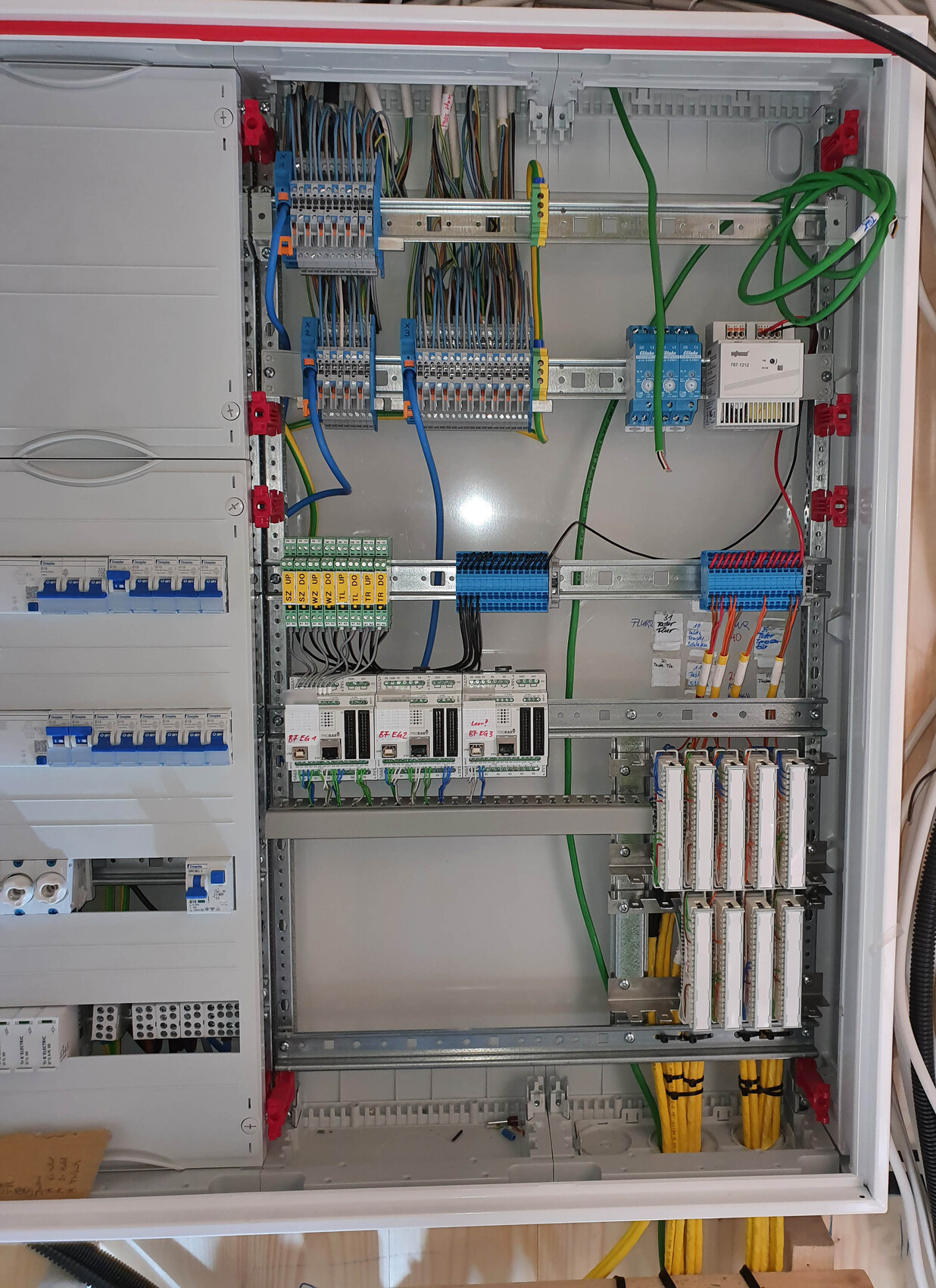
The result will soon be installed as a prototype in my unit (half a semi-detached house, about 65m² (700 sq ft)). The photo of the small sub-distribution board is only a small part of the test system currently being assembled! The Eltakos were installed only for comparison (space requirements vs. the Controllino) and will probably not be used in the finished system.
Almost anything “speaking” a smart home language can be integrated into the system via the appropriate binding.
The core hardware (the “brain” of the system) will cost about 1000 to 1500 euros (approximately $1100 to $1650). It mainly consists of the SmartHome Manager (Raspberry Pi) and Controllino Mega pure (Arduino).
The programming of OpenHub, etc. (open source) is done by our software developers/programmers.
Temperature, distance meters, motion detectors, humidity, CO2 sensors, and similar devices can easily be integrated. Small touchscreens (around 20€ (about $22)) as “cornerstone components” usually cost only a few euros.
I will be happy to report on further steps and on the prototype development once progress continues.
Notes:
The advantages of KNX are often mentioned, and some of these certainly apply. In our smart home, if the SmartHome Manager (which is also industrial hardware) fails, almost nothing works. With KNX, all unaffected subsystems continue to run. However, the example described by @Mycraft: “… It’s enough to just connect another push button to the bus cable and configure it…” is hardly feasible in practice. The user cannot do it themselves, the proverbial “unicorn” (ideal technician) is not there, and if the “system integrator” does come eventually, every small change or adjustment is extremely expensive. (These are the experiences of two people with KNX in our circle of acquaintances.)
Please do not fill this thread with pros and cons of the various systems. It only concerns “our” system based on the hardware and software components mentioned at the beginning – thanks!
I own an old house (about 270 years old) where my company and my apartment were located. As the office kept expanding with new employees being hired, I moved into a separate apartment due to space constraints.
However, this was not meant to be permanent. I wanted to have something of my own again, but this time “small but nice.”
After considering various options from tiny houses to mini houses, the decision was made to build a small semi-detached house and use one unit myself (about 65m² (700 sq ft) plus terrace and garden).
My brother is building the other semi-detached house, and both units will then be rented out.
High-quality, ecological, and sustainable construction was important to us from the start. A healthy indoor climate, photovoltaic system, heat pump, and controlled residential ventilation were therefore fixed requirements.
At first, I considered some home automation (implemented, for example, with Shelly devices installed later to control certain functions remotely).
But since our company is involved not only in general IT activities but also in software development, programming, and consulting on IT infrastructure and digitalization for larger organizations such as hospitals, and since my brother is the lead developer of a software that has been on the market for over 20 years and is the market leader in Germany in this field…
Couldn’t we do it ourselves?
Yes, we could!
“Coincidentally,” a bachelor thesis on an open (non-proprietary) smart home system was submitted to my brother (who teaches computer science at FOM among other things).
Based on this and other work that proved certain fundamentals, plus freely available information showing many other possibilities of a smart home, we formulated our requirements.
We wanted a “Smart Home” (as we understood it at the time).
We wanted to at least control lighting and blinds, have a front door with motorized lock, possibly video intercom systems, presence monitoring, etc. The wishes naturally grew as we learned what was possible. So, voice control via, for example, Alexa should also be possible (for those who find it useful).
Our key criteria were:
• Open system (no proprietary/cloud dependencies, etc.)
• All active components centralized in the distribution board if possible
• No “bus switches,” but “normal” Gira, Jung, etc. push buttons
• Affordable!
• The base programming can be quite complex (done by experts), but afterwards the system should be adjustable by “non-technical users” via a GUI (This alone could lead to lengthy discussions)
• We will do the wiring and programming ourselves (my brother and one of our partners are software developers, and I am an IT specialist)
• The wiring will be done with plenty of spare capacity and smart home compatibility.
-> Lighting circuits (lamps) all go directly to the distribution board
-> Outlets are wired room-wise to the distribution board and use 5-wire/three-phase cables so nearly any outlet can be switched later with small wiring adjustments.
-> All push buttons are connected with (plenty of) LAN cable directly to the distribution board
(Discussion about CAT7a/CAT8.x LAN cabling or 10DA took place: Result: Almost everything will be done as CAT7A duplex because, overall, it is easier to handle and cheaper for us.)
The result will soon be installed as a prototype in my unit (half a semi-detached house, about 65m² (700 sq ft)). The photo of the small sub-distribution board is only a small part of the test system currently being assembled! The Eltakos were installed only for comparison (space requirements vs. the Controllino) and will probably not be used in the finished system.
Almost anything “speaking” a smart home language can be integrated into the system via the appropriate binding.
The core hardware (the “brain” of the system) will cost about 1000 to 1500 euros (approximately $1100 to $1650). It mainly consists of the SmartHome Manager (Raspberry Pi) and Controllino Mega pure (Arduino).
The programming of OpenHub, etc. (open source) is done by our software developers/programmers.
Temperature, distance meters, motion detectors, humidity, CO2 sensors, and similar devices can easily be integrated. Small touchscreens (around 20€ (about $22)) as “cornerstone components” usually cost only a few euros.
I will be happy to report on further steps and on the prototype development once progress continues.
Notes:
The advantages of KNX are often mentioned, and some of these certainly apply. In our smart home, if the SmartHome Manager (which is also industrial hardware) fails, almost nothing works. With KNX, all unaffected subsystems continue to run. However, the example described by @Mycraft: “… It’s enough to just connect another push button to the bus cable and configure it…” is hardly feasible in practice. The user cannot do it themselves, the proverbial “unicorn” (ideal technician) is not there, and if the “system integrator” does come eventually, every small change or adjustment is extremely expensive. (These are the experiences of two people with KNX in our circle of acquaintances.)
Please do not fill this thread with pros and cons of the various systems. It only concerns “our” system based on the hardware and software components mentioned at the beginning – thanks!
K
knalltüte7 Mar 2021 14:05... I roughly counted above; it fits in the distribution board discussed with the electrician. He (the electrician) has 48 modular units (TE) + 24 switching units for power, and for the smart home including wiring, we have 96 TE + 24 TE concealed with low installation height.
My planning regarding lighting and presence detectors (PM) etc. is now almost finalized. Still, some questions occasionally come up (in my mind). A few things are already decided. For example, a professional lighting designer will no longer be involved; it is too late for that and not desired. We will have to live with possibly less than optimal results. But probably that’s the case for the majority of people anyway 😉
I also understand that I can’t create a perfect plan for the rental apartment upstairs, since the furniture layout is not fixed and the lifestyle habits of future tenants are simply unknown. Therefore, I will provide some unused flush-mounted boxes in the upper floor where PMs or lamps can later be installed. However, since the attic floor structure consists only of dry screed panels, the possibilities are quite limited. Mainly along the line of the mechanical ventilation valves near the knee wall (which will be boxed in), there are good opportunities.
But for my residential unit on the ground floor, there are still many options. Here is the first question:
I would like a presence detector that, at night (period approximately 12:00 a.m. – 5:00 a.m.), turns the lights in the hallway and bathroom on to about 20% brightness when it detects “appropriate” movement in the bedroom. Where would be the optimal mounting location for this? I always hear about these “mysterious”: under-bed PMs... Would that really be the right place?
My planning regarding lighting and presence detectors (PM) etc. is now almost finalized. Still, some questions occasionally come up (in my mind). A few things are already decided. For example, a professional lighting designer will no longer be involved; it is too late for that and not desired. We will have to live with possibly less than optimal results. But probably that’s the case for the majority of people anyway 😉
I also understand that I can’t create a perfect plan for the rental apartment upstairs, since the furniture layout is not fixed and the lifestyle habits of future tenants are simply unknown. Therefore, I will provide some unused flush-mounted boxes in the upper floor where PMs or lamps can later be installed. However, since the attic floor structure consists only of dry screed panels, the possibilities are quite limited. Mainly along the line of the mechanical ventilation valves near the knee wall (which will be boxed in), there are good opportunities.
But for my residential unit on the ground floor, there are still many options. Here is the first question:
I would like a presence detector that, at night (period approximately 12:00 a.m. – 5:00 a.m.), turns the lights in the hallway and bathroom on to about 20% brightness when it detects “appropriate” movement in the bedroom. Where would be the optimal mounting location for this? I always hear about these “mysterious”: under-bed PMs... Would that really be the right place?
 untergasse437 Mar 2021 14:30
1. Installation in the bedroom: The hallway light turns on when you turn around or move in any other way.
2. Installation under the bed: The hallway light turns on when someone gets out of bed or when the warm blanket is hanging awkwardly out.
3. Installation in the hallway: The hallway light turns on when you enter the hallway.
Assuming your bedroom door is closed while sleeping, it makes no sense to install the presence detector (PM) anywhere but in the hallway. Installation in the bedroom or under the bed only makes sense if you want to control a light inside the bedroom or detect sleep mode for other automation purposes. If you don’t want that—my wife, for example, wakes up at the first photon of light—you will have to navigate the way to the door in the dark anyway, and installing a detector in the bedroom gains you nothing.
I have reliably detected actual getting out of bed using pressure sensor mats placed under the area rug in front of the bed or at the right spot under the bedroom carpet. As mentioned, PMs placed under the bed tend to react to blankets hanging out as well.
If you really want to detect movement already inside the bedroom, a detector with a sharply defined detection zone that faces past the bed and triggers when you move a certain distance away from the bed is recommended. However, such a setup is impossible to plan precisely in advance and, in my opinion, has a high risk of not working properly.
2. Installation under the bed: The hallway light turns on when someone gets out of bed or when the warm blanket is hanging awkwardly out.
3. Installation in the hallway: The hallway light turns on when you enter the hallway.
Assuming your bedroom door is closed while sleeping, it makes no sense to install the presence detector (PM) anywhere but in the hallway. Installation in the bedroom or under the bed only makes sense if you want to control a light inside the bedroom or detect sleep mode for other automation purposes. If you don’t want that—my wife, for example, wakes up at the first photon of light—you will have to navigate the way to the door in the dark anyway, and installing a detector in the bedroom gains you nothing.
I have reliably detected actual getting out of bed using pressure sensor mats placed under the area rug in front of the bed or at the right spot under the bedroom carpet. As mentioned, PMs placed under the bed tend to react to blankets hanging out as well.
If you really want to detect movement already inside the bedroom, a detector with a sharply defined detection zone that faces past the bed and triggers when you move a certain distance away from the bed is recommended. However, such a setup is impossible to plan precisely in advance and, in my opinion, has a high risk of not working properly.


@superzapp = @knalltüte ?
Are you using the same system as Superzapp/Knalltüte?
i_b_n_a_n schrieb:Straight to the first question.
I will continue this here sporadically as my time allows...
I’ll gladly try to answer questions.
Are you using the same system as Superzapp/Knalltüte?
Progress is being made; one half of the house already has electricity. However, I’m still missing the list of electricians to install the blinds and lights, then the first living unit will be complete. Two others are halfway done, and the last one hasn’t been started at all 🙄
The network is 65% finished… unfortunately, some labels were "lost," so a few had to be traced by testing the connections ("ringing through").

The network is 65% finished… unfortunately, some labels were "lost," so a few had to be traced by testing the connections ("ringing through").
Similar topics