
ᐅ New window feels very cold between the frame and the wall. What can be done?
Created on: 5 Dec 2023 07:09
G
GnadenpinselG
Gnadenpinsel5 Dec 2023 07:09We installed a new window in the kitchen of our house built in 1989 (30 cm (12 inches) hollow brick wall). The window has an installation depth of about 6 cm (2.4 inches) from the outer edge of the wall. It was thoroughly sealed all around with window foam approved for installation according to RAL standards. The joint between the wall and the window frame on the inside was additionally sealed with an acrylic sealant. I am aware that this does not meet new construction standards.
During winter, the transition area between the window reveal and the frame becomes very cold. I took thermal images, see the pictures. What can I do? The foam insulation seems to have been done quite well. Would it help to apply a sealing tape on the inside at the junction of the window and wall and then cover it with a trim piece? Or are there other options?

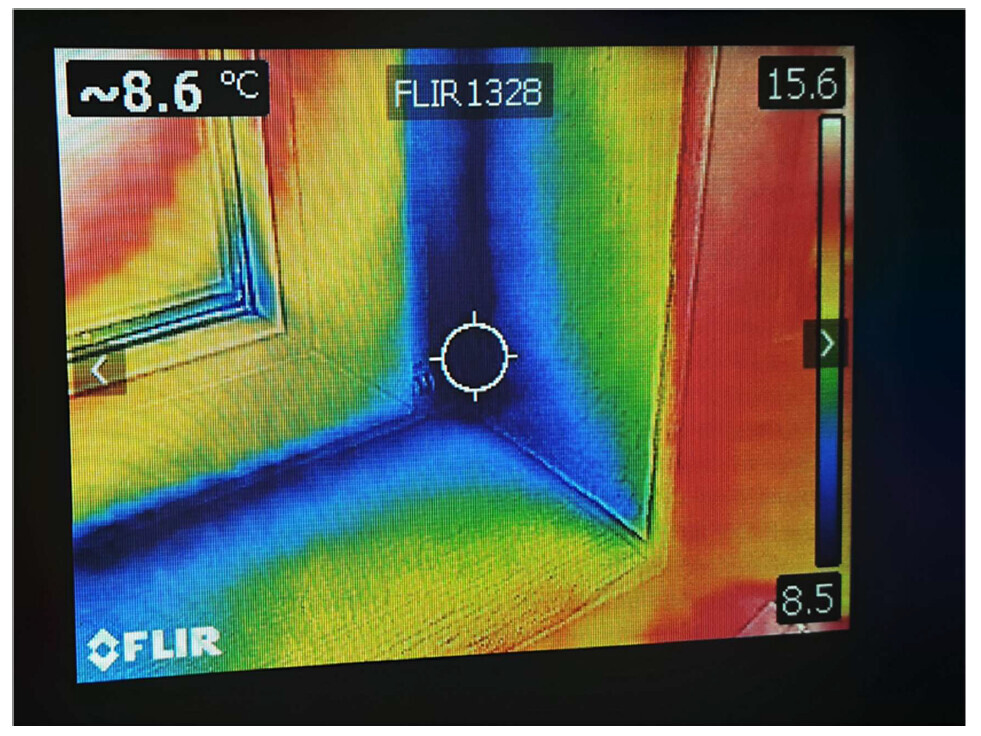

During winter, the transition area between the window reveal and the frame becomes very cold. I took thermal images, see the pictures. What can I do? The foam insulation seems to have been done quite well. Would it help to apply a sealing tape on the inside at the junction of the window and wall and then cover it with a trim piece? Or are there other options?
J
Jesse Custer5 Dec 2023 08:46Well – expanding foam is vapor permeable, which is actually desired in existing buildings. If you don’t have a ventilation system, air exchange is intentional...
Windows are installed with three sealing layers.
The outer layer is rainproof and vapor-permeable, for example using compressible sealing tape or a membrane. You didn’t describe this layer—how is it done?
The middle layer provides thermal insulation, in your case with foam. This must be done properly, using high-quality PU foam and not just any foam. The foam is also not intended to make incorrectly sized windows fit—that could be an issue here. The same applies to the compressible tape on the outside.
The inner layer is vapor-proof, usually a membrane. Acrylic sealant is a cheaper but possible option.
I suspect the windows are too small, and the foam insulation was meant to compensate for this. It is also possible that the quality of the window frame is (additionally) simply not good, which you can guess from the cold spots in the middle of the window.
The outer layer is rainproof and vapor-permeable, for example using compressible sealing tape or a membrane. You didn’t describe this layer—how is it done?
The middle layer provides thermal insulation, in your case with foam. This must be done properly, using high-quality PU foam and not just any foam. The foam is also not intended to make incorrectly sized windows fit—that could be an issue here. The same applies to the compressible tape on the outside.
The inner layer is vapor-proof, usually a membrane. Acrylic sealant is a cheaper but possible option.
I suspect the windows are too small, and the foam insulation was meant to compensate for this. It is also possible that the quality of the window frame is (additionally) simply not good, which you can guess from the cold spots in the middle of the window.
B
Buchsbaum5 Dec 2023 13:25From the picture, it looks like there is no thermal break at the bottom of the window sill. Cold air is penetrating through the window sill into the house.
Nowadays, nothing is foamed in anymore. Compression tape and an inner breathable window connection tape are used, which is then plastered over.
I also no longer install windows with foam. Compression tapes are now available in all sizes. They are better for insulation, air circulation, and soundproofing.
You probably also have a window profile with poor insulation. What exactly do you hope to achieve later in terms of thermal insulation here?
I only see the possibility of doing something on the outer reveal itself, for example, adding extra Styrodur insulation.
To say something more concrete, you would need to see the reveal from the outside.
Nowadays, nothing is foamed in anymore. Compression tape and an inner breathable window connection tape are used, which is then plastered over.
I also no longer install windows with foam. Compression tapes are now available in all sizes. They are better for insulation, air circulation, and soundproofing.
You probably also have a window profile with poor insulation. What exactly do you hope to achieve later in terms of thermal insulation here?
I only see the possibility of doing something on the outer reveal itself, for example, adding extra Styrodur insulation.
To say something more concrete, you would need to see the reveal from the outside.
X
xMisterDx5 Dec 2023 21:52Buchsbaum schrieb:
Nowadays, nothing is normally foamed anymore. Compression tape and breathable interior window connection tape that is then plastered over. No, you can still use foam, even according to RAL standards. What’s important is an airtight connection tape on the inside and a vapor-permeable connection on the outside that is resistant to driving rain. More than 50% of new buildings here have foamed windows, no compression tape—this can be clearly seen on the shell construction stage, even from a distance.
If that were the issue, my window frames would also be freezing cold, especially on the west side where the cold wind pushes against them. That’s not the case.
Foam is sometimes even better because compression tape requires a perfectly fitting opening and must be plastered before installation. The foam won’t fully expand into the gripping handles of aerated concrete blocks or the grooves of porous bricks. That results in a clear thermal bridge. Nowadays, when everything is rushed, the risk of errors with compression tape is much higher... so better to use foam without major errors.

That is not generally true. In the reveal, a smooth plaster finish (with light mortar) is sufficient, and if you buy the right tape, it can expand up to 45mm (1.8 inches). This also fills in any unevenness.
However, it is correct that foam can also comply with RAL standards, and it is better to let a professional do the work they are experienced with (as long as it is technically acceptable).
However, it is correct that foam can also comply with RAL standards, and it is better to let a professional do the work they are experienced with (as long as it is technically acceptable).
Similar topics