
ᐅ New window feels very cold between the frame and the wall. What can be done?
Created on: 5 Dec 2023 07:09
G
Gnadenpinsel
We installed a new window in the kitchen of our house built in 1989 (30 cm (12 inches) hollow brick wall). The window has an installation depth of about 6 cm (2.4 inches) from the outer edge of the wall. It was thoroughly sealed all around with window foam approved for installation according to RAL standards. The joint between the wall and the window frame on the inside was additionally sealed with an acrylic sealant. I am aware that this does not meet new construction standards.
During winter, the transition area between the window reveal and the frame becomes very cold. I took thermal images, see the pictures. What can I do? The foam insulation seems to have been done quite well. Would it help to apply a sealing tape on the inside at the junction of the window and wall and then cover it with a trim piece? Or are there other options?

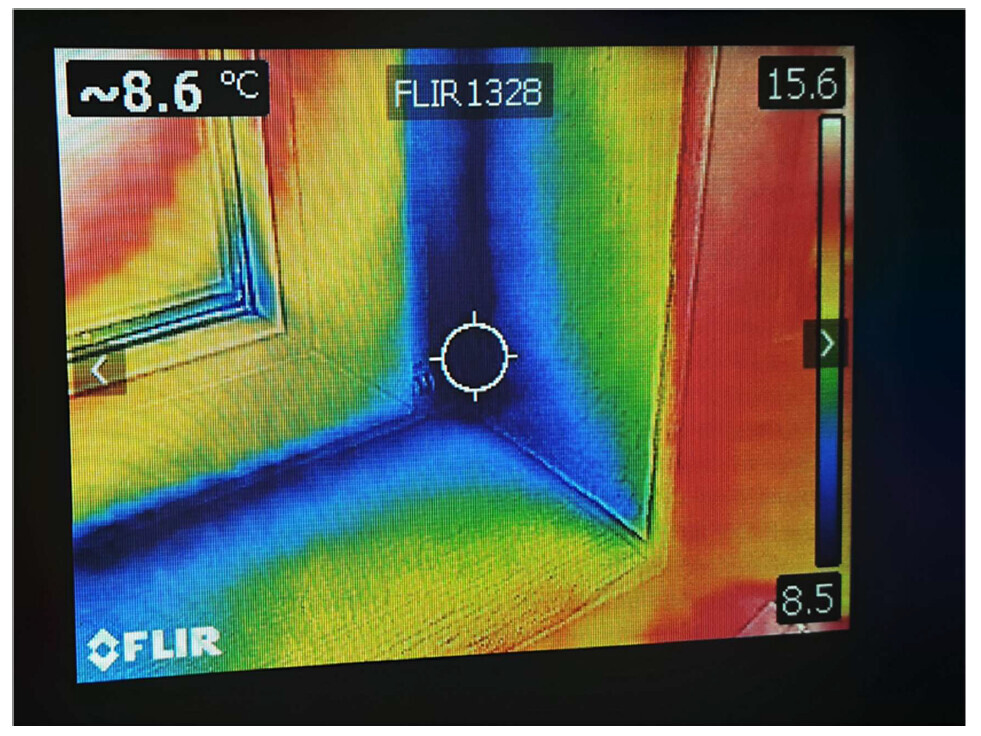

During winter, the transition area between the window reveal and the frame becomes very cold. I took thermal images, see the pictures. What can I do? The foam insulation seems to have been done quite well. Would it help to apply a sealing tape on the inside at the junction of the window and wall and then cover it with a trim piece? Or are there other options?

Tolentino schrieb:
But it is true that foam can also comply with RAL standards and that you should preferably let a craftsman do what they are experienced and skilled at (as long as it is technically appropriate).Unfortunately, what is really true (not in the sense of "correct," but in the sense of "actually happening") is that carelessness during measuring (or even ordering windows based solely on the planned dimensions) often leads to excessive foaming.https://www.instagram.com/11antgmxde/
https://www.linkedin.com/company/bauen-jetzt/
Minimum thermal insulation according to DIN4108-2 is not met. 89mm (3.5 inches) hollow bricks probably do not provide enough thermal resistance across the window profile width to prevent heat transfer, ensuring the minimum temperature of 12.6°C (55°F) at the window reveal is maintained during natural ventilation.
If the window is airtight, this will likely cause the problem. A relatively simple solution is to install internal reveal insulation using calcium silicate or wood fiber insulation boards (I would prefer the latter). The windowsill remains an issue, but it has to be accepted.
An external solution is also possible, but only makes sense with external thermal insulation composite systems (ETICS), which are usually not necessary with 89mm (3.5 inches) hollow bricks combined with 30mm (1.2 inches) insulation thickness.
If the window is airtight, this will likely cause the problem. A relatively simple solution is to install internal reveal insulation using calcium silicate or wood fiber insulation boards (I would prefer the latter). The windowsill remains an issue, but it has to be accepted.
An external solution is also possible, but only makes sense with external thermal insulation composite systems (ETICS), which are usually not necessary with 89mm (3.5 inches) hollow bricks combined with 30mm (1.2 inches) insulation thickness.
Similar topics