
Hello
we are currently building a new semi-detached house
I am considering installing underfloor heating in the basement.
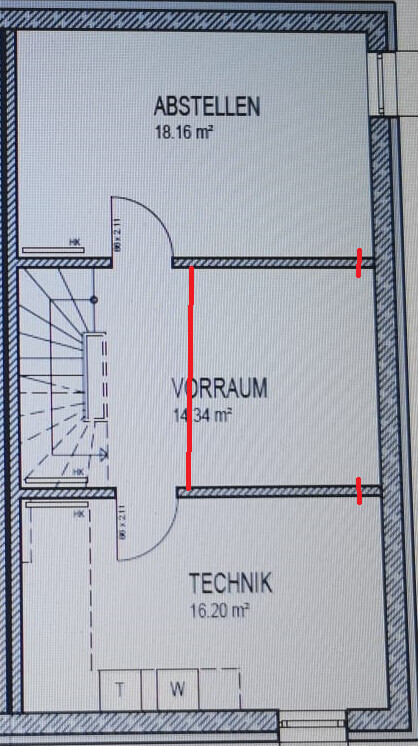
Our basement comes standard with conventional radiators under the stairs in the utility and storage rooms. As a special request, we will (red line) partition off this area as a separate room (of course with a door). The two lines at the back of the room will be ventilation slots to allow airflow since the other two rooms have windows.
The new room is intended as a pantry/storage room, and the storage room might be used as a workout room.
I have a few questions:
1: What do you think about installing underfloor heating throughout the entire basement? What are the advantages and disadvantages? The additional cost is 2700€.
2: In the underfloor heating package, the two rooms in the middle (hallway and newly partitioned room) will share a single heating circuit manifold, meaning the underfloor heating would be controlled by one thermostat and would heat both rooms. The underfloor heating would run beneath the new wall (a sand-lime brick wall).
My option would be, for an additional cost (amount unknown), to give the new room its own heating circuit, or to omit underfloor heating in that room altogether (which would of course reduce the extra cost of 2700€), or to have the hallway and new room share one heating circuit.
What would you recommend?
we are currently building a new semi-detached house
I am considering installing underfloor heating in the basement.
Our basement comes standard with conventional radiators under the stairs in the utility and storage rooms. As a special request, we will (red line) partition off this area as a separate room (of course with a door). The two lines at the back of the room will be ventilation slots to allow airflow since the other two rooms have windows.
The new room is intended as a pantry/storage room, and the storage room might be used as a workout room.
I have a few questions:
1: What do you think about installing underfloor heating throughout the entire basement? What are the advantages and disadvantages? The additional cost is 2700€.
2: In the underfloor heating package, the two rooms in the middle (hallway and newly partitioned room) will share a single heating circuit manifold, meaning the underfloor heating would be controlled by one thermostat and would heat both rooms. The underfloor heating would run beneath the new wall (a sand-lime brick wall).
My option would be, for an additional cost (amount unknown), to give the new room its own heating circuit, or to omit underfloor heating in that room altogether (which would of course reduce the extra cost of 2700€), or to have the hallway and new room share one heating circuit.
What would you recommend?
P
Pwnage61911 Oct 2021 21:34Another question is whether I can switch to a heat pump later on, or am I tied to the district heating system? Initially, I am contractually bound to the district heating system for 15 years, but is it even possible to switch after that?
Of course, you can do that. You can also pay the basic fee for district heating for 15 years and keep yourself warm with a wood stove, electric heater, or liquefied petroleum gas during that time. Or with an air-to-water heat pump. You can, but you don’t have to.
Although an air-to-water heat pump might not be the best choice for a mid-terrace house... I have no idea what your project looks like anyway 😉
Although an air-to-water heat pump might not be the best choice for a mid-terrace house... I have no idea what your project looks like anyway 😉
P
Pwnage61911 Oct 2021 22:10We have a semi-detached house.
So, technically, is it possible to switch to a heat pump at some point?
What are the advantages and disadvantages of underfloor heating compared to radiators?
So, technically, is it possible to switch to a heat pump at some point?
What are the advantages and disadvantages of underfloor heating compared to radiators?
D
Deliverer11 Oct 2021 23:22A combined heat and power unit usually runs on gas. So the question is whether, after the combined heat and power unit phase ends, you want your basement to be cooler or if you plan to retrofit underfloor heating. Of course, one can also speculate about the timeframe. At some point between 10 and 25 years, the combined heat and power unit will no longer be in operation. For a basement, it’s probably acceptable to dig up the floor again after around 15 years.
Another perspective is the financial one. You mentioned €2700 for the underfloor heating. What exactly is the cost per square meter of your living space, and how many square meters would radiators occupy or block? I would guess there is a net gain with underfloor heating…
Another perspective is the financial one. You mentioned €2700 for the underfloor heating. What exactly is the cost per square meter of your living space, and how many square meters would radiators occupy or block? I would guess there is a net gain with underfloor heating…
Pwnage619 schrieb:I don’t quite understand the question now. Have you read the last six pages? Everything was already covered…
What are the advantages and disadvantages of underfloor heating compared to radiators?
Thank you for your help.
Basically, there are only advantages to underfloor heating, except for the only downside, which is the additional cost.
For us, the only remaining question is whether we should also install underfloor heating in the small storage room with the room thermostat located in the hallway, or if we should just leave the storage room without heating since it will be sufficiently warmed by the adjacent rooms.
According to the heating engineer, the different lengths of the heating circuits are not a problem.
Basically, there are only advantages to underfloor heating, except for the only downside, which is the additional cost.
For us, the only remaining question is whether we should also install underfloor heating in the small storage room with the room thermostat located in the hallway, or if we should just leave the storage room without heating since it will be sufficiently warmed by the adjacent rooms.
According to the heating engineer, the different lengths of the heating circuits are not a problem.
D
Deliverer12 Oct 2021 11:40The
Maybe for him not. Unfortunately, physics disagrees. Very short circuits cause hydraulic short-circuits. Eventually, this makes hydraulic balancing difficult or even impossible. But the heating engineer won’t be doing the balancing anyway...
Pacc666 schrieb:
According to the heating engineer, the different lengths of the heating circuits are not a problem
Maybe for him not. Unfortunately, physics disagrees. Very short circuits cause hydraulic short-circuits. Eventually, this makes hydraulic balancing difficult or even impossible. But the heating engineer won’t be doing the balancing anyway...
Similar topics