
Hello
we are currently building a new semi-detached house
I am considering installing underfloor heating in the basement.
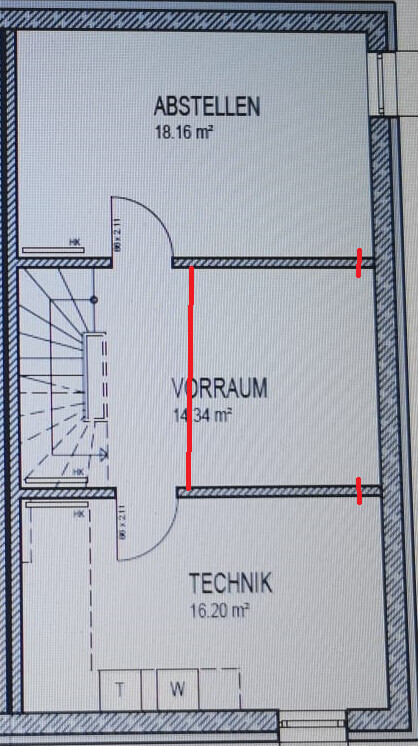
Our basement comes standard with conventional radiators under the stairs in the utility and storage rooms. As a special request, we will (red line) partition off this area as a separate room (of course with a door). The two lines at the back of the room will be ventilation slots to allow airflow since the other two rooms have windows.
The new room is intended as a pantry/storage room, and the storage room might be used as a workout room.
I have a few questions:
1: What do you think about installing underfloor heating throughout the entire basement? What are the advantages and disadvantages? The additional cost is 2700€.
2: In the underfloor heating package, the two rooms in the middle (hallway and newly partitioned room) will share a single heating circuit manifold, meaning the underfloor heating would be controlled by one thermostat and would heat both rooms. The underfloor heating would run beneath the new wall (a sand-lime brick wall).
My option would be, for an additional cost (amount unknown), to give the new room its own heating circuit, or to omit underfloor heating in that room altogether (which would of course reduce the extra cost of 2700€), or to have the hallway and new room share one heating circuit.
What would you recommend?
we are currently building a new semi-detached house
I am considering installing underfloor heating in the basement.
Our basement comes standard with conventional radiators under the stairs in the utility and storage rooms. As a special request, we will (red line) partition off this area as a separate room (of course with a door). The two lines at the back of the room will be ventilation slots to allow airflow since the other two rooms have windows.
The new room is intended as a pantry/storage room, and the storage room might be used as a workout room.
I have a few questions:
1: What do you think about installing underfloor heating throughout the entire basement? What are the advantages and disadvantages? The additional cost is 2700€.
2: In the underfloor heating package, the two rooms in the middle (hallway and newly partitioned room) will share a single heating circuit manifold, meaning the underfloor heating would be controlled by one thermostat and would heat both rooms. The underfloor heating would run beneath the new wall (a sand-lime brick wall).
My option would be, for an additional cost (amount unknown), to give the new room its own heating circuit, or to omit underfloor heating in that room altogether (which would of course reduce the extra cost of 2700€), or to have the hallway and new room share one heating circuit.
What would you recommend?
Very short loops cause hydraulic short circuits. This eventually makes hydraulic balancing difficult or even impossible. But the heating technician usually doesn’t perform the balancing anyway...(almost) all radiators have a fixed adjustable throttle valve on the return pipe, which is often mistakenly seen only as a shut-off valve. However, this valve is intended to enable the flow regulation and balancing (previously often called modulation).
Is such a throttle valve uncommon in underfloor heating systems?
In that case, you would simply close the throttle just enough to match the heat output/flow rate required for the undersized "radiator."
D
Deliverer12 Oct 2021 12:41Yes, these valves are installed in the heating circuit manifold. However, due to relatively low flow rates, it is quite difficult to set precise flow values. Adjusting any valve slightly changes the flow rates in the other circuits. In short: it’s a fiddly task.
The more the basic hydraulics of the circuits differ—for example, one circuit with 160 meters (525 feet) and another with 20 meters (66 feet)—the harder it becomes to balance them all. Especially since the small circuit must be adjusted very close to the "off" position, which is particularly challenging.
It’s like trying to adjust an old faucet to drip exactly every 10 seconds.
The more the basic hydraulics of the circuits differ—for example, one circuit with 160 meters (525 feet) and another with 20 meters (66 feet)—the harder it becomes to balance them all. Especially since the small circuit must be adjusted very close to the "off" position, which is particularly challenging.
It’s like trying to adjust an old faucet to drip exactly every 10 seconds.
ok thanks
what do you think about the statement that modern underfloor heating systems have become more responsive? He says about 3-5 hours.
Our underfloor heating will have individual room thermostats that automatically turn off when the target temperature is reached and switch back on independently when the temperature drops again.
I only knew underfloor heating as being slow, around 24-48 hours.
what do you think about the statement that modern underfloor heating systems have become more responsive? He says about 3-5 hours.
Our underfloor heating will have individual room thermostats that automatically turn off when the target temperature is reached and switch back on independently when the temperature drops again.
I only knew underfloor heating as being slow, around 24-48 hours.
D
Deliverer12 Oct 2021 14:10The individual room thermostats are useless and ruin any hydraulic balancing. If the heating installer cannot be convinced to do without them, be sure to choose ones that open without power and unplug them after commissioning.
The more "responsive" a floor heating system is, the worse it actually is. A truly "modern" solution would be concrete core activation. This means even more mass, even greater inertia in the system, and even lower supply temperature.
The more "responsive" a floor heating system is, the worse it actually is. A truly "modern" solution would be concrete core activation. This means even more mass, even greater inertia in the system, and even lower supply temperature.
Or do the individual room thermostats have anything to do with district heating?
I don’t have a heating system where I can set the temperature myself.
I’m not very familiar with district heating (haven’t had any experience with it so far) and I also have very little knowledge about underfloor heating.
I don’t have a heating system where I can set the temperature myself.
I’m not very familiar with district heating (haven’t had any experience with it so far) and I also have very little knowledge about underfloor heating.
Pacc666 schrieb:
Or do individual room thermostats have something to do with district heating?
...I hardly know anything about district heating Primary energy sources like district heating, gas heating, oil heating, etc., have no direct connection to individual room thermostats.
You can attach an individual room thermostat to (almost) any radiator.
Just like a radiator thermostat,
sometimes even with BUS connection (also Wi-Fi) to a central home automation system.
But with a slow-responding underfloor heating system, it becomes very sluggish and therefore irrelevant
(for example, regarding night setback mode and so on).
Similar topics