
Hello everyone,
we are planning a prefabricated house using timber frame construction. It will have 180 sqm (1,937 sq ft) of living space with underfloor heating, and about 230 sqm (2,475 sq ft) of usable area.
So far, the offer included an air-to-water heat pump from Daikin (Altherma 3R, formerly Rotex HPSU compact Ultra).
Now it seems that this unit might not have enough capacity (?) and as an alternative (additional cost around 4,000) we have been offered a "Wolf heat pump CHC Monoblock 10/300-35".
The Daikin is available in the 4-9 kW version—would that really be insufficient for this size? And what do you think about this offer?
I have the energy-saving regulation heat protection certification and a renewable energy heat law document available, if any information from those is needed.
Thank you very much!
Best regards
we are planning a prefabricated house using timber frame construction. It will have 180 sqm (1,937 sq ft) of living space with underfloor heating, and about 230 sqm (2,475 sq ft) of usable area.
So far, the offer included an air-to-water heat pump from Daikin (Altherma 3R, formerly Rotex HPSU compact Ultra).
Now it seems that this unit might not have enough capacity (?) and as an alternative (additional cost around 4,000) we have been offered a "Wolf heat pump CHC Monoblock 10/300-35".
The Daikin is available in the 4-9 kW version—would that really be insufficient for this size? And what do you think about this offer?
I have the energy-saving regulation heat protection certification and a renewable energy heat law document available, if any information from those is needed.
Thank you very much!
Best regards

Daniel-Sp schrieb:
Which heat pump was chosen in the end? So far, none. The heating contractor prefers to install a Daikin Altherma. However, I find their outdoor units quite unattractive. We’ll see.
nordanney schrieb:
And does it really have to be 33 degrees flow temperature? Unbelievable. I would invest a bit and have it calculated externally. Heated basement, two bay windows, many floor-to-ceiling windows. Apparently, yes.
T_im_Norden schrieb:
Who did the calculation, the heating contractor or externally?
Is this supposed to be the room-by-room heating load calculation or the underfloor heating design?
If underfloor heating, what pipe diameter, spacing, and circuit lengths were used in the calculation?
How many heating circuits? Heckmann, externally commissioned by me, with the goal to make it as energy-efficient as possible. I haven’t received the design of the heating circuits yet, only the room-by-room heating load calculation so far. With the complete package, I will approach my heating contractor and discuss which heat pump to choose and whether he can also fit in wall heating with the pipe layout. Wall heating might make it possible to get below 33°C (91°F), but I don’t see much potential in our bathroom for that—basically only behind the door. Not so much behind the partition walls, etc.
I’m already looking at 8 circuits on the ground floor and 10 on the upper floor.
T
T_im_Norden14 Oct 2020 18:31Wall heating can be installed on any free wall, for example an exterior wall, stairwell wall, or shower wall.
If you have the specifications for the underfloor heating, you can enter those values accordingly.
If you have the specifications for the underfloor heating, you can enter those values accordingly.
I have received the calculation. Our full equipment with parquet flooring in all rooms except the bathrooms and the hallway also works against the flow temperature.
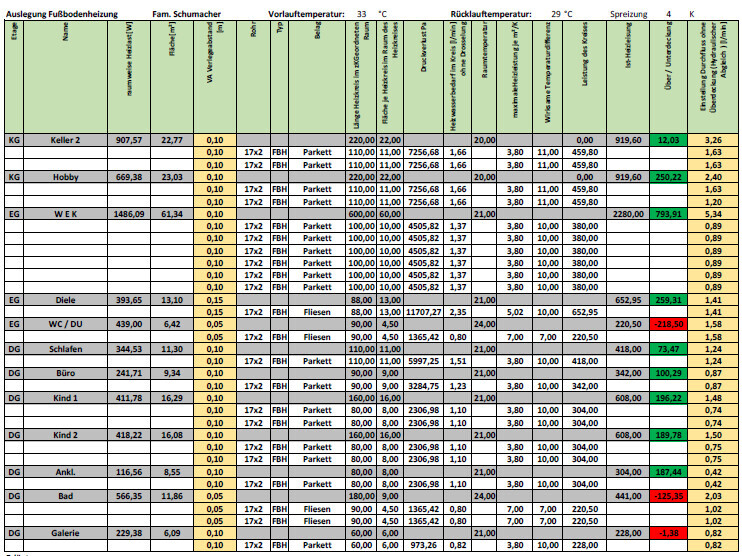
Heating load calculation by room:
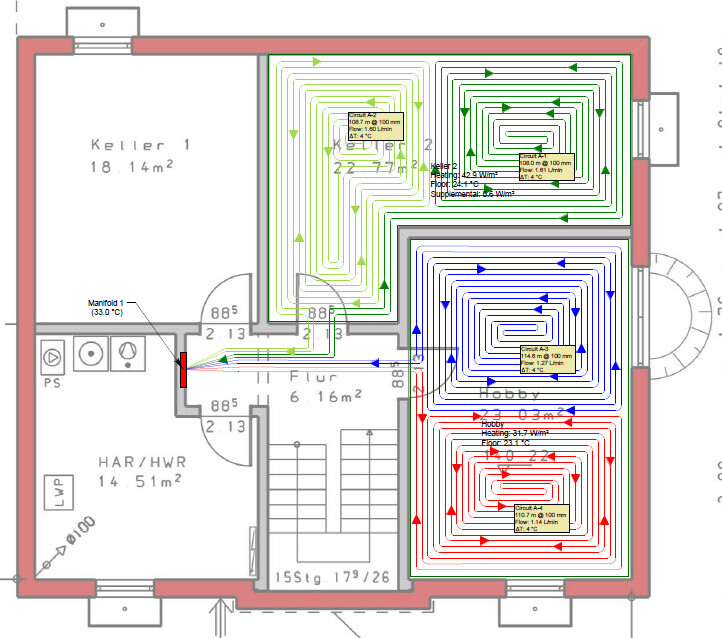
Basement installation plan:
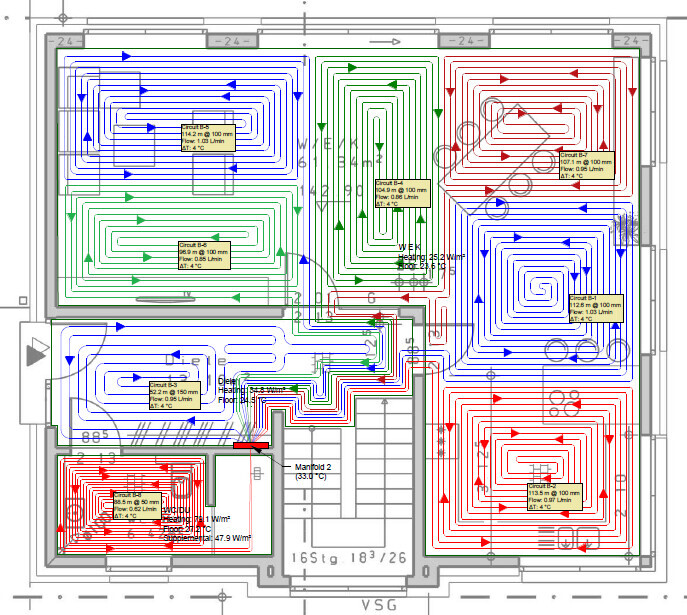
Ground floor:
Upper floor:
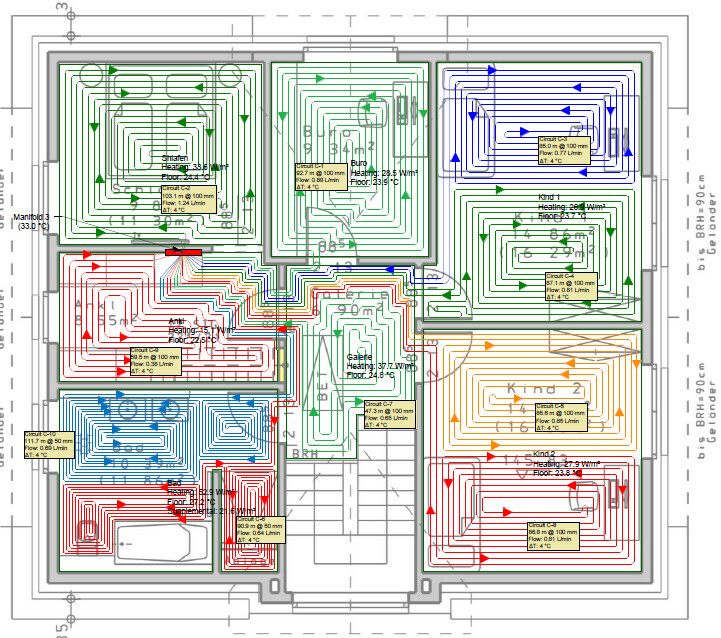
To reach 24°C (75°F) in the bathroom, an additional 3 sqm (32 sq ft) of wall heating needs to be installed as shown in the sketch. On the ground floor, this setup only achieves 22°C (72°F), which would be enough for me. I’ll be the only one regularly showering there once the kids come.
Edit: I just noticed that the tiled shower in the guest WC is not covered with underfloor heating. I need to address this again.
So, the supply/return temperature difference is 33/29°C (91/84°F) with a spread of 4K. The insulation and window quality are likely fixed at this point. I would rather focus my energy on making sure the installation is done exactly as I have planned here. Honestly, I think I’m the first client of the general contractor demanding this.
However, the heating specialist is competent. Essentially, he knows exactly what I want and calls it very sensible, but probably just isn’t enthusiastic because it goes beyond the standard. He’s more the OWL-muffel type.
Should I proceed like this, or are the 33°C (91°F) supply temperatures really that bad?
Heating load calculation by room:
Basement installation plan:
Ground floor:
Upper floor:
To reach 24°C (75°F) in the bathroom, an additional 3 sqm (32 sq ft) of wall heating needs to be installed as shown in the sketch. On the ground floor, this setup only achieves 22°C (72°F), which would be enough for me. I’ll be the only one regularly showering there once the kids come.
Edit: I just noticed that the tiled shower in the guest WC is not covered with underfloor heating. I need to address this again.
So, the supply/return temperature difference is 33/29°C (91/84°F) with a spread of 4K. The insulation and window quality are likely fixed at this point. I would rather focus my energy on making sure the installation is done exactly as I have planned here. Honestly, I think I’m the first client of the general contractor demanding this.
However, the heating specialist is competent. Essentially, he knows exactly what I want and calls it very sensible, but probably just isn’t enthusiastic because it goes beyond the standard. He’s more the OWL-muffel type.
Should I proceed like this, or are the 33°C (91°F) supply temperatures really that bad?
T
T_im_Norden15 Oct 2020 19:29No, a 33 flow temperature is not bad; it’s always better when you can go lower.
However, since standard calculations usually do not fully account for solar gains and the design temperature (i.e., the negative degrees Celsius) is rarely reached, this should be fine.
Are all the heating circuits roughly the same length? Some of the numbers are hard for me to read.
Is there one room in the basement without heating?
Is the bathtub installed directly on the screed?
If so, make sure to install pipes underneath as well.
Pay attention to the connection of the heating manifold to ensure it does not become too small.
By the way, your name is shown at the top of the plan.
However, since standard calculations usually do not fully account for solar gains and the design temperature (i.e., the negative degrees Celsius) is rarely reached, this should be fine.
Are all the heating circuits roughly the same length? Some of the numbers are hard for me to read.
Is there one room in the basement without heating?
Is the bathtub installed directly on the screed?
If so, make sure to install pipes underneath as well.
Pay attention to the connection of the heating manifold to ensure it does not become too small.
By the way, your name is shown at the top of the plan.
The original idea was to create a "potato cellar" there. I’m not sure if that will turn out to be a good idea. I want to have a cool storage room.
The thought process was that the utility room will naturally become warm due to heating and all the equipment. The pantry cellar can stay cool, and the other two basement rooms are used and therefore also heated.
But basically, with 33°C (91°F) and a total heating load of 5.9 kW, I’m not making a big mistake, right? Daikin offers a 6 kW heat pump, which should be fine, correct? Vaillant has a 7 kW model – that would be a bit oversized but not drastically beyond the requirement. What’s the maximum performance class I should allow for a heat pump? The general principle here is always: As small as possible.
The thought process was that the utility room will naturally become warm due to heating and all the equipment. The pantry cellar can stay cool, and the other two basement rooms are used and therefore also heated.
But basically, with 33°C (91°F) and a total heating load of 5.9 kW, I’m not making a big mistake, right? Daikin offers a 6 kW heat pump, which should be fine, correct? Vaillant has a 7 kW model – that would be a bit oversized but not drastically beyond the requirement. What’s the maximum performance class I should allow for a heat pump? The general principle here is always: As small as possible.
Similar topics