
Hello
we are currently building a new semi-detached house
I am considering installing underfloor heating in the basement.
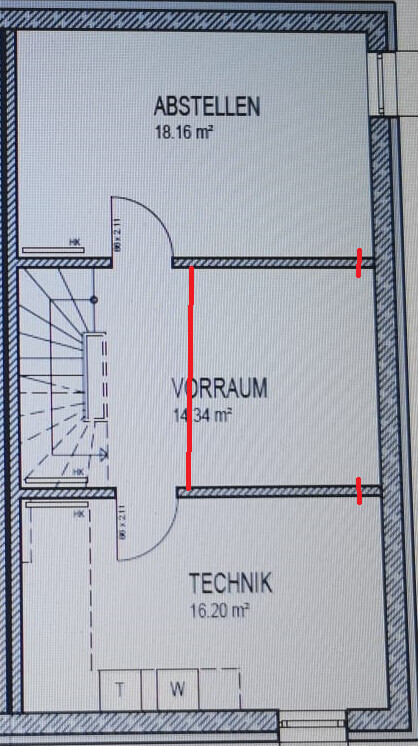
Our basement comes standard with conventional radiators under the stairs in the utility and storage rooms. As a special request, we will (red line) partition off this area as a separate room (of course with a door). The two lines at the back of the room will be ventilation slots to allow airflow since the other two rooms have windows.
The new room is intended as a pantry/storage room, and the storage room might be used as a workout room.
I have a few questions:
1: What do you think about installing underfloor heating throughout the entire basement? What are the advantages and disadvantages? The additional cost is 2700€.
2: In the underfloor heating package, the two rooms in the middle (hallway and newly partitioned room) will share a single heating circuit manifold, meaning the underfloor heating would be controlled by one thermostat and would heat both rooms. The underfloor heating would run beneath the new wall (a sand-lime brick wall).
My option would be, for an additional cost (amount unknown), to give the new room its own heating circuit, or to omit underfloor heating in that room altogether (which would of course reduce the extra cost of 2700€), or to have the hallway and new room share one heating circuit.
What would you recommend?
we are currently building a new semi-detached house
I am considering installing underfloor heating in the basement.
Our basement comes standard with conventional radiators under the stairs in the utility and storage rooms. As a special request, we will (red line) partition off this area as a separate room (of course with a door). The two lines at the back of the room will be ventilation slots to allow airflow since the other two rooms have windows.
The new room is intended as a pantry/storage room, and the storage room might be used as a workout room.
I have a few questions:
1: What do you think about installing underfloor heating throughout the entire basement? What are the advantages and disadvantages? The additional cost is 2700€.
2: In the underfloor heating package, the two rooms in the middle (hallway and newly partitioned room) will share a single heating circuit manifold, meaning the underfloor heating would be controlled by one thermostat and would heat both rooms. The underfloor heating would run beneath the new wall (a sand-lime brick wall).
My option would be, for an additional cost (amount unknown), to give the new room its own heating circuit, or to omit underfloor heating in that room altogether (which would of course reduce the extra cost of 2700€), or to have the hallway and new room share one heating circuit.
What would you recommend?
D
Deliverer6 Oct 2021 12:44Since radiators require significantly different supply temperatures than underfloor heating, you should definitely avoid combining both systems. Also, not heating the basement does not save energy because the ground floor then heats the basement, which means the supply temperature has to be increased.
Therefore, in my opinion, it is essential to use underfloor heating and keep it running (for example, set to around 18°C (64°F)).
Whether to use one or two loops depends somewhat on the design of the underfloor heating system. Visually, I would estimate at least two. As a general rule, loops should always be of similar length (usually between 80 and 100 meters (262 and 328 feet)). If one loop deviates significantly, it negatively affects the overall system and must be corrected, sometimes with some insistence.
Therefore, in my opinion, it is essential to use underfloor heating and keep it running (for example, set to around 18°C (64°F)).
Whether to use one or two loops depends somewhat on the design of the underfloor heating system. Visually, I would estimate at least two. As a general rule, loops should always be of similar length (usually between 80 and 100 meters (262 and 328 feet)). If one loop deviates significantly, it negatively affects the overall system and must be corrected, sometimes with some insistence.
Thank you for your help.
Currently, there are three heating circuits. My idea was to split the middle heating circuit into two separate circuits so that I can control the hallway and the new storage room independently.
The standard setup has the entire middle area covered with underfloor heating. If we build the wall, the underfloor heating would run beneath the wall (calcium silicate blocks). Would that cause any issues?
What would you suggest? Should we increase the number of circuits from three to four, or should we skip underfloor heating in the extra room if it is only going to be used as a pantry and storage room?
If we omit the underfloor heating, enough heat would still come in to prevent mold and similar problems.
Thanks for your help.
Currently, there are three heating circuits. My idea was to split the middle heating circuit into two separate circuits so that I can control the hallway and the new storage room independently.
The standard setup has the entire middle area covered with underfloor heating. If we build the wall, the underfloor heating would run beneath the wall (calcium silicate blocks). Would that cause any issues?
What would you suggest? Should we increase the number of circuits from three to four, or should we skip underfloor heating in the extra room if it is only going to be used as a pantry and storage room?
If we omit the underfloor heating, enough heat would still come in to prevent mold and similar problems.
Thanks for your help.
D
Deliverer6 Oct 2021 15:24Ah, I hadn’t read that quite precisely.
So: Three loops should fit. What definitely won’t be done is building a wall on top of the heated screed. The screed moves, so you shouldn’t build on it. You don’t even put drywall on it. Therefore, the underfloor heating won’t be installed under the wall.
For the reasons mentioned above (same length of the loops), I wouldn’t separate the hallway and storage room. First supply the hallway, then continue the loop into the storage room. The storage room will then get the slightly cooler water. The combined loop can be operated about 2 degrees cooler than the living areas. Larger differences are not good for efficiency because neighboring rooms would then be “cooled.”
Proper ventilation is also important for the mold issue mentioned. Therefore, the basement should be included in the ventilation concept, especially a storage room where items—and not just walls—could develop mold.
So: Three loops should fit. What definitely won’t be done is building a wall on top of the heated screed. The screed moves, so you shouldn’t build on it. You don’t even put drywall on it. Therefore, the underfloor heating won’t be installed under the wall.
For the reasons mentioned above (same length of the loops), I wouldn’t separate the hallway and storage room. First supply the hallway, then continue the loop into the storage room. The storage room will then get the slightly cooler water. The combined loop can be operated about 2 degrees cooler than the living areas. Larger differences are not good for efficiency because neighboring rooms would then be “cooled.”
Proper ventilation is also important for the mold issue mentioned. Therefore, the basement should be included in the ventilation concept, especially a storage room where items—and not just walls—could develop mold.
How does the circuit then connect to the storage room? The circuits will probably be joined near the door, right?
I marked the ventilation with 2 red lines; there will be a grille that allows the storage room (without a window) to exchange air with the two adjacent rooms (with windows).
So, it’s best to use the standard underfloor heating that the builder offers, meaning 3 circuits: 1 for the technical room, 1 for the storage and hallway + storage room? Is that correct?
I marked the ventilation with 2 red lines; there will be a grille that allows the storage room (without a window) to exchange air with the two adjacent rooms (with windows).
So, it’s best to use the standard underfloor heating that the builder offers, meaning 3 circuits: 1 for the technical room, 1 for the storage and hallway + storage room? Is that correct?
D
Deliverer6 Oct 2021 16:01Yes, the rooms are usually connected through the door thresholds. There are also control joints in the screed there, as it would probably crack at these narrow points otherwise. The heating pipes should be installed within protective conduits in that section.
And yes: Three circuits, as you described.
And yes: Three circuits, as you described.
Similar topics