
Hello
we are currently building a new semi-detached house
I am considering installing underfloor heating in the basement.
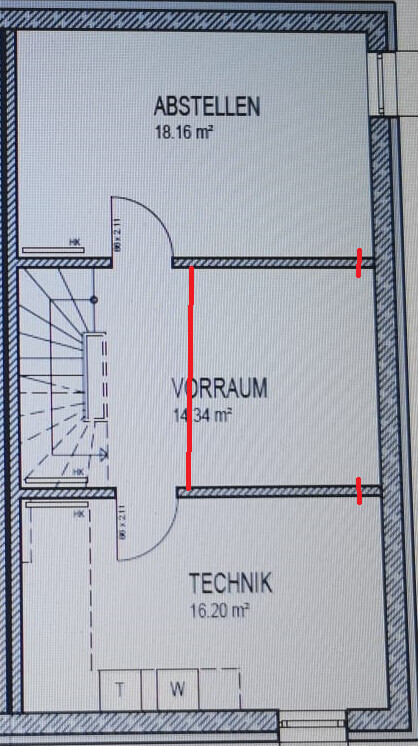
Our basement comes standard with conventional radiators under the stairs in the utility and storage rooms. As a special request, we will (red line) partition off this area as a separate room (of course with a door). The two lines at the back of the room will be ventilation slots to allow airflow since the other two rooms have windows.
The new room is intended as a pantry/storage room, and the storage room might be used as a workout room.
I have a few questions:
1: What do you think about installing underfloor heating throughout the entire basement? What are the advantages and disadvantages? The additional cost is 2700€.
2: In the underfloor heating package, the two rooms in the middle (hallway and newly partitioned room) will share a single heating circuit manifold, meaning the underfloor heating would be controlled by one thermostat and would heat both rooms. The underfloor heating would run beneath the new wall (a sand-lime brick wall).
My option would be, for an additional cost (amount unknown), to give the new room its own heating circuit, or to omit underfloor heating in that room altogether (which would of course reduce the extra cost of 2700€), or to have the hallway and new room share one heating circuit.
What would you recommend?
we are currently building a new semi-detached house
I am considering installing underfloor heating in the basement.
Our basement comes standard with conventional radiators under the stairs in the utility and storage rooms. As a special request, we will (red line) partition off this area as a separate room (of course with a door). The two lines at the back of the room will be ventilation slots to allow airflow since the other two rooms have windows.
The new room is intended as a pantry/storage room, and the storage room might be used as a workout room.
I have a few questions:
1: What do you think about installing underfloor heating throughout the entire basement? What are the advantages and disadvantages? The additional cost is 2700€.
2: In the underfloor heating package, the two rooms in the middle (hallway and newly partitioned room) will share a single heating circuit manifold, meaning the underfloor heating would be controlled by one thermostat and would heat both rooms. The underfloor heating would run beneath the new wall (a sand-lime brick wall).
My option would be, for an additional cost (amount unknown), to give the new room its own heating circuit, or to omit underfloor heating in that room altogether (which would of course reduce the extra cost of 2700€), or to have the hallway and new room share one heating circuit.
What would you recommend?
D
Durran12347 Oct 2021 08:59Whether there will only be heat pump heating systems in 10 years remains to be seen.
I am rather skeptical about that.
If energy prices and supply conditions continue as they are, there will probably be fewer heat pumps in 10 years.
Electric cars and heat pumps might not work well in our areas, especially if we have winters similar to the last one.
If everything goes as smoothly as the digitalization efforts in Germany over the past 20 years, combined with an ecological transformation, I am somewhat concerned.
A utility company employee recently told me that if only 20 percent of vehicles are electric, our power grids become overloaded and stop functioning properly. And if all the heat pumps also need electric backup heating in winter, the situation gets worse.
I am rather skeptical about that.
If energy prices and supply conditions continue as they are, there will probably be fewer heat pumps in 10 years.
Electric cars and heat pumps might not work well in our areas, especially if we have winters similar to the last one.
If everything goes as smoothly as the digitalization efforts in Germany over the past 20 years, combined with an ecological transformation, I am somewhat concerned.
A utility company employee recently told me that if only 20 percent of vehicles are electric, our power grids become overloaded and stop functioning properly. And if all the heat pumps also need electric backup heating in winter, the situation gets worse.
D
Deliverer7 Oct 2021 10:07The employee clearly lacks expertise and ignores all statements from scientists on the subject – and the Federal Constitutional Court has ruled on the heat pump issue. There isn’t much left to discuss...
However, I am also concerned because a large part of the population (CDU, SPD, FDP, AFD) obviously still hasn’t grasped it...
However, I am also concerned because a large part of the population (CDU, SPD, FDP, AFD) obviously still hasn’t grasped it...
As you can see, opinions differ here somewhat. If I were you, I would ask the professional who will be installing the heating system later. They need to ensure that it works as intended. Spending several thousand euros more just based on opinions from this forum seems questionable to me.
If regular radiators were really that bad and would later cause problems with mold or extremely high heating costs, they probably wouldn’t be included as standard. After all, that would lead to a lot of customer complaints, which would ultimately reduce the profit margin.
If regular radiators were really that bad and would later cause problems with mold or extremely high heating costs, they probably wouldn’t be included as standard. After all, that would lead to a lot of customer complaints, which would ultimately reduce the profit margin.

Sorry, but this is a classic fallacy. The contractual partner is most likely a limited liability company set up specifically for the project. Once the project has been fully accepted (including remaining work and even confirmed defect claims), the profit is transferred to a parent company within one year.
Defect claims are either ignored entirely, with the “ostrich” approach being taken, or at best, delayed and referred to subcontractors. However, subcontractors will not take action if they are not paid, which the developer company no longer does (since there are no assets left).
Legal action leads nowhere, as it can be delayed by further company restructurings and “sales,” and even if you eventually win in court, there are no financial resources left to potentially compensate for defects.
Defect claims are either ignored entirely, with the “ostrich” approach being taken, or at best, delayed and referred to subcontractors. However, subcontractors will not take action if they are not paid, which the developer company no longer does (since there are no assets left).
Legal action leads nowhere, as it can be delayed by further company restructurings and “sales,” and even if you eventually win in court, there are no financial resources left to potentially compensate for defects.
D
Deliverer7 Oct 2021 10:46@FloHB123 Have you ever worked with heating engineers before?
Yes, several times already, and there were never any problems. This might also be because we live in a small community where the heating installers in the nearby area have all been established for a long time, and some of them (or their employees) know each other. So, it’s not as anonymous as in a big city.
However, I stick to my opinion: Most of the people writing here on these topics are not professionals but have educated themselves during their own house building project. And such an opinion should carry more weight than that of an expert (and by that, I don’t mean the developer / seller)? That can’t be serious.
However, I stick to my opinion: Most of the people writing here on these topics are not professionals but have educated themselves during their own house building project. And such an opinion should carry more weight than that of an expert (and by that, I don’t mean the developer / seller)? That can’t be serious.