
ᐅ Garden drainage during heavy rainfall, like recently experienced in North Rhine-Westphalia
Created on: 26 Jul 2021 18:02
T
Tarnari
Hello everyone,
I have a question that I can’t phrase very precisely. If more details are needed, please ask.
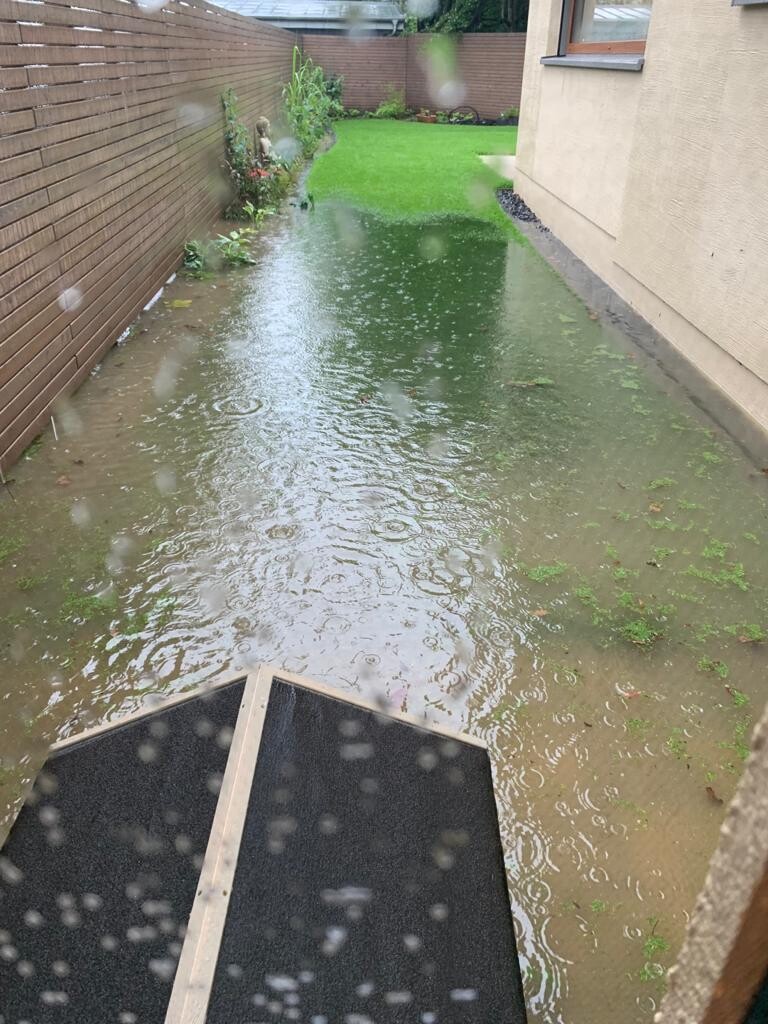
Recently, during heavy rain in NRW, we had the problem that so much water fell that it couldn’t drain away, and after a while, it looked like this:
Here from the garage door
and here from the first floor looking towards the adjacent kindergarten.
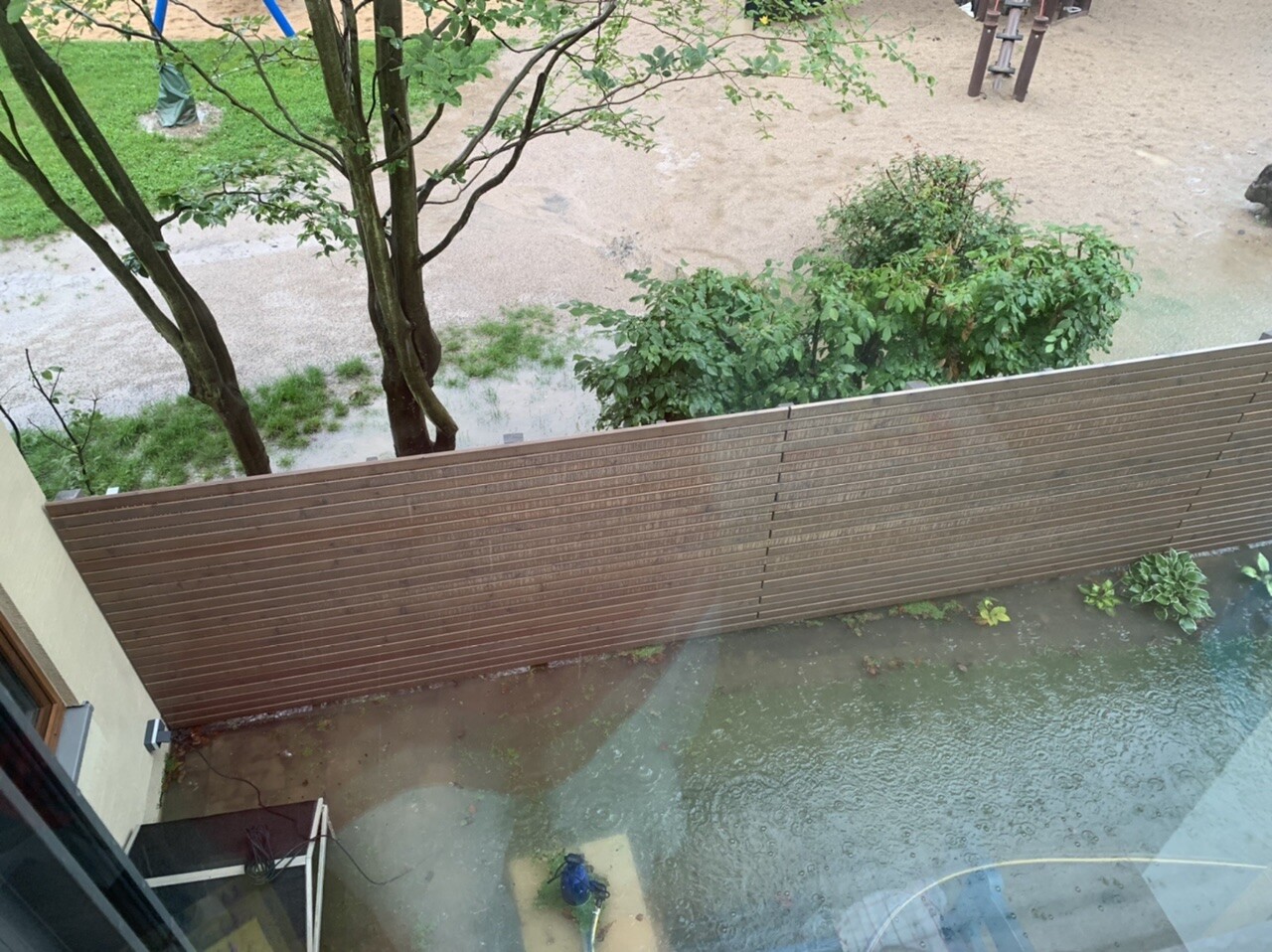
This is the lowest spot in the garden, which is why water collected there.
In the end, the water reached 25cm (10 inches) high at the garage door. Fortunately, the door was watertight, and a pump prevented worse damage. We were lucky that the rain eased overnight, otherwise, the water level might have risen up to the terrace.
The soil is unfortunately very clay-heavy, and the water collecting near the kindergarten in the second picture didn’t help either, as it eventually “connected” with our pool of water, turning two ponds into one large one.
Tomorrow, our landscaping contractor is coming to check how this could be at least partially controlled in the future. Currently, there is no drainage, no soakaway, no gravel bed—nothing.
The current idea from the architect and the landscaper is to remove the lawn, excavate the area with a mini excavator, fill it with gravel underneath, and additionally install a drain pipe in the damp-proof course towards the terrace, connecting it to the terrace drain and the roof downspouts.
Does that sound reasonable? We definitely need to do something, but we don’t want to waste money either. We are willing to invest if it helps. We assume that similar weather conditions will occur more frequently rather than rarely in the future.
I appreciate any tips or suggestions. As mentioned, if important information is missing, please just ask.
I have a question that I can’t phrase very precisely. If more details are needed, please ask.
Recently, during heavy rain in NRW, we had the problem that so much water fell that it couldn’t drain away, and after a while, it looked like this:
Here from the garage door
and here from the first floor looking towards the adjacent kindergarten.
This is the lowest spot in the garden, which is why water collected there.
In the end, the water reached 25cm (10 inches) high at the garage door. Fortunately, the door was watertight, and a pump prevented worse damage. We were lucky that the rain eased overnight, otherwise, the water level might have risen up to the terrace.
The soil is unfortunately very clay-heavy, and the water collecting near the kindergarten in the second picture didn’t help either, as it eventually “connected” with our pool of water, turning two ponds into one large one.
Tomorrow, our landscaping contractor is coming to check how this could be at least partially controlled in the future. Currently, there is no drainage, no soakaway, no gravel bed—nothing.
The current idea from the architect and the landscaper is to remove the lawn, excavate the area with a mini excavator, fill it with gravel underneath, and additionally install a drain pipe in the damp-proof course towards the terrace, connecting it to the terrace drain and the roof downspouts.
Does that sound reasonable? We definitely need to do something, but we don’t want to waste money either. We are willing to invest if it helps. We assume that similar weather conditions will occur more frequently rather than rarely in the future.
I appreciate any tips or suggestions. As mentioned, if important information is missing, please just ask.

rick2018 schrieb:
Connect the hole to a large pump and the roof drainage system?
With a float switch or similar, so it’s also “automated.” Is a hole just a hole? Or is it “underground” under the lawn, like a basin?
With such volumes of water, you have no chance. You would need to prepare for 200 liters per m² (20 gallons per ft²). If I assume an area of 100 m² (1,076 ft²), you would have to dispose of 20,000 liters (5,283 gallons).
In my view, this can only be managed by replacing the soil—clay with coarse gravel—plus a large, deep soakaway pit and an automatic pump connected to the sewer system. Estimated costs are 10,000 to 15,000 euros.
In my view, this can only be managed by replacing the soil—clay with coarse gravel—plus a large, deep soakaway pit and an automatic pump connected to the sewer system. Estimated costs are 10,000 to 15,000 euros.
Bookstar schrieb:
With such volumes of water, you don’t stand a chance. You would have to prepare for 200 liters per square meter. Assuming an area of 100m2 (1,076 sq ft), you would need to manage 20,000 liters (5,283 gallons).
In my opinion, this can only be done by replacing clay soil with coarse gravel, plus a large, deep soakaway pit and an automatic pump connected to the sewer system. Estimated costs 10,000 to 15,000 euros.Thanks for the assessment. I feared something like this… 🙁Well, I guess damage limitation is the only option.

Bookstar schrieb:
connected to the sewerWhen it rains heavily, the sewer is often full and pushes wastewater back into your property instead of draining away. Raising the ground level does not help either, as the water will then accumulate inside the house.
If you live in such an area, only a small flood wall of 20-30cm (8-12 inches) and pumping and redirecting the water over it will help.
Similar topics