
Hello,
Is it worth installing a small photovoltaic system to use the electricity during the day?
Is it true that turnkey systems can be obtained for about 4500 euros?
We have a lot of laundry and cook every day here.
Thanks for your advice.
Best regards, Xinette
Is it worth installing a small photovoltaic system to use the electricity during the day?
Is it true that turnkey systems can be obtained for about 4500 euros?
We have a lot of laundry and cook every day here.
Thanks for your advice.
Best regards, Xinette

I would also recommend a somewhat larger system. Otherwise, the fixed costs make it unprofitable.
We used the fixed scaffolding installed for the plasterers during the installation of our photovoltaic system. Unfortunately, we decided to install the photovoltaic system quite late. As a result, the roofer’s scaffolding (which was higher) was already removed, and we had to pay extra for an additional one-sided scaffold extension.
We chose a 5.5 kWp system. I can’t say much yet about the efficiency achieved for self-consumption, as we only moved in about two weeks ago.
Our idea was to cover a larger portion of the consumption by the washing machine, dryer, dishwasher, and individual continuous consumers (e.g., fridge/freezer), so that only a small amount of electricity would need to be fed back into the grid. Since I’m not home from 6:30 a.m. to 7:30 p.m., cooking typically takes place in the evening, so this particular consumption can mostly use photovoltaic power only on weekends.
If you are planning new appliances, make sure they are programmable.
@Elina
I assume your electricity consumption has generally decreased because you moved in with newer appliances and maybe are now more conscious of keeping consumption low.
Regarding your Twizy – I just looked it up. Is the battery rental a yearly or monthly fee? I would guess it’s yearly since monthly rental would probably not make sense anymore, in my opinion.
You’re right about the dark season. From December 1st to 6th, we didn’t produce a single kWh because it was continuously dark with an endless cloud cover. Yesterday was the first day the sun shone. Unfortunately, my wife forgot to start the washing machine, which was already prepared.
Well, everything will settle over time.
We used the fixed scaffolding installed for the plasterers during the installation of our photovoltaic system. Unfortunately, we decided to install the photovoltaic system quite late. As a result, the roofer’s scaffolding (which was higher) was already removed, and we had to pay extra for an additional one-sided scaffold extension.
We chose a 5.5 kWp system. I can’t say much yet about the efficiency achieved for self-consumption, as we only moved in about two weeks ago.
Our idea was to cover a larger portion of the consumption by the washing machine, dryer, dishwasher, and individual continuous consumers (e.g., fridge/freezer), so that only a small amount of electricity would need to be fed back into the grid. Since I’m not home from 6:30 a.m. to 7:30 p.m., cooking typically takes place in the evening, so this particular consumption can mostly use photovoltaic power only on weekends.
If you are planning new appliances, make sure they are programmable.
@Elina
I assume your electricity consumption has generally decreased because you moved in with newer appliances and maybe are now more conscious of keeping consumption low.
Regarding your Twizy – I just looked it up. Is the battery rental a yearly or monthly fee? I would guess it’s yearly since monthly rental would probably not make sense anymore, in my opinion.
You’re right about the dark season. From December 1st to 6th, we didn’t produce a single kWh because it was continuously dark with an endless cloud cover. Yesterday was the first day the sun shone. Unfortunately, my wife forgot to start the washing machine, which was already prepared.
Well, everything will settle over time.
@ F-pNo
No, it’s not the devices’ fault. We moved in here 2.5 years ago, and the two annual statements I mentioned are both from this place. One covers Nov 2012 to Nov 2013, and the other from Nov 2013 to Nov 2014. Nothing changed with the devices except one thing: at the end of Nov 2013, we bought a new refrigerator with an A3+ rating instead of the previous A2+, but the new one is about twice as large and uses almost twice the energy.
Our Twizy costs 40 euros per month for battery rental, which includes 5000 km per year (about 3100 miles), but there is also an option for 30 euros monthly for 2500 km per year (about 1550 miles). However, the Twizy is still economical since a full charge costs less than one euro. If you drive more, it becomes even more cost-effective, but initially, we weren’t sure how much we would drive with it. We can increase the mileage allowance at any time.
Because the battery is rented, it will be replaced free of charge if it breaks or its capacity falls below 75%. Also, you can get free roadside assistance if the battery runs out and there is no charging station nearby.
We don’t pay taxes for the small vehicle, and the insurance costs 260 euros per year regardless of no-claims bonus or mileage (flat rate).
No, it’s not the devices’ fault. We moved in here 2.5 years ago, and the two annual statements I mentioned are both from this place. One covers Nov 2012 to Nov 2013, and the other from Nov 2013 to Nov 2014. Nothing changed with the devices except one thing: at the end of Nov 2013, we bought a new refrigerator with an A3+ rating instead of the previous A2+, but the new one is about twice as large and uses almost twice the energy.
Our Twizy costs 40 euros per month for battery rental, which includes 5000 km per year (about 3100 miles), but there is also an option for 30 euros monthly for 2500 km per year (about 1550 miles). However, the Twizy is still economical since a full charge costs less than one euro. If you drive more, it becomes even more cost-effective, but initially, we weren’t sure how much we would drive with it. We can increase the mileage allowance at any time.
Because the battery is rented, it will be replaced free of charge if it breaks or its capacity falls below 75%. Also, you can get free roadside assistance if the battery runs out and there is no charging station nearby.
We don’t pay taxes for the small vehicle, and the insurance costs 260 euros per year regardless of no-claims bonus or mileage (flat rate).
Thank you for the information @Elina
Of course, we are also considering how to become more mobile-independent (also one reason for the photovoltaic system). However, I think that such a "boxy" car is more suitable for city driving. On country roads, which I often use even for short distances, it can quickly become a stationary obstacle. I would also be interested in how it performs in hilly terrain (8-10% gradients are quite common in our wine region).
I once spoke with someone who bought the BMW i3. However, that is a completely different price range, making such a vehicle, in my opinion, only very long-term economical with a mileage of about 140-160 km (90-100 miles).
Well, we’ll see how the development continues.
Of course, we are also considering how to become more mobile-independent (also one reason for the photovoltaic system). However, I think that such a "boxy" car is more suitable for city driving. On country roads, which I often use even for short distances, it can quickly become a stationary obstacle. I would also be interested in how it performs in hilly terrain (8-10% gradients are quite common in our wine region).
I once spoke with someone who bought the BMW i3. However, that is a completely different price range, making such a vehicle, in my opinion, only very long-term economical with a mileage of about 140-160 km (90-100 miles).
Well, we’ll see how the development continues.
We specifically acquired the Twizy for use in rural areas (country roads). While it is ideal for city driving, it also works well for short trips in the countryside (like going shopping—does that really require a combustion engine?), even though those trips can cover quite a few kilometers.
Of course, having a nearby charging option is essential. Since the Twizy is usually ordered with a standard Schuko plug (ours was a demo model with a Type 2 connector, which is also no problem—an adapter costs just a few euros), charging at home on the countryside is mostly possible via your own house, garage, or carport. In the city, however, charging infrastructure is more limited, as most people don’t have a garage and public charging stations are rarely right outside the front door.
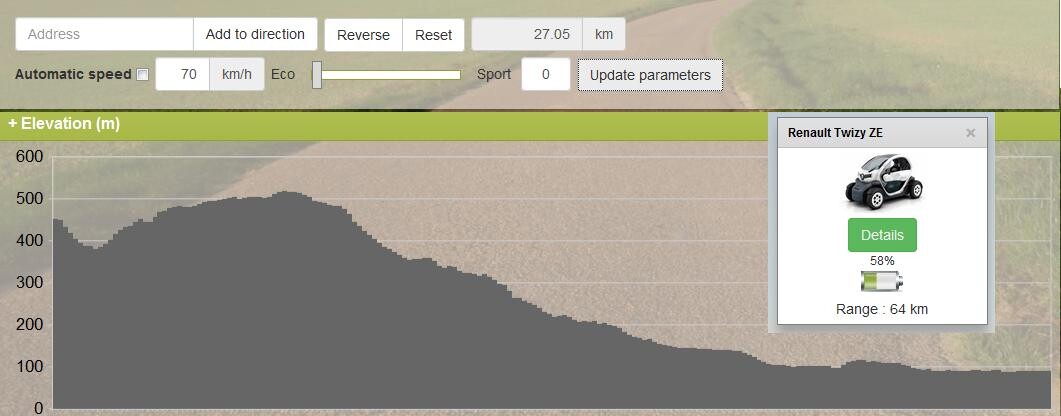
That said, I have also considered using the Twizy for the daily commute to work (my husband). The commute is to Wiesbaden and involves a significant elevation profile. There is an online tool where you can calculate whether the Twizy can manage this without charging stops. You can input or adjust values such as rolling resistance and battery capacity for the worst-case scenario (winter!).
Here’s what I found:
The outbound trip:
And the return trip:
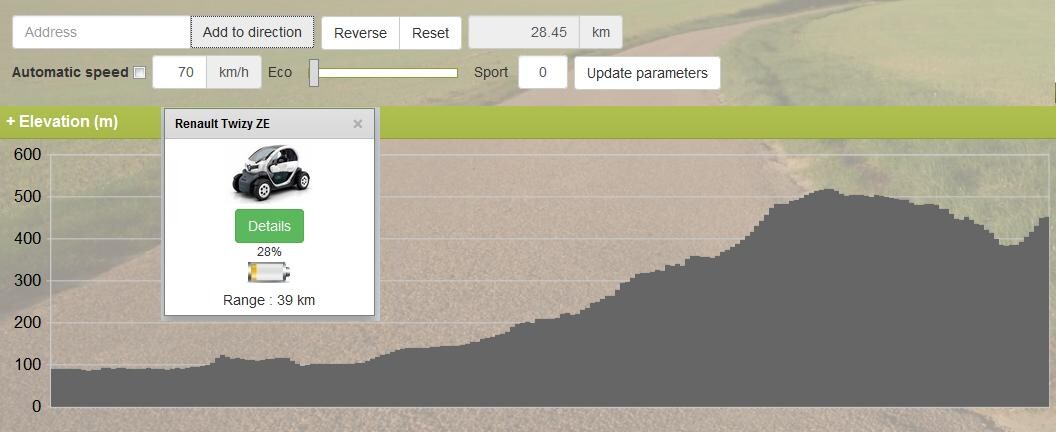
This means I need 42% of the battery capacity for the outbound trip, and 72% for the return, each based on the maximum battery capacity in winter. But it also means that charging at work makes the commute feasible.
We have already tested the trip in summer when we picked up our little one from Frankfurt—using the highway, by the way!
The top speed is 84 km/h (52 mph), but we bought a tuning box that increases the speed to 92 km/h (57 mph) on flat roads, which is perfectly adequate for highways or country roads. You can easily draft behind trucks, which helps save battery power by taking advantage of their slipstream!
As an alternative, we initially considered the ZOE, which has a longer range, is faster, and can now be found new for around 15,000 euros (demo models, mobile classifieds). But I really wanted the Twizy, and since both couldn’t work together, we postponed the ZOE until our combustion car dies. That car is about five years old, so it might still last a while. Nothing new planned for the next two years.
By the way, the Twizy is quite practical for shopping. Four full bags and two people fit easily. You can place two bags next to you by the doors and the other two can be held on the lap of the rear passenger. My husband, who is 1.92 meters (6 ft 4 in) tall, has no problems sitting in the back! With only one person, you could even fit two crates in the back.
If you need a full-fledged car (the Twizy is more like a quadricycle, although it does have airbags and doors), then I would recommend the ZOE.
Speaking of being a stationary obstacle: even on the highway, I’ve never felt like one! However, our little car has often been slowed down by cautious drivers. Especially on tight curves (typical in mountainous areas), but also on country roads you occasionally have slow drivers, showing that whether you become a moving obstacle depends more on driving style than the top speed.
Of course, having a nearby charging option is essential. Since the Twizy is usually ordered with a standard Schuko plug (ours was a demo model with a Type 2 connector, which is also no problem—an adapter costs just a few euros), charging at home on the countryside is mostly possible via your own house, garage, or carport. In the city, however, charging infrastructure is more limited, as most people don’t have a garage and public charging stations are rarely right outside the front door.
That said, I have also considered using the Twizy for the daily commute to work (my husband). The commute is to Wiesbaden and involves a significant elevation profile. There is an online tool where you can calculate whether the Twizy can manage this without charging stops. You can input or adjust values such as rolling resistance and battery capacity for the worst-case scenario (winter!).
Here’s what I found:
The outbound trip:
And the return trip:
This means I need 42% of the battery capacity for the outbound trip, and 72% for the return, each based on the maximum battery capacity in winter. But it also means that charging at work makes the commute feasible.
We have already tested the trip in summer when we picked up our little one from Frankfurt—using the highway, by the way!
The top speed is 84 km/h (52 mph), but we bought a tuning box that increases the speed to 92 km/h (57 mph) on flat roads, which is perfectly adequate for highways or country roads. You can easily draft behind trucks, which helps save battery power by taking advantage of their slipstream!
As an alternative, we initially considered the ZOE, which has a longer range, is faster, and can now be found new for around 15,000 euros (demo models, mobile classifieds). But I really wanted the Twizy, and since both couldn’t work together, we postponed the ZOE until our combustion car dies. That car is about five years old, so it might still last a while. Nothing new planned for the next two years.
By the way, the Twizy is quite practical for shopping. Four full bags and two people fit easily. You can place two bags next to you by the doors and the other two can be held on the lap of the rear passenger. My husband, who is 1.92 meters (6 ft 4 in) tall, has no problems sitting in the back! With only one person, you could even fit two crates in the back.
If you need a full-fledged car (the Twizy is more like a quadricycle, although it does have airbags and doors), then I would recommend the ZOE.
Speaking of being a stationary obstacle: even on the highway, I’ve never felt like one! However, our little car has often been slowed down by cautious drivers. Especially on tight curves (typical in mountainous areas), but also on country roads you occasionally have slow drivers, showing that whether you become a moving obstacle depends more on driving style than the top speed.
Elina schrieb:
We specifically acquired the Twizy for rural roads. While it’s ideal for city driving, it also works for the short trips in the countryside (like going shopping—does that really require a combustion engine?), even though these involve covering quite a few kilometers.
Of course, the prerequisite is that there is a charging option nearby. Since the Twizy is usually ordered with a standard Schuko plug (ours was a demo model with a Type 2 connector, but that’s no problem either—an adapter costs just a few euros), having a charging option in rural areas often means charging at your own house, garage, or carport. In the city, however, charging options are much harder to find because few people have a garage, and public charging stations are rarely right outside the door.
Speaking of being a slow vehicle: even on the highway, I have never really felt like one! But it does happen that our little one gets held back by slow drivers. Especially on tight curves (mountains, of course) but also frequently on country roads, there are slowpokes, which shows that whether you become an obstacle is less about the top speed and more about driving style.I regularly feel like a slow-moving obstacle with my wife’s small car (Toyota Yaris 1.0) (since the kids arrived, I had to give up my car), especially going uphill. It often reminds me of Jim Knopf with his locomotive Emma: "(going uphill) I can do it, I can do it, I can do it, no. - (then downhill) I made it, I made it."
Here, an electric vehicle might have an advantage thanks to its direct power delivery.
Personally, I would feel rather uncomfortable driving at 90 km/h (55 mph) on the highway. I can imagine that such a small car could easily be overlooked at higher speeds.
Going uphill with our combustion engine isn’t much better either—at best 80 km/h (50 mph), but with two people and a load, it drops to around 60 km/h (37 mph). Trucks experience the same, so there’s no need to feel bad about it.
Electric vehicles have the advantage that you can really leave everyone behind at traffic lights. It accelerates smoothly and quickly. You’re unlikely to be overlooked, as the Twizy’s height is similar to any car (except SUVs), just a bit narrower.
However, if you regularly drive long distances on highways, the Twizy wouldn’t be the right choice. It performs very well on rural roads, though.
I would see this small vehicle more as a safer and better alternative to a scooter. You have to keep in mind that it’s simply not a car when comparing it to regular cars.
Electric vehicles have the advantage that you can really leave everyone behind at traffic lights. It accelerates smoothly and quickly. You’re unlikely to be overlooked, as the Twizy’s height is similar to any car (except SUVs), just a bit narrower.
However, if you regularly drive long distances on highways, the Twizy wouldn’t be the right choice. It performs very well on rural roads, though.
I would see this small vehicle more as a safer and better alternative to a scooter. You have to keep in mind that it’s simply not a car when comparing it to regular cars.
Similar topics