
ᐅ Floor Plan for a Single-Family Home, 240 m², with Partially Built-Over Garage
Created on: 3 Dec 2023 13:51
H
Haus 42
Hello everyone,
My wife and I are currently favoring the attached design for our house project. It is our own concept, inspired by forum discussions, catalogs, and model homes, but also discussed with architects and now unrecognizable compared to the first drafts.
A first detailed drawing is in progress (which may include structural and building services adjustments), so general criticism is welcome, but especially suggestions on potential problem areas or ways to achieve essential improvements through small changes: After all, we don’t want to build an expensive house only to regret it later, but rather invest in meaningful improvements (e.g., bay windows). At the bottom, I have listed some specific concerns.
Framework conditions:
Design:
Notes on the floor plans:
Development:
We had several designs, including with a basement, without construction over the garage (which was recently confirmed as possible), with open space, guest rooms on different sides, a 180° half-landing staircase, etc. – the current approach now seems quite logical to us and despite the naturally high costs, not extravagant. I grew up in a house with a full basement and converted attic, and the plan tries to provide similar spaces over two floors.
Ground floor details:
Upper floor details:
Concerns / Questions
We look forward to your comments!
My wife and I are currently favoring the attached design for our house project. It is our own concept, inspired by forum discussions, catalogs, and model homes, but also discussed with architects and now unrecognizable compared to the first drafts.
A first detailed drawing is in progress (which may include structural and building services adjustments), so general criticism is welcome, but especially suggestions on potential problem areas or ways to achieve essential improvements through small changes: After all, we don’t want to build an expensive house only to regret it later, but rather invest in meaningful improvements (e.g., bay windows). At the bottom, I have listed some specific concerns.
Framework conditions:
- Planned residents: two adults (working days home/office: 2/3 and 3/2), two (initially small) children, two cats, guests staying several weeks per year.
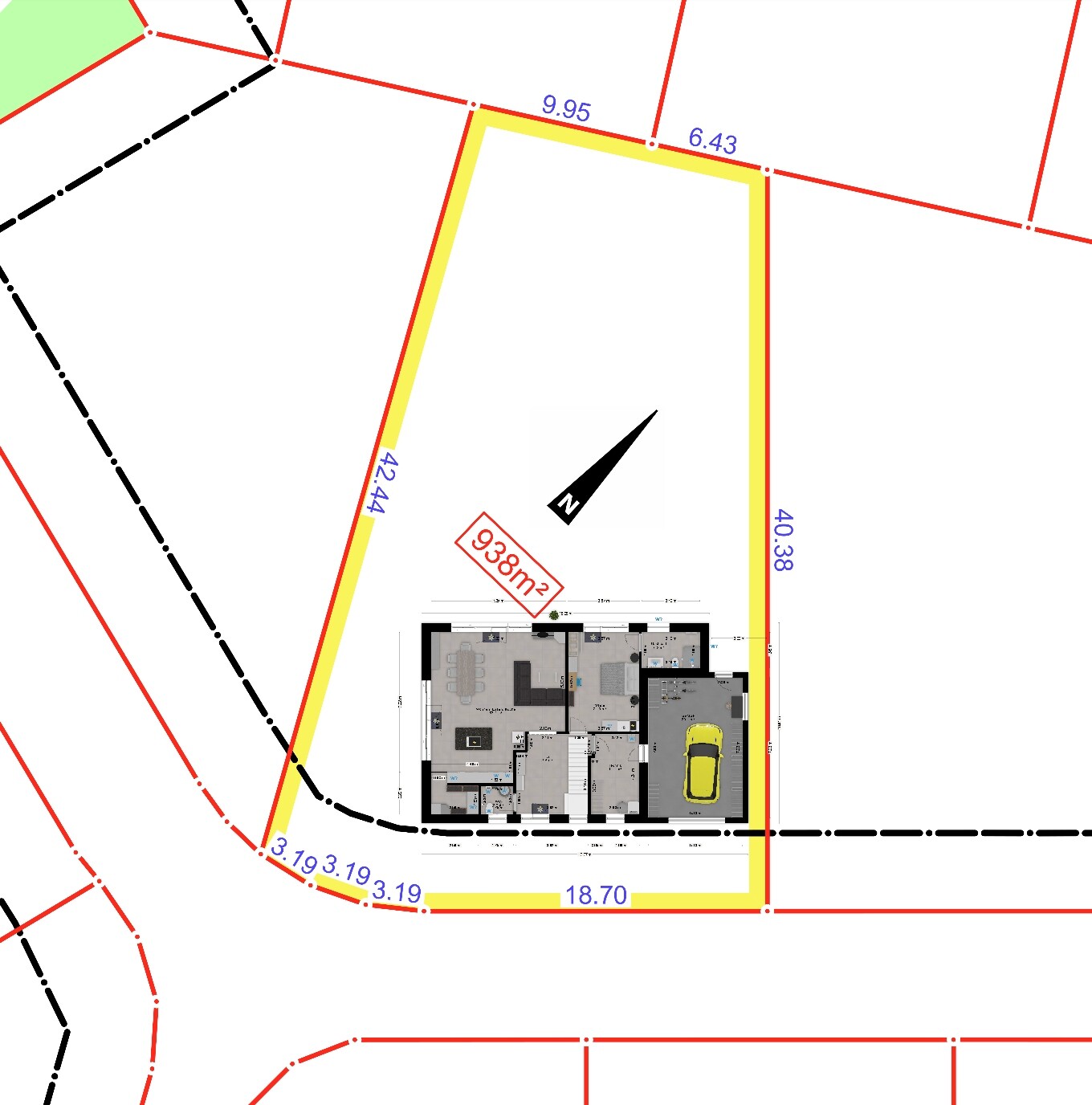
- Conditions: Small-town new development area in Mecklenburg-Vorpommern, site coverage ratio 0.35, maximum one full story, eaves height max. 5m (16 ft 5 in), gable or half-hipped roof with 20°–50° pitch, minimum distance to street 5m (16 ft 5 in), to neighbors 3m (10 ft).
- Plot: 938 m² (10,094 sq ft), essentially flat, with utility garden and play lawn.
- Neighboring plots: Northeast (“right”) already developed (close to road and at distance from us, since their garage is on the side facing away from us), southwest (“left”) not yet sold.
Design:
- Footprint: approx. 15.5m×11m (51 ft × 36 ft) + garage overhang 2m×8m (6 ft 7 in × 26 ft), garage-boundary distance 1m (3 ft 3 in)
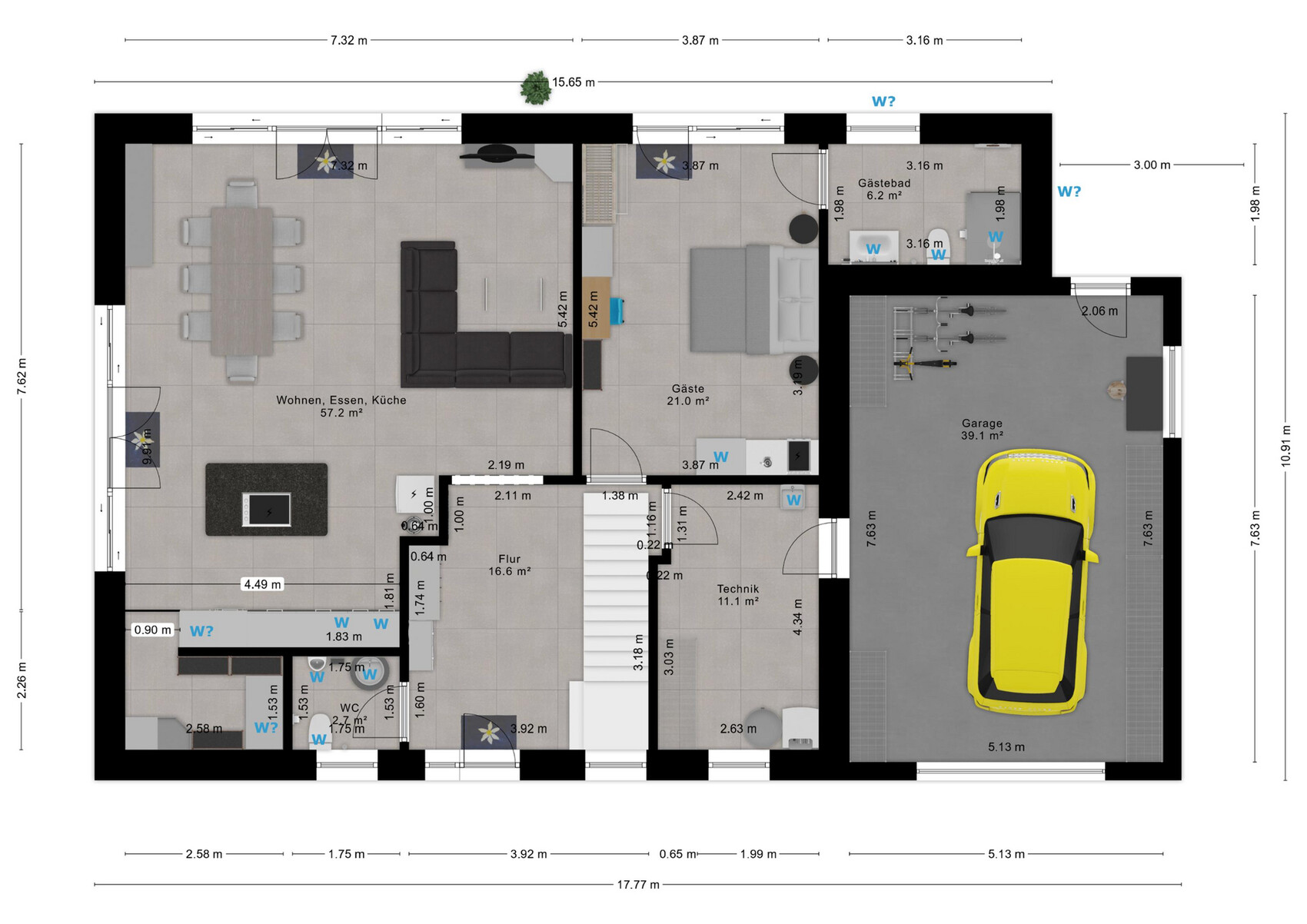
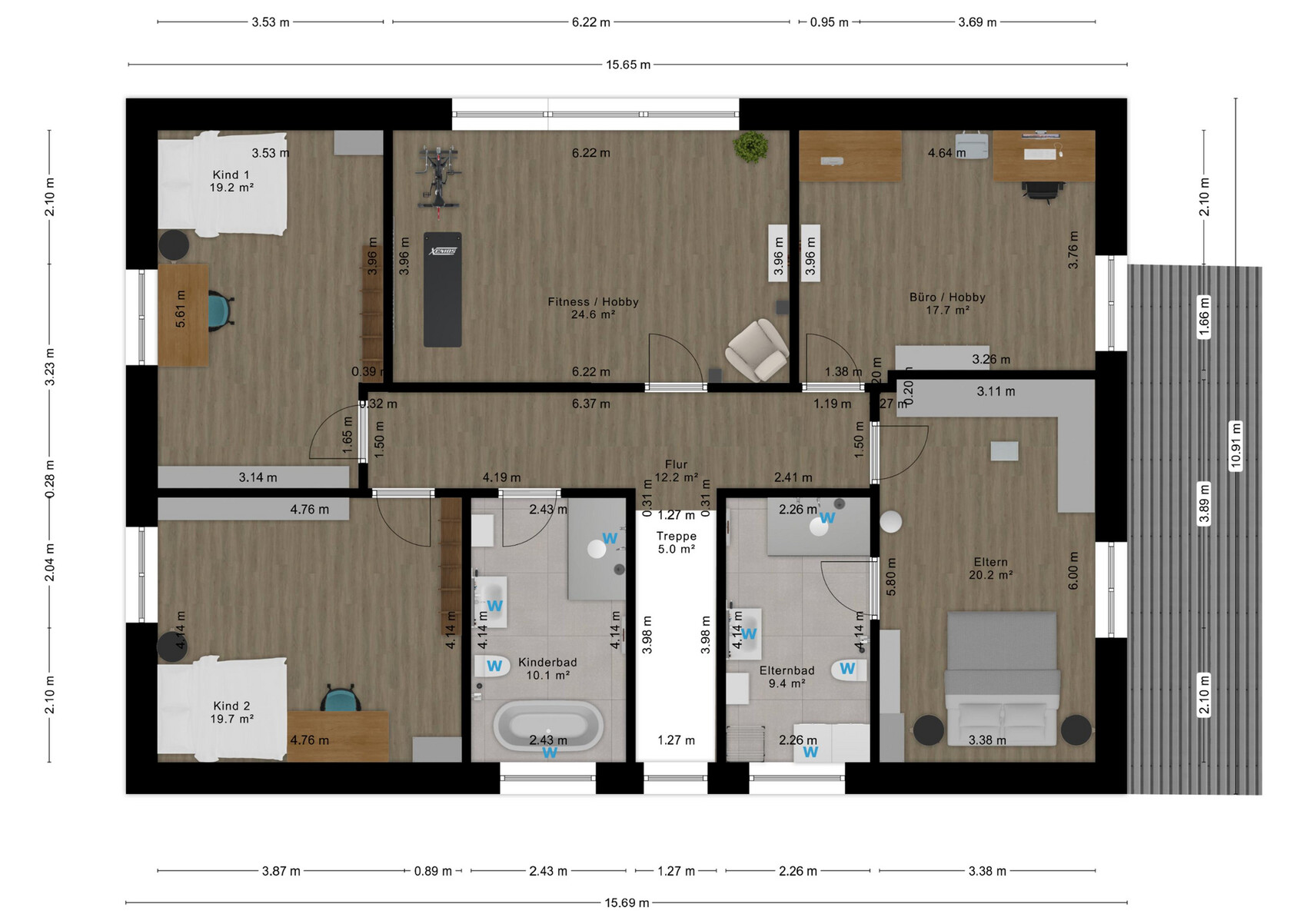
- Living and utility space: ground floor approx. 115 m² (1,238 sq ft), upper floor approx. 125 m² (1,345 sq ft), garage approx. 40 m² (430 sq ft)
- Ceiling height: ground floor approx. 2.60m (8 ft 6 in), upper floor approx. 2.50m (8 ft 2 in)
- Building services: ventilation system, photovoltaic panels on southeast roof, underfloor heating powered by air-source heat pump everywhere except garage/attic.
- Location: the house should be as close to the street as possible (see plan) with the main entrance facing it (southeast), to maximize garden space.
- Gable roof: rather flat (25°) to allow for a high knee wall (>1.20m (3 ft 11 in)), attic therefore only used for storage.
- We are foregoing a basement in favor of a larger footprint, which also enables a barrier-free guest area.
- Ground floor: the living area should get both sunlight and garden views, so it must be on the west side.
- Upper floor: usability of space is the priority, so we accept the narrow corridor (approx. 1.5m×8m (4 ft 11 in × 26 ft)). Still, generous dormers, including in the stairwell, should provide enough daylight.
- Exterior walls are brick-clad, interior rather modern: white walls/kitchen fronts, tiled floors on the ground floor, PVC on the upper floor.
Notes on the floor plans:
- Area measurements do not account for sloping ceilings on the upper floor.
- ⚡ means high-voltage electricity, W (waste) water
Development:
We had several designs, including with a basement, without construction over the garage (which was recently confirmed as possible), with open space, guest rooms on different sides, a 180° half-landing staircase, etc. – the current approach now seems quite logical to us and despite the naturally high costs, not extravagant. I grew up in a house with a full basement and converted attic, and the plan tries to provide similar spaces over two floors.
- What we like: the bright living room, purely functional generous sizing everywhere, especially for guests and thanks to the large room upstairs, the access from the garage.
- What we don’t like: see also the “Concerns” listed at the bottom. Otherwise, the “very generous” house (architect’s comment) might have few ‘eye-catchers’ for its price, e.g., no gallery or two bathrooms upstairs instead of one large. Therefore, general suggestions are welcome on how to enhance the design beyond the floor plan, for instance through lighting, mirrors, windows, external design.
Ground floor details:
- Living room with window fronts each with a door leading to terraces in the southwest (for sunlight) and northwest (toward the garden).
- Kitchen open to the living area; appliances located in a central niche—therefore, to minimize noise, the oven/microwave are there instead of the refrigerator.
- Room behind kitchen (separated by a slightly hidden door) serves as storage and a place for some kitchen appliances and an additional worktop.
- From the hallway, a doorless passage to the living room, doors to guest room, guest toilet, and utility room, also from there access to the garage.
- Large guest room with barrier-free bathroom and external access, potentially a one-room separate apartment.
- Garage for one car, e-scooter/bicycles and as a workshop/storage room, for example for garden tools.
Upper floor details:
- Children’s rooms on the sunnier gable side.
- Children’s bathroom with bathtub, master bathroom with washing machine/dryer (but space in utility room to allow for changes).
- Long dormers above bathrooms/stairwell and fitness/hobby room; no other roof windows.
- Access to attic via fitness/hobby room.
Concerns / Questions
- The (currently half-landing) staircase may need to be spiral to allow doors to fit under its end. Is preserving the half-landing for climbing safety worth a bay window?
- Prefabricated houses often have bay windows, although they might be energetically disadvantageous. Are they mainly for aesthetics, or have we missed practical opportunities by not including any?
- Is the staircase too close to the entrance, e.g., regarding dirt distribution?
- We would like remote/central control for roller shutters on all burglary-relevant windows. Would narrow windows be acceptable in the utility room, guest bathroom, and ground floor toilet, to prevent break-ins? Does anyone have experience with this?
- With a 25° pitch and 1.20m (3 ft 11 in) knee wall, is an overhanging roof suitable as a cover for the entrance and/or terrace without causing too much shading? What other canopy options would make sense, especially since the terrace is on the exposure-prone side?
- To prevent bicycles from scratching the car in the garage, should it be widened? This would reduce the remaining strip on the southwest side, where the tightest boundary distance (at the west corner, “top left”) is currently about 5m (16 ft 5 in).
- Is a TV placed directly next to the window front a problem due to the northwest orientation?
- Should the pantry behind the kitchen have a second sink?
- Would it be better to fill the garden-facing dormer entirely with windows rather than leaving corners open as planned?
- Which windows should be included in the bathroom dormer considering there are houses on the opposite side of the street?
We look forward to your comments!

I cannot see that there is a thoughtfully designed room layout behind this. I mean something like planning for 4 bathrooms, none of which offers a comfortable size. They all have hotel-room dimensions. Or that the entire technical area for a family of four plus a permanent guest is only 6.8 m² (73 sq ft) in one example. That is simply absurd or doomed to fail.
I would take a big step back and honestly lay everything out in front of me with the question: Do I want to live like this?
I would take a big step back and honestly lay everything out in front of me with the question: Do I want to live like this?
ypg schrieb:
I would definitely reduce the hallway on the ground floor more significantly.It was initially smaller in the architect’s design before we requested the row of wardrobes behind the guest room door. We couldn’t think of an alternative where a reduced hallway wouldn’t just result in more circulation space in the guest room or the utility room — or, well, that was how it was set in version 1 due to the questionable relocation of the guest room entrance into the kitchen. How would you even “significantly” reduce it?ypg schrieb:
uh… no… shelves with 300mm (12 inches) depth or garage shelves do not replace wardrobes where seasonal clothing is stored or boxes can be kept. That needs to be distinguished.Of course those don’t replace wardrobes. But when it comes to other storage options, the rows in the garage and guest room are at least planned with 600mm (24 inches) depth.11ant schrieb:
If you understand and follow my house-building roadmap, then obviously not yet.I’ve read through it: obviously, from the start we haven’t followed it (according to this thread), so (and due to personal traits) the tension around planning may be more pronounced than ideally. On the other hand, we’ve also had calmer periods over the considerable time since planning began.11ant schrieb:
That is an explicitly unfair trick to circumvent the full storey regulations and therefore leads to disqualification.Where is this unfairness “explicitly” stated — in case law? Dormers are permitted, and if restrictions on their height are ultimately interpreted as contrary to the spirit of the building regulations, then so be it. But I wouldn’t dismiss options prematurely, especially since the purpose of the rules isn’t to complicate floor area usage but to maintain a uniform exterior appearance in the neighborhood. The neighbors even have a cross-gable dormer, which I subjectively see as standing out, not to mention a possible alternative ridge direction — maybe the approving authority is quite fine with “internally low” dormers.K a t j a schrieb:
I rarely say this, but here I would vote in favor of the basement. Otherwise, it just becomes a constant squeeze with tiny bathrooms and microscopic offices.
The fitness room can easily be moved downstairs, along with the utility and laundry areas, which already fill two-thirds of the basement.The “fitness room” is already intended for several functions, and losing its windows would be a bigger drawback to me than a 2m (6.5 feet) width of a bathroom. Of course, with a basement, at least the technical room could move there (though my wife wants the washing machine in the bathroom), and the office could take its place. But for that effect alone, a basement would be an expensive solution.
K a t j a schrieb:
I don’t see a well-thought-out spatial program behind this. [...] I would take a big step back and calmly lay out the situation, asking myself: Do I want to live like this? The question "Do I want to be satisfied with my own planning attempts?" is regularly answered with "yes!" — especially if a friend who works professionally as an architect hasn’t completely dismissed everything. So, okay, correction:
For the budget adjustment / decision-making phase, I would still proceed with this version 2; however,
for the preliminary building inquiry (building permit / planning permission request),
it is advisable not to use it but to first commission an independent architect without bias to develop the design.
K a t j a schrieb:
I mean things like planning four bathrooms, none of which are sized to feel comfortable. They all have hotel-like dimensions. Or the entire technical room for a family of four plus a permanent guest measures only 6.8 sqm (73 sq ft) in one example. That’s absurd and doomed to fail. Yes: You definitely don’t want the general contractor’s representative to only correct the technical room after the heating engineer’s feedback and then mess around with the floor plans like a game of dominoes — even if, from a layperson’s perspective, the worst outcome might be reducing the small study to a laptop bag storage room again.
Haus 42 schrieb:
I have now read into it: From the start, of course, we didn’t follow it (obviously, based on this thread); accordingly (and due to character), the dough’s resting phase might be more unsettled than ideal. On the other hand, there were calmer periods in between, considering the length of time since planning began. Dough resting (feel free to join the discussion) is equally advisable for all temperaments — it is by no means only for sanguine personalities or irrelevant for choleric ones.
Haus 42 schrieb:
Where is this impropriety "expressed" — in case law? Dormer windows are permitted, and if a restriction on their height is ultimately interpreted as contrary to the spirit of the building regulations, then so be it. But I wouldn’t prematurely rule out options, especially since the purpose of the rules is not to complicate floor space usage but rather to maintain a consistent exterior appearance throughout the neighborhood. The neighbors even have a cross-gabled dormer, which I personally see as rather out of place, not to mention a potentially different ridge orientation — maybe the approving authority is actually okay with dormers that are "lower on the inside." We were not talking about dormers or their individual height restrictions — I haven’t encountered such regulations yet — but specifically about your idea to manipulate the floor areas within dormers (or cross-gabled extensions, which is the same in this respect) by planning them to a height below 230 cm (7 ft 7 in) to exclude them from the full-storey calculation. It is stated at least in commentaries and/or rulings — if not directly in building code texts — that artificially or intentionally lower roof spaces for the purpose of calculations are considered an impermissible circumvention.
https://www.instagram.com/11antgmxde/
https://www.linkedin.com/company/bauen-jetzt/
Haus 42 schrieb:
The "fitness room" is intended for multiple uses, and I see giving up its windows as a bigger disadvantage than having a bathroom only 2m (6.5 feet) wide. Of course, with a basement, at least the technical equipment could be moved there (my wife insists on having the washing machine in the bathroom), and the home office could take that space. However, just for that purpose alone, a basement is obviously an expensive solution. First, having a basement doesn’t always mean there are no windows. You have to look at each case carefully. Second, a 2m (6.5 feet) wide bathroom for a lifetime is very limited, and if I had to choose a fitness room with few or no windows because of that, I wouldn’t hesitate to prioritize a decent bathroom. Third, having the washing machine in the bathroom is more of a makeshift solution than a dream to fulfill. But everyone is the architect of their own happiness.
K a t j a schrieb:
I mean something like planning four bathrooms, none of which are a size where you feel comfortable. They all have hotel-sized dimensions. Or the entire technical area for a family of four plus a permanent guest being just 6.8 sqm (73 sq ft) in one example. That’s absurd and doomed to fail.I completely agree. Lots of square meters, but nothing inspiring. Sometimes only similar comfort to a 135 sqm (1,450 sq ft) semi-detached house. But I’ve said that already. The same points I mentioned for the other version apply here as well.
ypg schrieb:
Here are some points:
- Poorly zoned yet very large open plan space -> the missing office could be added to the northwest area (see sketch)
- I recall the "granny flat" is for visiting parents? I would plan a smaller kitchenette, holiday apartments have smaller ones where the hotplate (electric) is portable. That should suffice.
- Also, I would consider connecting the guest WC and the granny flat bathroom with a transparent sliding partition. That would bring light and save space. The "barrier-free" circle in the guest bathroom makes no sense to me because you can’t even enter the granny flat bedroom without bumping into something.
- Personally, I am not comfortable with the side entrance. It wastes living area and you bring street dirt right to the stairs.
- Upstairs, I would avoid south-facing windows in the bedroom, place the bed under the sloped ceiling. The walk-in closet is too narrow – overall there is not enough wardrobe space in a 230 sqm (2,475 sq ft) house.
- Which brings us to storage space, which is completely lacking. There is nothing downstairs, the freezer cannot accommodate a wardrobe for clothes. No office where a closet could be placed either. Laundry is done in the small upstairs bathroom and there is nowhere to dry clothes. Where to put suitcases and decorative items? No options except cluttering the fitness room. I think the house is big and expensive enough that this should be planned properly.
- One might criticize that children’s rooms are next to the bedroom, but I don’t find that a problem.
- Basically, the bathrooms are quite small. They might be enough for morning and evening routines, but not more. I would merge the areas properly.
- The work nook is good as an alternative workspace (sewing machine, writing letters, sorting bills) but not suitable as a main office with a printer in my view. And then here is the repurposing Haus 42 schrieb:
before we requested the row of cupboards behind the guest room door Haus 42 schrieb:
the shelving units in the garage and guest room are at least 60 cm (24 inches) deep Haus 42 schrieb:
The "fitness room" is intended for multiple functions, Let me put it this way: when I build or have a house for my life, my family, and my daily work, that includes everyday living with storage for cleaning supplies, hobby boxes, seasonal clothing, and routine household errands. I want all of that properly accommodated. No mix and match. I am a fan of multifunction rooms, but I don’t know anyone who wants to have to go into the guest room first to get something, then go to the fitness room to get something else. If a light bulb burns out, you have to go into the cold garage. It’s just annoying to have to search for things and store them in places that don’t make much sense. And you also disturb other household members when you enter those rooms. There are two children planned or already living there, but no one will ever really have rooms to themselves. Guests won’t, sports people won’t, and watching TV won’t either because anyone can come out of the protected area, which makes true relaxation difficult. Because you’re always looking around to see who’s coming.
You inflate the guest room to have over 5 meters (16.5 feet) of wardrobe there, although the guest actually only needs half a meter or one meter (1.6 to 3.3 feet). The guest has more continuous wardrobe space than you in the bedroom. Sorry: the walk-in closet, which is supposed to be a room designed specifically for wardrobe space, has less...
Bathrooms! They aren’t tiny but also not in line with 240 sqm (2,585 sq ft). I’d say they are disappointing. Much more could be done. Your wife wants the washing machine in the bathroom. Or does she mean she wants it where laundry is generated? How about planning a generous utility room? The space in the master bathroom is limited and if you want to nicely arrange white goods there, there is no room. And again: there is no quiet time for toilet use or bathing because someone (e.g., the kids) needs to do laundry.
A bedroom with two doors at the head of the bed – also very cozy.
Personally, I don’t even understand why a fitness room is needed. Put on your running shoes, open the door, and run laps. The rest happens through gardening.
Yes, you can of course build like that! But I think this plan misses common basic human needs a bit. You can see the planning comes from a family perspective with less connection to everyday household work and a preference for sticking to their home gym equipment (in an apartment?).
Haus 42 schrieb:
How would you "properly" reduce the size? ypg schrieb:
But I think the planning overlooks some basic human needs. You can see that the planning part within the family has less connection to everyday work and household tasks... The consequence will be that two years after moving in, people start considering where to extend their home because, despite 240 square meters (approximately 2,583 square feet), there is still not enough space everywhere.
Similar topics