
ᐅ House without a garage and basement? Converting the attic? Vent pipe?
Created on: 24 Jun 2015 19:59
G
Grym
We have been considering the following:
If we want to build without a basement and without a garage, preferably with just a carport, does it make sense – and what would the cost difference be – to convert the attic instead?
We plan to build a structure approximately 10.50 meters x 8.50 meters (34.4 ft x 27.9 ft) along the street. On top, a gable roof with a 45-degree pitch (alternatively: only 40 degrees), and the knee wall on the first floor should be about 1.40 meters (4.6 ft) high. At the highest point, the interior height would probably be around 2.80 meters (9.2 ft).
Instead of insulating the top floor ceiling, we would insulate the roof. For cost reasons, the top floor ceiling would remain a wooden beam construction (I assume?). The attic would be an unheated secondary space but equipped with at least one ventilation opening.
The staircase up to the attic should be reasonably comfortable. What is the cost of a standard residential staircase? We might simply extend the living area staircase to the attic if the additional cost is not too high.
In the medium term, we want a wood-and-metal design carport for two cars next to the house, with bike racks in the rear area (which in my opinion looks much better than a concrete and steel garage box). The bikes would be weather-protected but quickly accessible. Necessary garden tools will be stored in the utility room; unnecessary items, seasonal goods, heirlooms, etc., will go into the attic (within the thermal envelope and ventilated by a controlled residential ventilation system). Likewise, winter storage of the garden chairs would be in the attic; in summer, they will remain outside permanently.
It is also unclear whether and what kind of equipment could be located in the utility room (ground or air source heat pump, controlled residential ventilation system, hot water hygiene storage tank, etc.).
Another question is what the cost impact would be for this kind of attic conversion (planned from the start and carried out by the general contractor) compared to the standard option (insulating the top floor ceiling, insulated pull-down stairs to the unheated attic space).
If we want to build without a basement and without a garage, preferably with just a carport, does it make sense – and what would the cost difference be – to convert the attic instead?
We plan to build a structure approximately 10.50 meters x 8.50 meters (34.4 ft x 27.9 ft) along the street. On top, a gable roof with a 45-degree pitch (alternatively: only 40 degrees), and the knee wall on the first floor should be about 1.40 meters (4.6 ft) high. At the highest point, the interior height would probably be around 2.80 meters (9.2 ft).
Instead of insulating the top floor ceiling, we would insulate the roof. For cost reasons, the top floor ceiling would remain a wooden beam construction (I assume?). The attic would be an unheated secondary space but equipped with at least one ventilation opening.
The staircase up to the attic should be reasonably comfortable. What is the cost of a standard residential staircase? We might simply extend the living area staircase to the attic if the additional cost is not too high.
In the medium term, we want a wood-and-metal design carport for two cars next to the house, with bike racks in the rear area (which in my opinion looks much better than a concrete and steel garage box). The bikes would be weather-protected but quickly accessible. Necessary garden tools will be stored in the utility room; unnecessary items, seasonal goods, heirlooms, etc., will go into the attic (within the thermal envelope and ventilated by a controlled residential ventilation system). Likewise, winter storage of the garden chairs would be in the attic; in summer, they will remain outside permanently.
It is also unclear whether and what kind of equipment could be located in the utility room (ground or air source heat pump, controlled residential ventilation system, hot water hygiene storage tank, etc.).
Another question is what the cost impact would be for this kind of attic conversion (planned from the start and carried out by the general contractor) compared to the standard option (insulating the top floor ceiling, insulated pull-down stairs to the unheated attic space).
Yes, yes... it will be purchased this year (already reserved with a binding agreement). It seems to be a highly sought-after residential area, as almost all plots are already taken, even though nothing has appeared yet on real estate platforms like Immoscout or similar. The development company only receives most of the payment upon completed handover, so they are really pushing hard now and want to finish it as quickly as possible.
The construction prices are not that ambitious when compared, for example, to Polish prefabricated houses. Currently, the Saxony branch offers around 1,050 EUR per square meter (about 98 USD per square foot) including the foundation slab and KfW 70 standard. But the goal is not to go with such cheap providers, and neither with Heinz von Heiden, which is in a similar price range.
At 1,250 EUR per square meter (about 116 USD per square foot), it’s about a local, reputable construction company working with local, well-known partners. I have now read countless building blogs about various local providers. But prices can be quite different in NRW.
Now it doesn’t really matter how regional price differences are, does it?
The construction prices are not that ambitious when compared, for example, to Polish prefabricated houses. Currently, the Saxony branch offers around 1,050 EUR per square meter (about 98 USD per square foot) including the foundation slab and KfW 70 standard. But the goal is not to go with such cheap providers, and neither with Heinz von Heiden, which is in a similar price range.
At 1,250 EUR per square meter (about 116 USD per square foot), it’s about a local, reputable construction company working with local, well-known partners. I have now read countless building blogs about various local providers. But prices can be quite different in NRW.
Now it doesn’t really matter how regional price differences are, does it?

Grym schrieb:
The local prices, which were also confirmed to me at the last construction fair (and for which I have a concrete quote), are roughly in the range of 1,200 - 1,300 EUR per sqm (about 110 - 120 USD per sq ft) for the standard package (that means underfloor heating, no mechanical ventilation with heat recovery, gas heating, including earthworks for soil classes 3-5, natural stone window sills, a reasonable simple electrical installation with network/SAT cabling, crank-operated roller shutters, finished except for floor coverings in living and bedrooms as well as wall paint). The provider from whom I have an offer of about 1,250 EUR per sqm (about 115 USD per sq ft) seems to be reputable according to several online construction diaries and their pricing realistic (i.e., no hidden costs or additional charges).
Extras, of course, are extra, but I wouldn’t calculate them per square meter. A nicer staircase is a nicer staircase, regardless of the house’s size. An air-source heat pump instead of a gas heater, higher-quality sanitary fixtures, better interior doors, etc.
For 150 sqm (1,615 sq ft), this comes to 188,000 EUR (about 204,000 USD) plus extras (mechanical ventilation with heat recovery around 10,000 EUR (about 11,000 USD), air-source heat pump at least a few thousand euros, etc.).
Since most newly built apartments here for families have 4 rooms and 90-100 sqm (970-1,076 sq ft), I do wonder if 150 sqm might be somewhat excessive.
And of course, I’m serious—I don’t want to live as three people in a 2-room apartment for long nor do I want to lose my binding land reservation. The problem might be that I don’t have a fixed budget and I don’t necessarily want a certain roof style. In the end, I want a solution that balances cost and value reasonably. Diminishing returns and all that (1 child’s bedroom is a must, 2 child’s bedrooms basically also a must, 3 child’s bedrooms would be a nice bonus, 7 child’s bedrooms is too much—how much is the first and second child’s bedroom worth? How much is the seventh child’s bedroom worth? Here’s a tip: construction costs are always the same, but the value for us and most other families varies greatly between the first and the seventh child’s bedroom).I don’t necessarily have to understand your calculation, but that’s okay.
You want to have a standard box built for 1,200 EUR per sqm (about 110 USD per sq ft) and then calculate your desired features separately. In the end, when you add everything up, you will probably arrive at the often-mentioned 1,500 EUR per sqm (about 140 USD per sq ft). But let’s leave that aside.
Is 150 sqm (1,615 sq ft) excessive? It depends.
It depends on what exactly you want. What you need (e.g., an office/guest room or something else)? Storage space?
You mentioned you want to build without a basement and garage (possibly a carport later). We did the same. However, we built two full floors plus a pitched roof. Up there we already store quite a bit (leftover materials from construction—some paint and wallpaper, laminate flooring, three packages per tile type as spares). Also in the utility room. There will also be a carport and a garden shed for patio furniture, grill, bicycles, garden tools, etc.
Are 150 sqm enough or too much? Rather ask yourself if you will be happy with it long-term. Or could it happen that in five years, when you possibly have two kids, you’ll say: “Too bad, I should have built bigger.”
Sure, there’s always the argument: when I was a kid, I lived in 7 sqm (about 75 sq ft). But firstly, as parents, you want the best for your children (as far as possible)—they should have enough space to grow and play. And secondly, you wouldn’t want to live in 7 sqm yourself now.
You move out of a rental apartment and look for something bigger. With your own house, you usually want to live there a long time and be HAPPY.
Sit down and think everything through carefully. Keep in mind that it should also fit your future needs and that you will need enough storage. Patio furniture won’t be carried up to the attic constantly. I already find it annoying to just carry mine a few meters to the storage room (okay—we have very heavy wooden chairs, though).
So long.
So here are the details, somewhat larger this time (150 sqm (1,615 sq ft) urban villa with 2 full floors), option to use the attic via a pull-down ladder, option for a garage but initially without garage and carport. In the house, besides 2 children's rooms, there is a study, which is also large enough to be a third children's room, as well as a bedroom with a walk-in closet. I copied the ground floor plan from the internet:
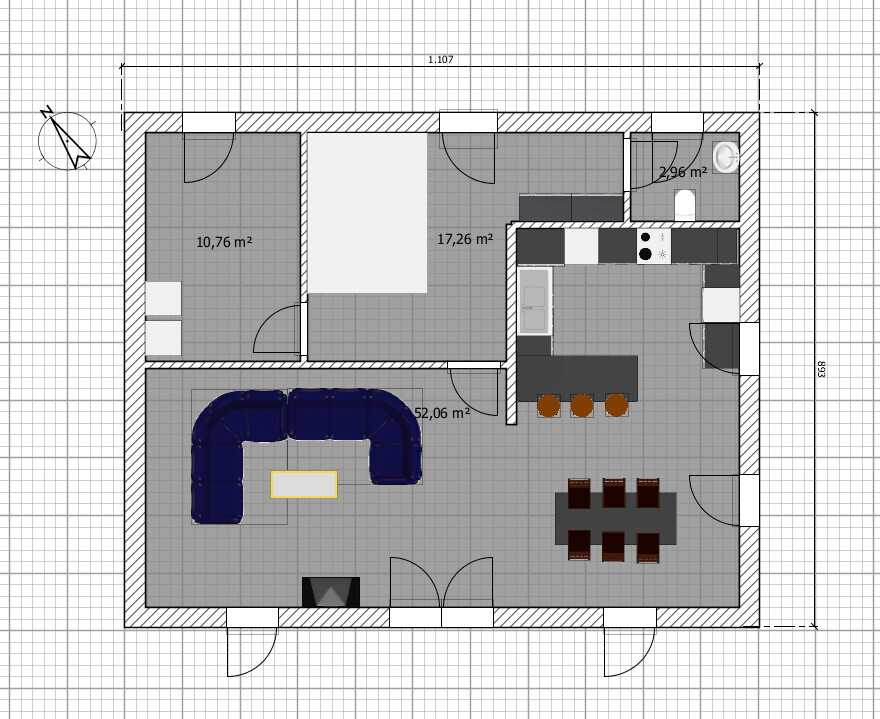
Explanations:
The stairs are a half-landing staircase, starting roughly in the middle of the room (so the closest to the living room door; unfortunately, my drawing software doesn’t have suitable stair options). Outward-opening windows are fixed glazing. Except for one kitchen window and the windows in the utility room and bathroom, all windows and doors are floor-to-ceiling.
Function of the countertop according to my wife: If you have breakfast alone and want a quick coffee or when cooking and wanting to sit to peel or similar tasks, and of course for the visual and dividing effect while still being open to the dining area.
When we invite more guests, it’s clear whether we are inside or outside. If we stay inside that day, we would extend the dining table and move it toward the terrace doors (which won’t be used on that day). I forgot to draw cabinets, possible locations could be the bottom left and right corners or between the kitchen and dining area.
Regarding the front door swing: shoes should be placed under the staircase landing. This area is right at the entrance of the house. Oh, and the stairs will have a window as well (likely fixed glazing), which I also forgot to draw.
The door between the hallway and living area is intended to be left open permanently. Only if someone needs to use the bathroom can they close both doors behind them. That was my wife’s concern—if everything is open, bathroom noises might reach the living room.
The utility room is for various purposes, including hanging laundry, occasional ironing (rarely), storage space, and some gardening supplies.
Initially, we are three people living on the 150 sqm (1,615 sq ft). A second child will come later. I don’t expect any space problems in the next few years. When the time comes, we can decide on attic conversion or garage. Space for the garage remains reserved. The attic will be constructed so that there are no structural problems with future conversion, but that expansion is not necessary yet with three people on 150 sqm (1,615 sq ft).
Explanations:
The stairs are a half-landing staircase, starting roughly in the middle of the room (so the closest to the living room door; unfortunately, my drawing software doesn’t have suitable stair options). Outward-opening windows are fixed glazing. Except for one kitchen window and the windows in the utility room and bathroom, all windows and doors are floor-to-ceiling.
Function of the countertop according to my wife: If you have breakfast alone and want a quick coffee or when cooking and wanting to sit to peel or similar tasks, and of course for the visual and dividing effect while still being open to the dining area.
When we invite more guests, it’s clear whether we are inside or outside. If we stay inside that day, we would extend the dining table and move it toward the terrace doors (which won’t be used on that day). I forgot to draw cabinets, possible locations could be the bottom left and right corners or between the kitchen and dining area.
Regarding the front door swing: shoes should be placed under the staircase landing. This area is right at the entrance of the house. Oh, and the stairs will have a window as well (likely fixed glazing), which I also forgot to draw.
The door between the hallway and living area is intended to be left open permanently. Only if someone needs to use the bathroom can they close both doors behind them. That was my wife’s concern—if everything is open, bathroom noises might reach the living room.
The utility room is for various purposes, including hanging laundry, occasional ironing (rarely), storage space, and some gardening supplies.
Initially, we are three people living on the 150 sqm (1,615 sq ft). A second child will come later. I don’t expect any space problems in the next few years. When the time comes, we can decide on attic conversion or garage. Space for the garage remains reserved. The attic will be constructed so that there are no structural problems with future conversion, but that expansion is not necessary yet with three people on 150 sqm (1,615 sq ft).
No, honestly. We don’t want a door between the kitchen and the hallway. Today, I looked at quite a few pictures of open kitchens, and when there is still a door, it just looks awful. Maybe an architect can explain it better, but having two openings in one space somehow makes it feel uncomfortable. It feels like you are standing in a passage room—which it actually is.
In our current apartment, you also have to go through the living room from the kitchen to get to the hallway, and that works great. So please just ignore the supposedly missing door and focus on the rest, or even better, see the absence of the door as a positive feature.
In our current apartment, you also have to go through the living room from the kitchen to get to the hallway, and that works great. So please just ignore the supposedly missing door and focus on the rest, or even better, see the absence of the door as a positive feature.
Grym schrieb:
It feels like standing in a walkthrough room. Which it actually is....but not if you have a room divider counter. Smart one!
Now it’s more like a confined space!
So the kitchen isn’t fully accessible either when your prep cook or breakfast kid is sitting at the counter.
Edit: You’re turning your living room into a passageway and making the kitchen dependent on the living area.
The kitchen wouldn’t be a walkthrough room since the living room has a separate door to the hallway.
Similar topics