
Hello
we are planning a new semi-detached house.
We want to install a photovoltaic system later on.
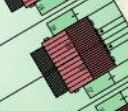
We will get the right half shown in the photo. Orientation is southwest.
The photovoltaic system will of course be installed on the southwest side facing the garden.
The black area is the 3x5 m (10x16 ft) terrace, which will later be covered with a fixed terrace roof measuring 4 m (13 ft) deep and 5.5 m (18 ft) wide.
My question is whether it will still be possible to install a photovoltaic system on the roof once the fixed terrace roof is there?
If the terrace roof is on the southwest side in the garden, it will no longer be possible to set up scaffolding.
For maintenance or in case of problems, access to the photovoltaic system will be necessary later on (is access without scaffolding not possible?)
Or can the photovoltaic system be installed without scaffolding?
The house will have a gable roof and 2.5 full stories.
we are planning a new semi-detached house.
We want to install a photovoltaic system later on.
We will get the right half shown in the photo. Orientation is southwest.
The photovoltaic system will of course be installed on the southwest side facing the garden.
The black area is the 3x5 m (10x16 ft) terrace, which will later be covered with a fixed terrace roof measuring 4 m (13 ft) deep and 5.5 m (18 ft) wide.
My question is whether it will still be possible to install a photovoltaic system on the roof once the fixed terrace roof is there?
If the terrace roof is on the southwest side in the garden, it will no longer be possible to set up scaffolding.
For maintenance or in case of problems, access to the photovoltaic system will be necessary later on (is access without scaffolding not possible?)
Or can the photovoltaic system be installed without scaffolding?
The house will have a gable roof and 2.5 full stories.
H
hampshire16 Sep 2021 23:06Deliverer schrieb:
How do you save those 10 tons of CO2 per year? The expression "saving CO2" sounds a bit odd. What exactly are you "saving" there? It's enough to say "reduced consumption." I can convince myself as a forest owner—however, the forest would store CO2 anyway as long as it remains standing, even if it is not under my ownership. I can tell myself that refraining from intensive management is a contribution. Sometimes I do that. 😉 I am still looking for about 10 hectares (25 acres) of contiguous deciduous forest in the Bergisches Land region to leave standing and take out of management. Maybe someone has a tip for me.
D
Deliverer17 Sep 2021 07:37hampshire schrieb:
The phrase "saving CO2" sounds a bit odd. Every kilowatt-hour produced means it doesn’t have to be generated from fossil fuels. The average kilowatt-hour in Germany has a carbon footprint of 440g (0.97 lbs) of CO2. Although this will decrease as renewable energy expands, right now I am reducing Germany’s carbon footprint by about the equivalent of two gas heating systems. And anyone with a roof can do the same! Plus, you even get paid for it!! How amazing is that?!?! :-) KingJulien17 Sep 2021 07:49
Deliverer schrieb:
Photovoltaic systems pay off after 11 to 12 years.That seems a bit too general to me. It definitely depends on certain conditions. For a turnkey, medium-sized system planned now and still receiving a maximum feed-in tariff of around 7.xx cents, probably not.D
Deliverer17 Sep 2021 08:30If I had written, "a photovoltaic system pays for itself in 8-18 years," would that have been better? ;-)
So: of course, as with any purchase, you should do some research beforehand to avoid the usual pitfalls.
I’ll address your terms directly:
Turnkey: That’s what I meant. If you build it yourself, the system pays for itself in two-thirds of the time.
Standard size: A system is considered standard size when all roof surfaces (house, garage, carport) are fully used, except if it faces fully north and is steeper than 25°. Standard size is not what a solar installer recommends. They are often lazy and prefer to spend less time on the roof so they can serve more customers with battery systems...
And yes – if you can only fit 5 kWp on a mid-terrace house roof, the payback period shifts further out, possibly becoming uneconomical. These roofs will then need a new roofing before installation is feasible.
Feed-in tariff / export tariff: Once you receive your offer, you can calculate if it’s good. Determine the yield (yourself), multiply it by the feed-in tariff, and then by 20. If the offer is below that, it’s good. If not, it’s bad. The rest depends on self-consumption.
If you do it this way, 11-12 years is a good average payback time. After that, you gain 8 years of ash (savings?) and another 18 years of cheap self-generated electricity.
You can optimize further by removing solar thermal systems and chimneys. Heat pumps will be needed in a few years anyway and are currently heavily subsidized. Also, heat pumps increase self-consumption and shift the payback period forward.
Two more notes:
- A battery storage system does not pay for itself. So exclude it from calculations (and preferably from the order).
- "No roof" is an excuse, "no money" is not. KFW loans are available at 1% interest. Most banks offer even better deals because the installments are legally guaranteed to come from the energy provider. So this is a very low-risk loan that anyone should be able to get after speaking with their banker.
So: of course, as with any purchase, you should do some research beforehand to avoid the usual pitfalls.
I’ll address your terms directly:
Turnkey: That’s what I meant. If you build it yourself, the system pays for itself in two-thirds of the time.
Standard size: A system is considered standard size when all roof surfaces (house, garage, carport) are fully used, except if it faces fully north and is steeper than 25°. Standard size is not what a solar installer recommends. They are often lazy and prefer to spend less time on the roof so they can serve more customers with battery systems...
And yes – if you can only fit 5 kWp on a mid-terrace house roof, the payback period shifts further out, possibly becoming uneconomical. These roofs will then need a new roofing before installation is feasible.
Feed-in tariff / export tariff: Once you receive your offer, you can calculate if it’s good. Determine the yield (yourself), multiply it by the feed-in tariff, and then by 20. If the offer is below that, it’s good. If not, it’s bad. The rest depends on self-consumption.
If you do it this way, 11-12 years is a good average payback time. After that, you gain 8 years of ash (savings?) and another 18 years of cheap self-generated electricity.
You can optimize further by removing solar thermal systems and chimneys. Heat pumps will be needed in a few years anyway and are currently heavily subsidized. Also, heat pumps increase self-consumption and shift the payback period forward.
Two more notes:
- A battery storage system does not pay for itself. So exclude it from calculations (and preferably from the order).
- "No roof" is an excuse, "no money" is not. KFW loans are available at 1% interest. Most banks offer even better deals because the installments are legally guaranteed to come from the energy provider. So this is a very low-risk loan that anyone should be able to get after speaking with their banker.
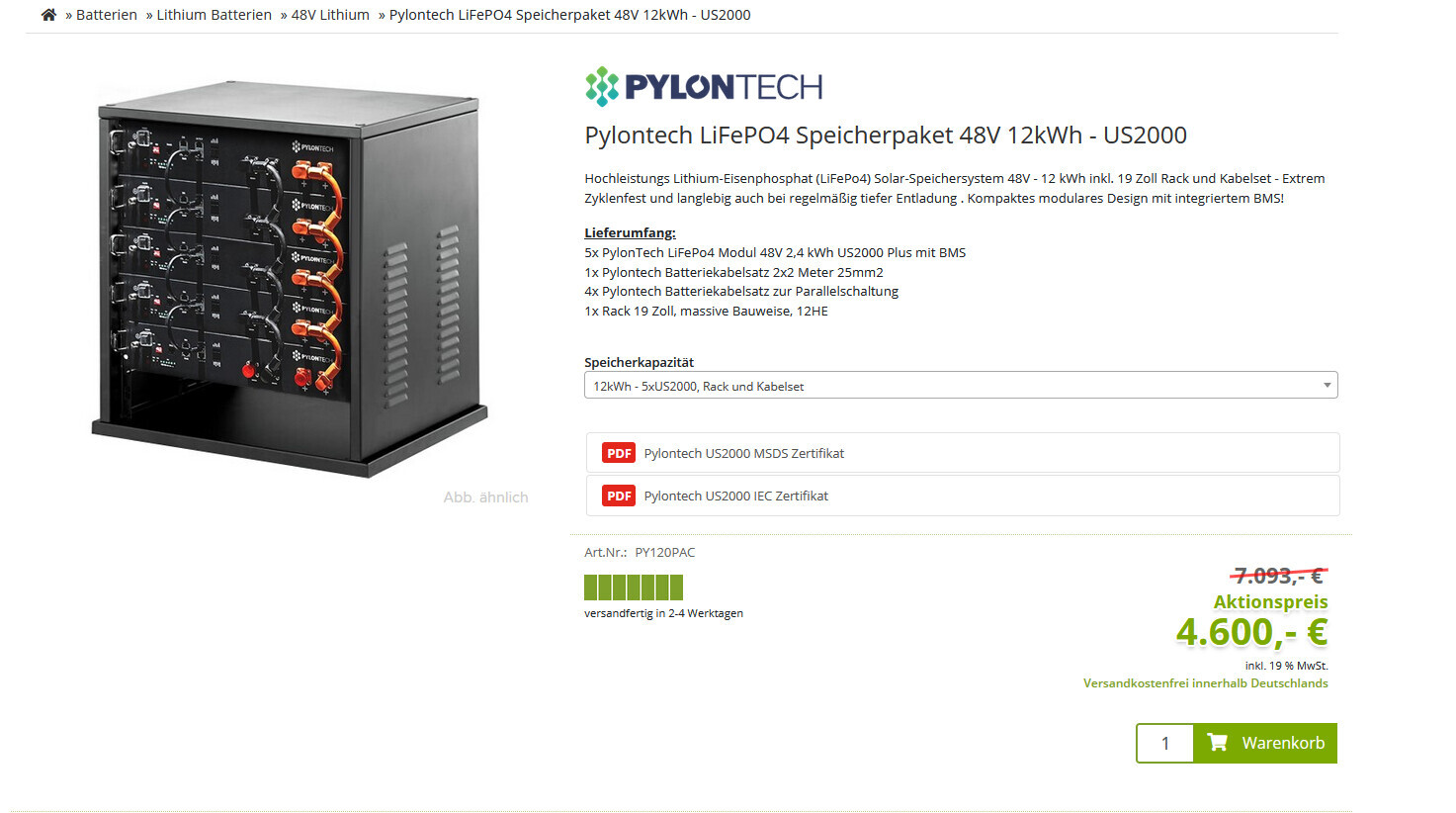
We are installing a 13.29 kWp photovoltaic system. Now the question is whether a storage system without subsidies is worthwhile. I searched online for storage options myself and came across this one. The price looks very good. The questions are always:
a) Will the photovoltaic installer also install it?
b) How reliable is it really?
Luckily, it will take about 10 months until completion here. Hopefully, by then, a new storage subsidy will be available in Brandenburg.
a) Will the photovoltaic installer also install it?
b) How reliable is it really?
Luckily, it will take about 10 months until completion here. Hopefully, by then, a new storage subsidy will be available in Brandenburg.
D
Deliverer17 Sep 2021 08:49@Tom1978 If you get below €250 per kWh (about $270 per kWh), have three times more photovoltaic capacity than storage, and can almost always fully discharge the storage overnight, it should be cost-effective.
A small addition to my earlier comment: Please be very, very careful with cloud tariffs and do some research beforehand. Most tariffs are already unfavorable from the start. The main problem is that people base their 20-year calculations on them. Currently, one of the largest providers is canceling all their "good" contracts, which is ruining the calculations for thousands of customers who were previously sold an extremely expensive large storage system as a condition of the cloud contract...
A small addition to my earlier comment: Please be very, very careful with cloud tariffs and do some research beforehand. Most tariffs are already unfavorable from the start. The main problem is that people base their 20-year calculations on them. Currently, one of the largest providers is canceling all their "good" contracts, which is ruining the calculations for thousands of customers who were previously sold an extremely expensive large storage system as a condition of the cloud contract...
Similar topics