
Hello everyone,
I hope I’m posting this question in the right forum. For some time now, I have suspected that photovoltaic (PV) systems are more of a way to preserve money relatively safely rather than being as profitable as often claimed. Since I am currently considering installing such a system myself, I’ve run some calculations. Maybe there are errors that you can point out. Because if this is really how it looks, I don’t quite understand the photovoltaic craze...
I based my calculation on an investment of 30,000 euros. That’s a significant amount, but it can be replaced by any other sum.
As an average price including installation, I found values of about 3,500 euros per module with an annual output of 1,000 kWh in Germany. I assumed that 20% of the electricity is self-consumed and 80% is fed into the grid. For the self-consumed electricity, I initially calculated a savings of 25 cents per kWh, increasing annually by 1.5% (as electricity prices rise, the savings increase). For the electricity fed into the grid, I also initially assumed 25 cents per kWh, with an annual increase of 1.5%. Is that actually realistic? If not, the outlook looks quite bleak! Furthermore, I assumed repair costs of about 5,000 euros every 15 years, for example, for a new inverter.
I compared this to a) financing costs of 2.5% and b) an alternative investment with an average interest rate of 1.5% over the next 30 years. The result looks like this (displayed small, just click to enlarge):
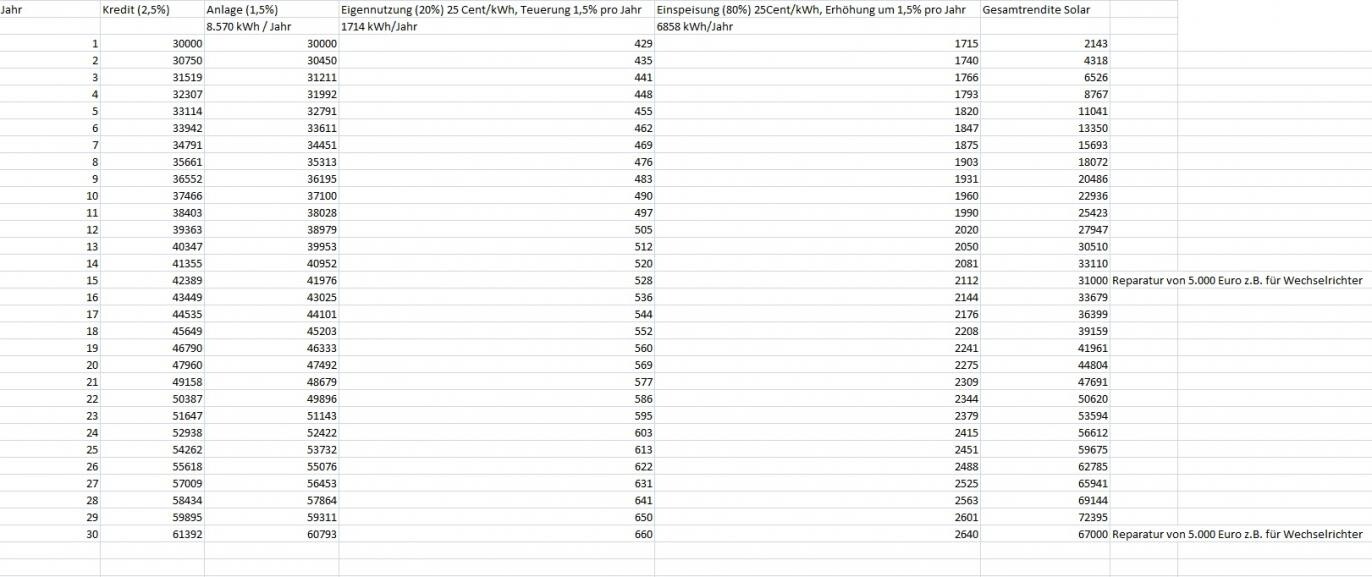
Conclusion: After 30 years, the photovoltaic system results in a profit of 6,000 to 7,000 euros, assuming everything goes normally. However, this only holds if the annual compensation (feed-in tariff / payment for fed electricity) increases by 1.5% every year and the average interest rate for alternative investments remains at only 1.5% (!) over the next 30 years. Therefore, I interpret this as meaning that this investment is quite questionable for me...
Where are the errors in my financial planning???
I hope I’m posting this question in the right forum. For some time now, I have suspected that photovoltaic (PV) systems are more of a way to preserve money relatively safely rather than being as profitable as often claimed. Since I am currently considering installing such a system myself, I’ve run some calculations. Maybe there are errors that you can point out. Because if this is really how it looks, I don’t quite understand the photovoltaic craze...
I based my calculation on an investment of 30,000 euros. That’s a significant amount, but it can be replaced by any other sum.
As an average price including installation, I found values of about 3,500 euros per module with an annual output of 1,000 kWh in Germany. I assumed that 20% of the electricity is self-consumed and 80% is fed into the grid. For the self-consumed electricity, I initially calculated a savings of 25 cents per kWh, increasing annually by 1.5% (as electricity prices rise, the savings increase). For the electricity fed into the grid, I also initially assumed 25 cents per kWh, with an annual increase of 1.5%. Is that actually realistic? If not, the outlook looks quite bleak! Furthermore, I assumed repair costs of about 5,000 euros every 15 years, for example, for a new inverter.
I compared this to a) financing costs of 2.5% and b) an alternative investment with an average interest rate of 1.5% over the next 30 years. The result looks like this (displayed small, just click to enlarge):
Conclusion: After 30 years, the photovoltaic system results in a profit of 6,000 to 7,000 euros, assuming everything goes normally. However, this only holds if the annual compensation (feed-in tariff / payment for fed electricity) increases by 1.5% every year and the average interest rate for alternative investments remains at only 1.5% (!) over the next 30 years. Therefore, I interpret this as meaning that this investment is quite questionable for me...
Where are the errors in my financial planning???
M
Micha&Dany7 Apr 2013 09:09Hello Orion,
Your calculation is unfortunately completely wrong.
(1) The system price for single-family house roofs (3-10 kWp) should currently be around 1300 - 1800 Euros per kWp. This means that if I assume a system with 5 kWp, the investment is approximately 7000 - 9000 Euros. The trend is downward.
(2) For the electricity you feed into the grid, you receive a fixed price per kWh (feed-in tariff). This price is set by the Renewable Energy Act. The feed-in tariff is guaranteed for exactly 20 years (+ the year of commissioning) and will not change during this period. The amount of the feed-in tariff depends on the day of commissioning. Currently, the tariff is about 17.x cents per kWh, but it decreases slightly every month depending on the overall expansion of photovoltaic systems nationwide (so-called "breathing cap").
(3) The electricity you consume yourself replaces purchased electricity – meaning the "profit" from the photovoltaic system is exactly the amount you don’t have to pay for electricity. My current electricity price is about 22 cents per kWh, with an upward trend.
(4) The amount of electricity generated mainly depends on the location. Here in the Ruhr area, you can expect around 850 kWh/(kWp*year), while in southern Germany, depending on location, values can be up to 1200 kWh/(kWp*year). That means the assumed photovoltaic system with 5 kWp generates about 5000 kWh annually at an average location in southern Germany (assumed 1000 kWh/(kWp*year)).
With full feed-in to the grid (assumed 17 cents), this brings in 850 Euros income per year. Over 20 years, that’s 17,000 Euros income with full feed-in.
With partial self-consumption, correspondingly more.
(5) Yes, you have to assume that the inverter will need to be replaced once within the 20 years. Furthermore, it depends on the quality of the installed modules how much they degrade over 20 years or not. Generally, a depreciation of 1 - 1.5% per year is assumed.
(6) Even after the subsidy expires after 20 years, the system does not immediately come off the roof – so at least part of the electricity can still be used yourself, even if you no longer receive money for the electricity fed into the grid.
(7) I am currently quite skeptical about increasing the self-consumption rate through storage of self-generated energy (batteries). On the one hand, batteries are still quite expensive, on the other hand, I have serious doubts about their longevity. But most importantly, the installation site must be considered carefully. Current conventional battery technologies have significant disadvantages. Lead batteries can emit gas – suddenly you have an explosion hazard in your basement! Lithium batteries cannot be extinguished in case of fire...
Installing batteries outdoors is also not that simple, because all battery technologies react strongly to temperature fluctuations. Ideally, you would have to place the batteries outside the house in a well-ventilated building that maintains a constant temperature throughout the year...
But even then you still have the problem that you have DC cables running through the house to the batteries. This is a problem for firefighters in case of fire! So you would also need to install an emergency fire switch to completely disconnect the DC cables.
All this increases the investment for batteries so much that storage currently is not economically viable.
Probably this will look different in 5-10 years – but at the moment I would advise against it!
So, I hope I was able to answer some of your questions.
Best regards
Micha
Your calculation is unfortunately completely wrong.
(1) The system price for single-family house roofs (3-10 kWp) should currently be around 1300 - 1800 Euros per kWp. This means that if I assume a system with 5 kWp, the investment is approximately 7000 - 9000 Euros. The trend is downward.
(2) For the electricity you feed into the grid, you receive a fixed price per kWh (feed-in tariff). This price is set by the Renewable Energy Act. The feed-in tariff is guaranteed for exactly 20 years (+ the year of commissioning) and will not change during this period. The amount of the feed-in tariff depends on the day of commissioning. Currently, the tariff is about 17.x cents per kWh, but it decreases slightly every month depending on the overall expansion of photovoltaic systems nationwide (so-called "breathing cap").
(3) The electricity you consume yourself replaces purchased electricity – meaning the "profit" from the photovoltaic system is exactly the amount you don’t have to pay for electricity. My current electricity price is about 22 cents per kWh, with an upward trend.
(4) The amount of electricity generated mainly depends on the location. Here in the Ruhr area, you can expect around 850 kWh/(kWp*year), while in southern Germany, depending on location, values can be up to 1200 kWh/(kWp*year). That means the assumed photovoltaic system with 5 kWp generates about 5000 kWh annually at an average location in southern Germany (assumed 1000 kWh/(kWp*year)).
With full feed-in to the grid (assumed 17 cents), this brings in 850 Euros income per year. Over 20 years, that’s 17,000 Euros income with full feed-in.
With partial self-consumption, correspondingly more.
(5) Yes, you have to assume that the inverter will need to be replaced once within the 20 years. Furthermore, it depends on the quality of the installed modules how much they degrade over 20 years or not. Generally, a depreciation of 1 - 1.5% per year is assumed.
(6) Even after the subsidy expires after 20 years, the system does not immediately come off the roof – so at least part of the electricity can still be used yourself, even if you no longer receive money for the electricity fed into the grid.
(7) I am currently quite skeptical about increasing the self-consumption rate through storage of self-generated energy (batteries). On the one hand, batteries are still quite expensive, on the other hand, I have serious doubts about their longevity. But most importantly, the installation site must be considered carefully. Current conventional battery technologies have significant disadvantages. Lead batteries can emit gas – suddenly you have an explosion hazard in your basement! Lithium batteries cannot be extinguished in case of fire...
Installing batteries outdoors is also not that simple, because all battery technologies react strongly to temperature fluctuations. Ideally, you would have to place the batteries outside the house in a well-ventilated building that maintains a constant temperature throughout the year...
But even then you still have the problem that you have DC cables running through the house to the batteries. This is a problem for firefighters in case of fire! So you would also need to install an emergency fire switch to completely disconnect the DC cables.
All this increases the investment for batteries so much that storage currently is not economically viable.
Probably this will look different in 5-10 years – but at the moment I would advise against it!
So, I hope I was able to answer some of your questions.
Best regards
Micha
Hello Michael,
I actually calculated most of the points the same way. Regarding the points:
(1) I based my calculations on researched values. If I get more output for the price, that speaks in favor of photovoltaic systems.
(2) I used the same calculation in my second estimate, but with 16 cents.
(3) I also calculated it the same way, with 10% self-consumption at 25 cents.
(4) Per kWp, I also assumed an average of 1000 kWh, just like you. So the values match.
(5) In the second calculation, I used exactly 1.5% provision per year.
(6) In the calculation, as you said, I also projected beyond 20 years. Of course, I don’t know what support or subsidies will look like then (if they even still exist). But what good is a system producing 5000 kWh if I only need 2000 kWh per year? I find it hard to justify covering the cost for the surplus and feeding it into the grid if I don’t get compensated.
(7) I agree with that as well.
(7)
I actually calculated most of the points the same way. Regarding the points:
(1) I based my calculations on researched values. If I get more output for the price, that speaks in favor of photovoltaic systems.
(2) I used the same calculation in my second estimate, but with 16 cents.
(3) I also calculated it the same way, with 10% self-consumption at 25 cents.
(4) Per kWp, I also assumed an average of 1000 kWh, just like you. So the values match.
(5) In the second calculation, I used exactly 1.5% provision per year.
(6) In the calculation, as you said, I also projected beyond 20 years. Of course, I don’t know what support or subsidies will look like then (if they even still exist). But what good is a system producing 5000 kWh if I only need 2000 kWh per year? I find it hard to justify covering the cost for the surplus and feeding it into the grid if I don’t get compensated.
(7) I agree with that as well.
(7)
Orion schrieb:
Hello Michael,
actually, I calculated most points the same way. Regarding the points:
(1) I based it on researched values. If I get more output for the price, that speaks in favor of photovoltaics.
(2) I calculated it the same way in my second calculation, but with 16 cents.
(3) I also calculated it the same way, 10% self-consumption at 25 cents.
(4) Per kWp, I also calculated an average of 1000 kWh. So the values match.
(5) In the second calculation, I used exactly 1.5% reserve per year.
(6) As you said, I continued calculating beyond 20 years. Of course, I don’t know what subsidies will look like then (if they even still exist). But what use is a system with an output of 5000 kWh if I only need 2000 kWh per year? I don’t really see why I should cover the rest myself and feed it into the grid if I don’t get anything for it.
(7) I agree with that
(7)1.) This is exactly where your calculation error lies. For 30,000 EUR you get 22-24 kWp, which means 22,000-24,000 kWh per year—that’s 3,300-3,600 EUR per year x 10 years equals 33,000 or 36,000 EUR. So the system pays for itself after 10 years, even with a loan. And here, I haven’t even factored in the avoided down payment. Regarding point 5) You replace the inverter only if necessary; corresponding inverter costs are currently around 3,000 EUR, and after 10 years there probably won’t be an additional replacement. So choose an inverter with a 10-year warranty. Please upload a photo of the roof and the roof dimensions.
M
Micha&Dany8 Apr 2013 05:56Hello Orion,
Your second calculation somehow slipped past me.
However, something doesn’t quite add up – but I’m not in the mood to double-check the numbers now…
Firstly, as b0012sm rightly pointed out, for an investment of 30,000 Euros you really get over 20 kWp. My estimate of 1300 - 1800 Euros was for systems under 10 kWp. For systems over 10 MWp, the current price is around 1100 - 1200 Euros per kWp. Systems around 30 kWp are naturally priced somewhere in between.
Secondly, from my experience, equity returns in photovoltaics have been normally around 6-8% for years and are relatively easy to achieve. Occasionally, there were periods when realistic equity returns of 15-18% were no problem (due to sharply reduced system prices and strong government incentives). In Germany, for example, this was the case in the first half of 2009. Returns were still in the double digits in 2010. Since then, the balance between prices and subsidies has settled down fairly solidly. I’m curious to see what happens after the next federal election…
Regarding self-consumption, you need to be very precise about *when* and how much electricity you actually use. In a single-family house where all residents are at work during the day, you will probably only achieve a very low self-consumption rate. Whether 10% is possible, I don’t know – but it seems quite ambitious “off the cuff.” If you have (small) children at home from midday – or older children who turn on the TV and PC after school – naturally, a higher rate is achievable. If one of you has a home office and works from home every day, even better.
Best regards,
Micha
Your second calculation somehow slipped past me.
However, something doesn’t quite add up – but I’m not in the mood to double-check the numbers now…
Firstly, as b0012sm rightly pointed out, for an investment of 30,000 Euros you really get over 20 kWp. My estimate of 1300 - 1800 Euros was for systems under 10 kWp. For systems over 10 MWp, the current price is around 1100 - 1200 Euros per kWp. Systems around 30 kWp are naturally priced somewhere in between.
Secondly, from my experience, equity returns in photovoltaics have been normally around 6-8% for years and are relatively easy to achieve. Occasionally, there were periods when realistic equity returns of 15-18% were no problem (due to sharply reduced system prices and strong government incentives). In Germany, for example, this was the case in the first half of 2009. Returns were still in the double digits in 2010. Since then, the balance between prices and subsidies has settled down fairly solidly. I’m curious to see what happens after the next federal election…
Regarding self-consumption, you need to be very precise about *when* and how much electricity you actually use. In a single-family house where all residents are at work during the day, you will probably only achieve a very low self-consumption rate. Whether 10% is possible, I don’t know – but it seems quite ambitious “off the cuff.” If you have (small) children at home from midday – or older children who turn on the TV and PC after school – naturally, a higher rate is achievable. If one of you has a home office and works from home every day, even better.
Best regards,
Micha
You are planning to spend a huge amount of money. Have a professional calculate everything for you, including site evaluation and analysis. By the way, self-consumption is not explicitly stated anywhere but refers to the amount of energy you use directly from your own system. Therefore, you don’t need to do many calculations here because if the system is running at full capacity, you won’t use all of the energy yourself, and at night when you need electricity, the system isn’t producing anything.
Self-consumption also implies close physical proximity between your consumers and the system. Do you have enough space on your roof for such a large system?
By the way: Module prices are currently rising because imported modules have to pay an additional tariff, and German-made modules are almost sold out.
Self-consumption also implies close physical proximity between your consumers and the system. Do you have enough space on your roof for such a large system?
By the way: Module prices are currently rising because imported modules have to pay an additional tariff, and German-made modules are almost sold out.
Hello everyone,
Okay, then the numbers I found were probably extremely outdated (regarding performance). If the basic assumption is incorrect, of course the entire calculation is wrong. If I get around 23 kWp for 30,000 euros, my return after 20 years would be about 70,000 euros compared to 50,000 euros from an investment. Or put differently: If I finance this, it would bring me approximately 70,000 - 50,000 = 20,000 euros "profit" in 20 years, which is 1,000 euros per year, or roughly 80 euros per month. By the way, the 30,000 euros were just an example calculation. I probably wouldn’t even have that much space on my roof...
Okay, then the numbers I found were probably extremely outdated (regarding performance). If the basic assumption is incorrect, of course the entire calculation is wrong. If I get around 23 kWp for 30,000 euros, my return after 20 years would be about 70,000 euros compared to 50,000 euros from an investment. Or put differently: If I finance this, it would bring me approximately 70,000 - 50,000 = 20,000 euros "profit" in 20 years, which is 1,000 euros per year, or roughly 80 euros per month. By the way, the 30,000 euros were just an example calculation. I probably wouldn’t even have that much space on my roof...
Similar topics