
ᐅ Number of required recessed lights (halogen) and which types?
Created on: 18 Mar 2020 14:31
M
ms-t-89Hello everyone,
we need some help planning the recessed downlights for our ground floor.
We’re not quite sure how many are necessary and how they should be arranged to achieve "proper" lighting conditions—not too bright, not too dark. The entire ground floor is to be fitted with recessed downlights, no pendant lights or similar fixtures, so no additional lamps.
We can only install the Halox housings into the ceiling; we have to purchase the bulbs and other components ourselves. So far, we don’t have any suggestions on this. Any tips would be much appreciated.
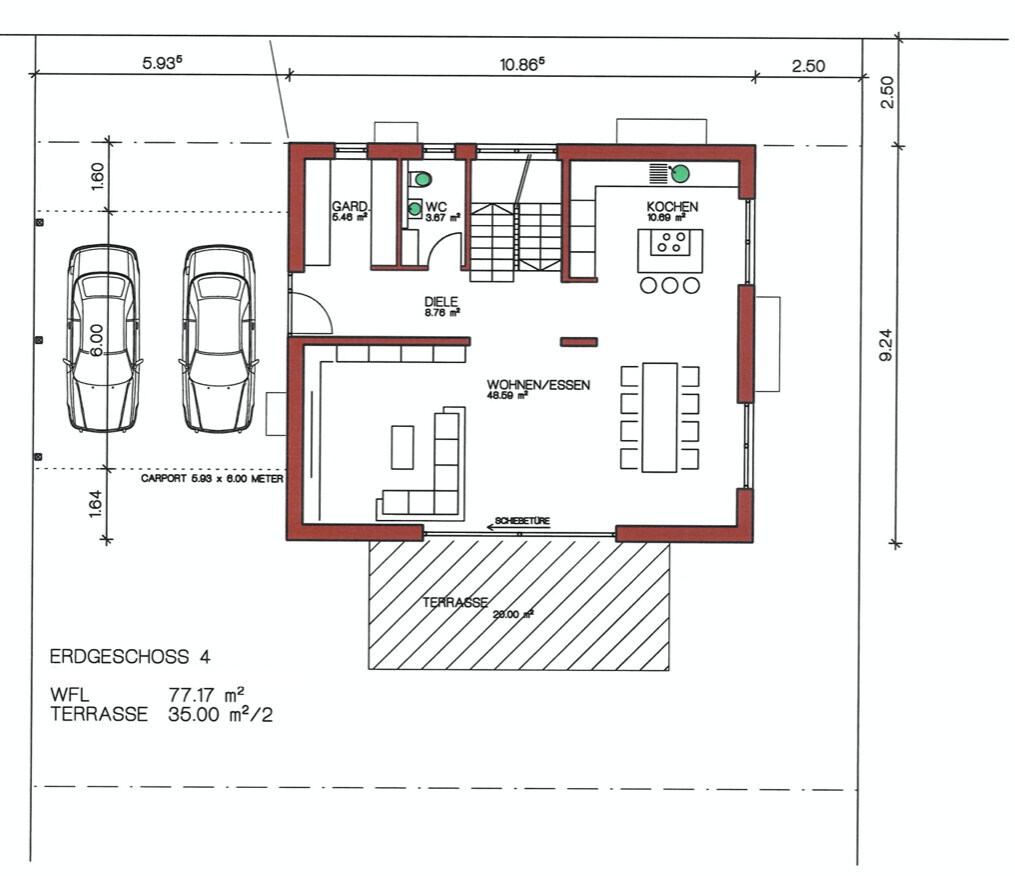
we need some help planning the recessed downlights for our ground floor.
We’re not quite sure how many are necessary and how they should be arranged to achieve "proper" lighting conditions—not too bright, not too dark. The entire ground floor is to be fitted with recessed downlights, no pendant lights or similar fixtures, so no additional lamps.
We can only install the Halox housings into the ceiling; we have to purchase the bulbs and other components ourselves. So far, we don’t have any suggestions on this. Any tips would be much appreciated.
A
Alessandro18 Mar 2020 14:42If you are working exclusively with recessed spotlights, I would recommend consulting a lighting designer. They can simulate the lighting setup. It costs around 500-700 euros, depending on the size of the project. You will regret it a lot if you forget something here or if the ceiling ends up looking like it has been shot with a nail gun.
Make sure the electrician does not cut the holes for the halogen fixtures larger than a diameter of 7cm (2.8 inches). Otherwise, your choice of spotlights will be very limited.
Make sure the electrician does not cut the holes for the halogen fixtures larger than a diameter of 7cm (2.8 inches). Otherwise, your choice of spotlights will be very limited.

It is important to decide in advance which recessed spotlights you want to use—most likely not pinpoint spots but rather ones that provide broad illumination—because this determines where and how many mounting boxes you should plan for. If you choose simple recessed frames with GU10 bulbs, you will generally need (significantly) more than with high-quality models, as the latter simply have more power.
As a rough guideline: In a similar living/dining area, we have four spotlights above the dining table and four above the sofa/coffee table, which can each be controlled in groups of two. At the lowest dimming level, the lighting creates a comfortable ambient light, and at full power, it is intensely bright. I would probably add three more in the hallway and one each in the cloakroom and the restroom. For the kitchen, we did not install recessed spotlights, so that the light source is set lower and can also be better directed. However, there are a total of eight lights plus under-cabinet lights on the wall units.
If you have no plan at all and don’t want to spend some time learning the basics (luminous flux, brightness, beam angle, ceiling height, visual planning, etc.), consulting a lighting designer might be the best option.
Best regards
K1300S
As a rough guideline: In a similar living/dining area, we have four spotlights above the dining table and four above the sofa/coffee table, which can each be controlled in groups of two. At the lowest dimming level, the lighting creates a comfortable ambient light, and at full power, it is intensely bright. I would probably add three more in the hallway and one each in the cloakroom and the restroom. For the kitchen, we did not install recessed spotlights, so that the light source is set lower and can also be better directed. However, there are a total of eight lights plus under-cabinet lights on the wall units.
If you have no plan at all and don’t want to spend some time learning the basics (luminous flux, brightness, beam angle, ceiling height, visual planning, etc.), consulting a lighting designer might be the best option.
Best regards
K1300S
ms-t-89 schrieb:
We only get the Halox housings installed in the ceiling; we have to "buy" the light bulbs and everything else ourselves. Hello MS-t-89
Are you getting a prefabricated ceiling or cast-in-place concrete?
For larger rooms, like living rooms, I would always distribute the lighting across 3 switches.
For example, 6 fixtures on each of the longer sides. That makes 12 fixtures in total. Then, 2 more on each of the shorter sides, totaling 16 fixtures. You control those by switching them on and off alternately. In the center, add another row that is switched separately.
I also have 3 fixtures in front of the window, controlled by another separate switch. These are fitted with 3-watt bulbs that give off a slightly bluish light. It’s comfortable when watching TV.
There are endless possibilities to vary this setup.
Steven
A
Alessandro19 Mar 2020 08:26The question I have is whether you want general lighting like standard ceiling lamps and/or accent lighting, which is usually installed about 20-30cm (8-12 inches) away from the wall.
Now it should hopefully become clear how important it is to determine the lighting fixtures. If I have calculated correctly for Steven, there are 21 spotlights planned for the living/dining area. That would simply be overkill for our model – and quite massively so.
One more point: recessed ceiling spotlights are probably intended only for general lighting. This would then be complemented by accent lighting (floor lamp, wall lamp, etc.). Keep this in mind when planning.
One more point: recessed ceiling spotlights are probably intended only for general lighting. This would then be complemented by accent lighting (floor lamp, wall lamp, etc.). Keep this in mind when planning.
Similar topics