
Hi, we had our electrical consultation on Friday to discuss where everything should be installed.
Attached is a plan showing how we planned it with the electrician. Almost all our wishes were included; there were hardly any suggestions for improvement.
In the pictures, the power outlets are marked in orange.
For internet/telephone, we only have 2 lines. He wanted to charge 108€ per outlet for more lines, so we are now doing it ourselves, meaning there will be an internet connection in every room.
Living room: 4-2-4 power outlets plus TV, and 2 plus another 2 outlets.
Hallway: 1 outlet at the front and at the back, plus a telephone connection.
Utility room: besides the appliances themselves, for washing machine and dryer there are 2 individual outlets.
Guest WC: 1 outlet.
Home office: 3 power outlets plus telephone and TV, and 2 times 1 outlet.
Upstairs:
Children’s rooms: 3 outlets plus TV and 2 times 2 outlets.
Dressing room: 2 individual outlets in the middle at the top (for Ikea Pax light). Also, the light switch for the bedroom is in the dressing room... is that a good setup? (Red dot-arrow)
Bedroom: 3 outlets plus TV, and next to the bed, 3 outlets on each side (would it be better to have these lower or slightly higher so they are above the bedside table? Since baby monitors, phones, etc. are plugged in daily.)
Storage room: 2 individual outlets.
Bathroom: 2 outlets on the left side of the vanity wall. Additionally, a ceiling light in front of the shower. Are there any suggestions for improvement here? Should one outlet be left there with a spotlight that shines into the shower, or use that one outlet to install LED spots in the ceiling?
Hallway at the back: 1 outlet.
So, now the pictures follow, which hopefully are clear.
I would appreciate your feedback and suggestions for improvements.
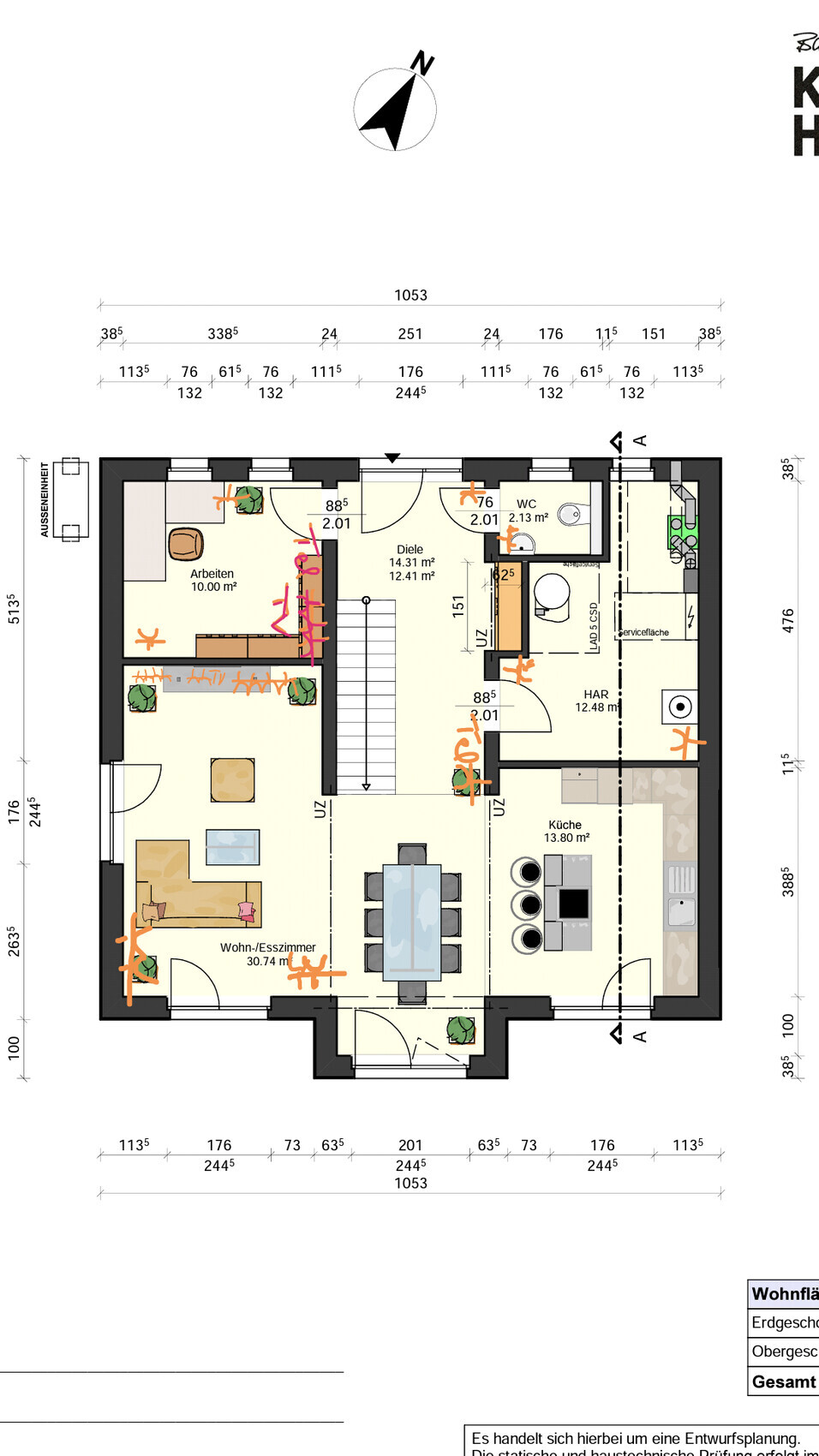
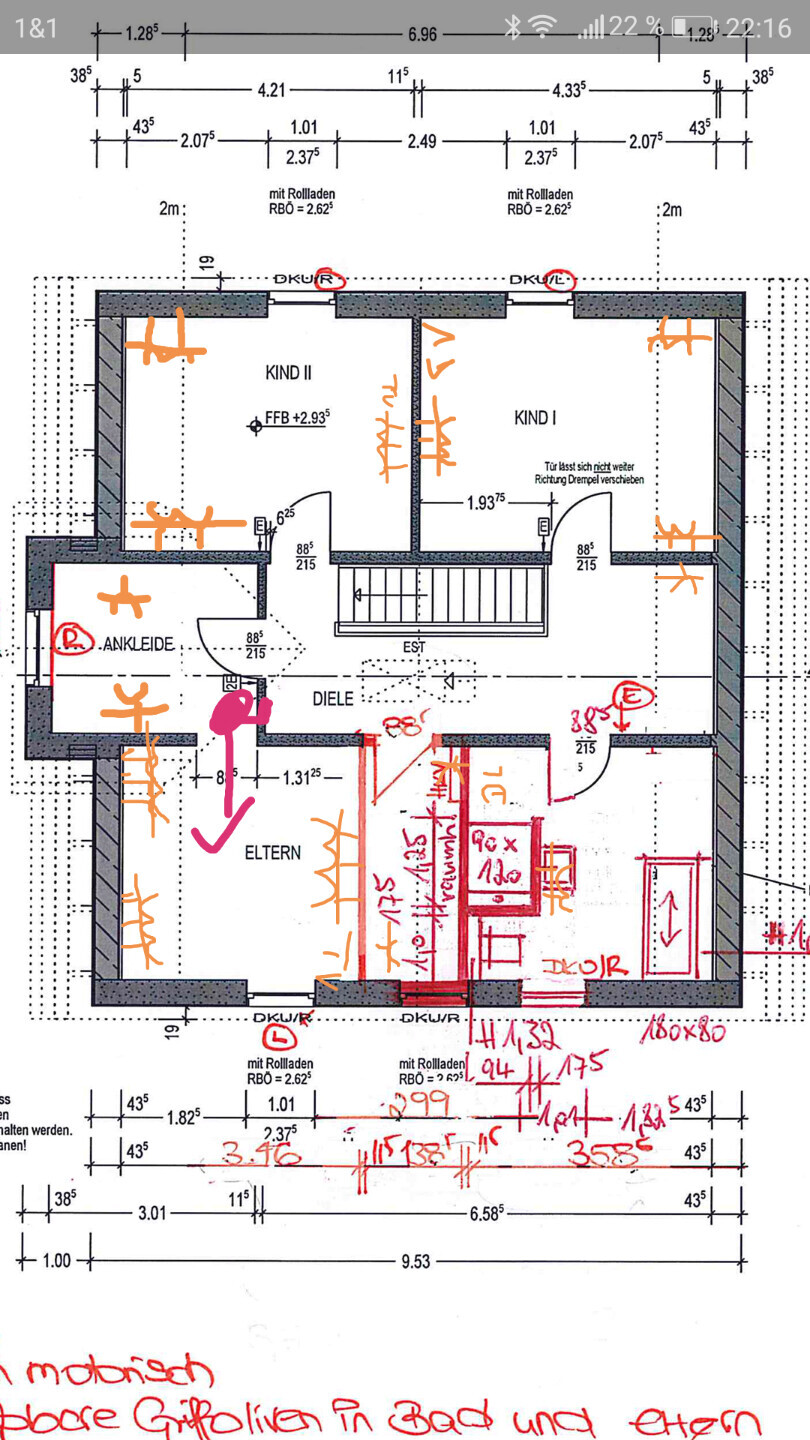
Attached is a plan showing how we planned it with the electrician. Almost all our wishes were included; there were hardly any suggestions for improvement.
In the pictures, the power outlets are marked in orange.
For internet/telephone, we only have 2 lines. He wanted to charge 108€ per outlet for more lines, so we are now doing it ourselves, meaning there will be an internet connection in every room.
Living room: 4-2-4 power outlets plus TV, and 2 plus another 2 outlets.
Hallway: 1 outlet at the front and at the back, plus a telephone connection.
Utility room: besides the appliances themselves, for washing machine and dryer there are 2 individual outlets.
Guest WC: 1 outlet.
Home office: 3 power outlets plus telephone and TV, and 2 times 1 outlet.
Upstairs:
Children’s rooms: 3 outlets plus TV and 2 times 2 outlets.
Dressing room: 2 individual outlets in the middle at the top (for Ikea Pax light). Also, the light switch for the bedroom is in the dressing room... is that a good setup? (Red dot-arrow)
Bedroom: 3 outlets plus TV, and next to the bed, 3 outlets on each side (would it be better to have these lower or slightly higher so they are above the bedside table? Since baby monitors, phones, etc. are plugged in daily.)
Storage room: 2 individual outlets.
Bathroom: 2 outlets on the left side of the vanity wall. Additionally, a ceiling light in front of the shower. Are there any suggestions for improvement here? Should one outlet be left there with a spotlight that shines into the shower, or use that one outlet to install LED spots in the ceiling?
Hallway at the back: 1 outlet.
So, now the pictures follow, which hopefully are clear.
I would appreciate your feedback and suggestions for improvements.

They don’t actually work according to DIN standards, but only follow VDE regulations.
Unfortunately, I can’t find anywhere that it must be an empty conduit and not just a protective pipe, or that it has to be replaceable.
Is it allowed to crush NYY cables?
Yesterday, I emailed an independent expert with these pictures. He is responsible for electrical engineering and installation.
Today, I spoke with him on the phone.
He told me that this does not comply with VDE standards, that we should immediately stop construction and not apply any plaster.
He is apparently also responsible for fire cause investigation for the criminal police and said that just recently he had a case where a house burned down after 22 years, caused by a bent nail during installation.
Another expert also said, based on the pictures, that he did not find it acceptable.
The site manager only says, as long as the electrician approves it and presents some protocols showing everything was measured and is correct, then it’s fine.
And if it’s only about the bent nails, they have nothing to do with the interior plaster.
Oh yes, it does matter because if that is not okay, the entire cable must be replaced, including the part inside the wall up to the outlet box, which is already embedded in plaster.
What about the insulation/jacketing of these NYY cables?
They have a thick, stiff black outer layer, then a thin white “rubber skin,” and then the three wires inside.
Do these cables, including the white or black jacketing, need to extend all the way into the electrical box, or is it sufficient if it ends before the box and only the three wires go into the box, as shown in the picture?

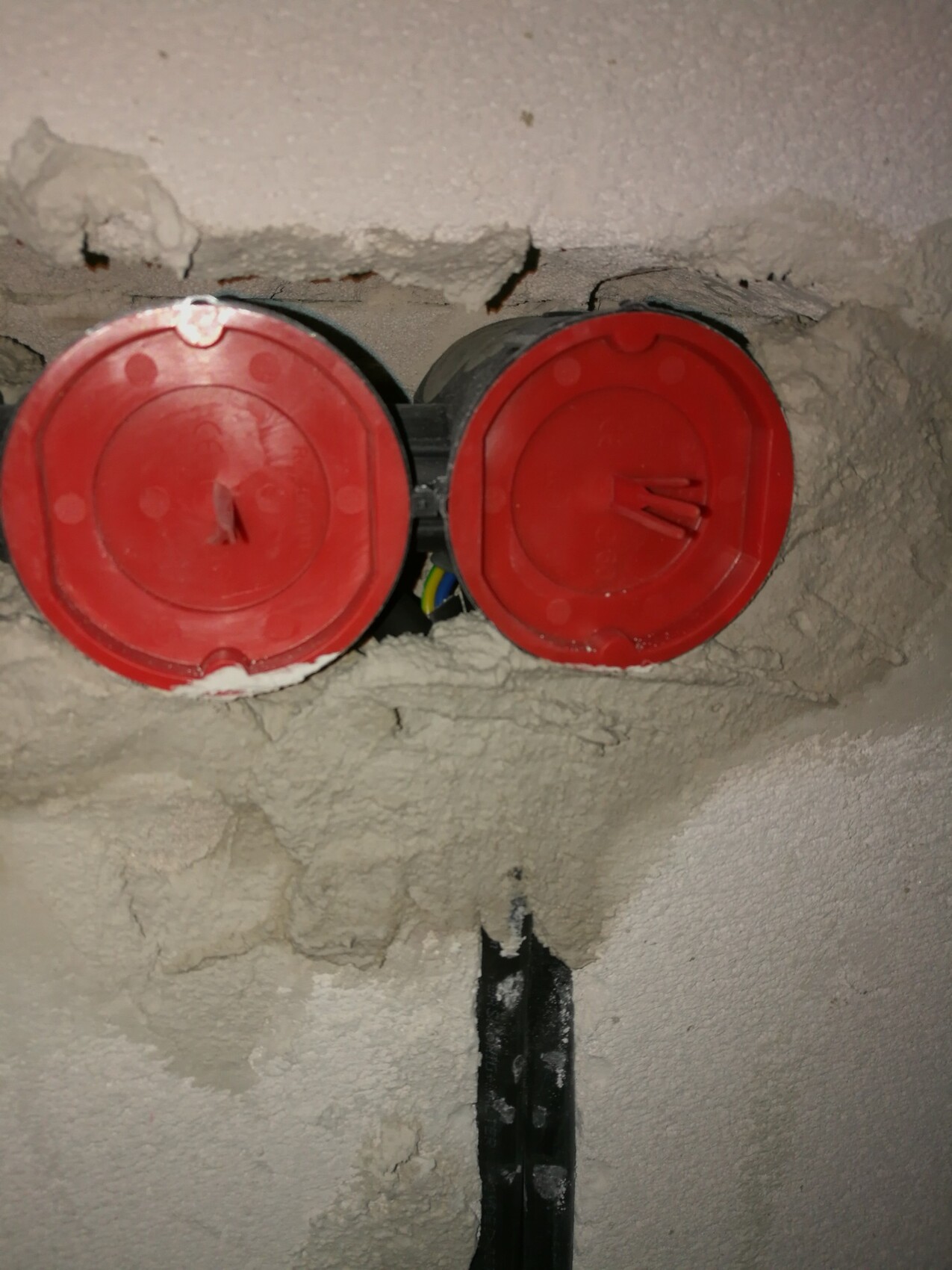
Unfortunately, I can’t find anywhere that it must be an empty conduit and not just a protective pipe, or that it has to be replaceable.
Is it allowed to crush NYY cables?
Yesterday, I emailed an independent expert with these pictures. He is responsible for electrical engineering and installation.
Today, I spoke with him on the phone.
He told me that this does not comply with VDE standards, that we should immediately stop construction and not apply any plaster.
He is apparently also responsible for fire cause investigation for the criminal police and said that just recently he had a case where a house burned down after 22 years, caused by a bent nail during installation.
Another expert also said, based on the pictures, that he did not find it acceptable.
The site manager only says, as long as the electrician approves it and presents some protocols showing everything was measured and is correct, then it’s fine.
And if it’s only about the bent nails, they have nothing to do with the interior plaster.
Oh yes, it does matter because if that is not okay, the entire cable must be replaced, including the part inside the wall up to the outlet box, which is already embedded in plaster.
What about the insulation/jacketing of these NYY cables?
They have a thick, stiff black outer layer, then a thin white “rubber skin,” and then the three wires inside.
Do these cables, including the white or black jacketing, need to extend all the way into the electrical box, or is it sufficient if it ends before the box and only the three wires go into the box, as shown in the picture?
D
dragonfreak20 Sep 2017 12:31Although I come from an industrial background, yes, the coating is applied all the way into the junction box.
Hi, today I had a meeting with the project manager of the electrical contractor.
He went through everything with me and mostly agreed with my points.
So, the outer sheath should at least go up to the junction box. If it’s pushed too far in, there’s simply no space inside anymore. He is having everything fixed everywhere and the outer sheath pulled over again by the two guys who did all the work for me.
The cables, the NYY cables (underground cables), are not pinched and have been tested. Nevertheless, he is removing the cable staples and having a perforated tape laid over them.
He is not doing anything with the protective conduit. That is fine because with so many corners and such a length, it is no longer possible to pull cables through anyway; it really only serves as protection and not for later replacement.
There were still cable staples in all the walls, partly already covered with plaster. Although one worker told me they would all be removed, I personally pulled out at least 10 nails just in the office and guest bathroom. Some cable ducts were even still full of these things! The project manager spoke quite firmly to the two workers and reiterated that this is unacceptable! That they absolutely must be removed as they only serve to hold the plaster in place.
I think those two guys had to work overtime today =)
So it appears everything will be repaired and I’m at least somewhat relieved.
The two guys who were on site the whole time seem to be very young! From what I caught, the younger one mentioned something about being an intern and then a trainee. Apparently, they just recently started their training. I wouldn’t mind if at least the foreman inspects and approves the work afterward!
If I hadn’t been so persistent and pushy, there would now be hundreds of cable staples under the plaster in the walls, which would cause rust problems later on!
Tomorrow morning I’m going to check everything again!
The interior plaster was actually supposed to be applied today, but I doubt they will even start tomorrow! Like every other trade so far!!!! -.-
He went through everything with me and mostly agreed with my points.
So, the outer sheath should at least go up to the junction box. If it’s pushed too far in, there’s simply no space inside anymore. He is having everything fixed everywhere and the outer sheath pulled over again by the two guys who did all the work for me.
The cables, the NYY cables (underground cables), are not pinched and have been tested. Nevertheless, he is removing the cable staples and having a perforated tape laid over them.
He is not doing anything with the protective conduit. That is fine because with so many corners and such a length, it is no longer possible to pull cables through anyway; it really only serves as protection and not for later replacement.
There were still cable staples in all the walls, partly already covered with plaster. Although one worker told me they would all be removed, I personally pulled out at least 10 nails just in the office and guest bathroom. Some cable ducts were even still full of these things! The project manager spoke quite firmly to the two workers and reiterated that this is unacceptable! That they absolutely must be removed as they only serve to hold the plaster in place.
I think those two guys had to work overtime today =)
So it appears everything will be repaired and I’m at least somewhat relieved.
The two guys who were on site the whole time seem to be very young! From what I caught, the younger one mentioned something about being an intern and then a trainee. Apparently, they just recently started their training. I wouldn’t mind if at least the foreman inspects and approves the work afterward!
If I hadn’t been so persistent and pushy, there would now be hundreds of cable staples under the plaster in the walls, which would cause rust problems later on!
Tomorrow morning I’m going to check everything again!
The interior plaster was actually supposed to be applied today, but I doubt they will even start tomorrow! Like every other trade so far!!!! -.-

305er schrieb:
What do you think about this? Am I right?Just as a comparison, this is how it looks at our site..
I guess the electricians wanted to finish up quickly at your place.
W
winnetou7820 Sep 2017 21:56I can fully understand you.
But I believe that normally installed nail-in anchors cause no problems at all once covered with plaster.
But I believe that normally installed nail-in anchors cause no problems at all once covered with plaster.
Similar topics