
Hello everyone,
We have a question regarding the following issue (all work was carried out by professional contractors).
In front of the house, we had a wall built using basement formwork blocks (2021). In 2022, wall cap slabs were installed on top. At the time the cap slabs were installed, the wall was dry. Afterwards, the wall was plastered on the sides. The drip edge was plastered over without any prior notice to us. After just a few months, we noticed some stains and have since been in regular contact with the contractors. The two companies have now concluded that the cap slabs are too narrow and need to be replaced with wider slabs to restore the drip edge.
We now have the following questions and hope someone here can help us.
Best regards
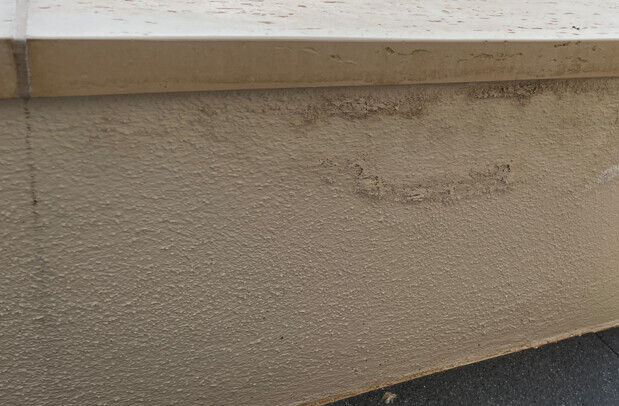
We have a question regarding the following issue (all work was carried out by professional contractors).
In front of the house, we had a wall built using basement formwork blocks (2021). In 2022, wall cap slabs were installed on top. At the time the cap slabs were installed, the wall was dry. Afterwards, the wall was plastered on the sides. The drip edge was plastered over without any prior notice to us. After just a few months, we noticed some stains and have since been in regular contact with the contractors. The two companies have now concluded that the cap slabs are too narrow and need to be replaced with wider slabs to restore the drip edge.
We now have the following questions and hope someone here can help us.
- What causes these stains or where do they come from?
- Is the problem resolved by using wider cap slabs or a drip edge?
Best regards
The stains appear to result from classic capillary backflow, which is almost to be expected with plastered drip edges. When water pools on the cover plate and, due to a lack of proper drainage, runs back along the underside, it penetrates the plaster, carrying with it fine efflorescence or dirt particles, leaving exactly such streaks. The narrow plate contributes to the problem because the edge is simply too close to the wall. Therefore, wider cover plates are not just a cosmetic suggestion but technically essential; otherwise, this will remain a persistent defect. Have you had it checked whether there is a capillary-breaking mortar bed applied under the plates? Without this, the problem worsens. With a clean drip edge, at least 3 cm (1.2 inches) overhang, and a hydrophobic finishing coat on the plaster, this issue is typically resolved.
Good luck!
Good luck!
Hello Nauer,
Thank you very much for your reply.
A reinforced concrete ring beam was cast on the concrete blocks, and the panels were glued on top of that.
By now, it is assumed that the panels were already too narrow before plastering, which we were not aware of. The plastering over the drip edge then made the situation worse.
Can you tell us if there are other ways to fix this? Removing the plaster, using a different type of plaster, waterproofing, metal covers, etc., so that the current narrow cover panels could be left as they are.
Thank you very much. Best regards
Thank you very much for your reply.
A reinforced concrete ring beam was cast on the concrete blocks, and the panels were glued on top of that.
By now, it is assumed that the panels were already too narrow before plastering, which we were not aware of. The plastering over the drip edge then made the situation worse.
Can you tell us if there are other ways to fix this? Removing the plaster, using a different type of plaster, waterproofing, metal covers, etc., so that the current narrow cover panels could be left as they are.
Thank you very much. Best regards
Hi,
the stains are caused by capillary backflow: water runs along the underside of the too narrow board and carries plaster particles with it. Without a proper drip edge, neither different plaster nor waterproofing will provide a lasting solution. Metal flashing or sealing tape can only be a temporary fix. Removing the plaster and installing wider cover boards with a drip edge is the only reliable solution.
the stains are caused by capillary backflow: water runs along the underside of the too narrow board and carries plaster particles with it. Without a proper drip edge, neither different plaster nor waterproofing will provide a lasting solution. Metal flashing or sealing tape can only be a temporary fix. Removing the plaster and installing wider cover boards with a drip edge is the only reliable solution.
I would also say that hiring an expert in such a case is not a bad idea, simply to get an unbiased assessment. Especially when two trades are involved, it can be difficult for a layperson to understand who should have done what differently. This way, you have something in writing and can be certain whether the proposed solution is really the right one.
Similar topics