
Hello everyone.
We are facing the following issue with our construction project. According to building regulations, rainwater must be infiltrated on-site or retained within the property. However, according to our soil report, the ground is not suitable for this.
The groundwater level is approximately 3.50 meters (11.5 feet).
Attached is an excerpt from the report.
What options do we have for infiltrating the rainwater? I have already read a lot about soakaway pits, infiltration trenches, and similar solutions, but I am completely unsure.
I look forward to constructive suggestions.
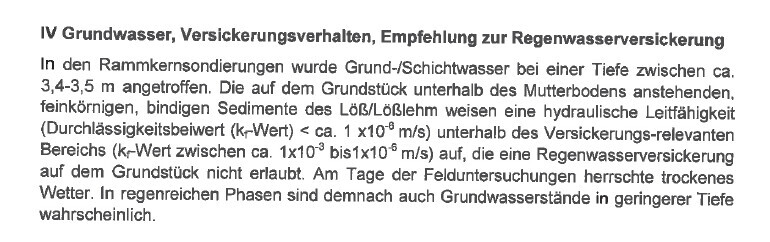
We are facing the following issue with our construction project. According to building regulations, rainwater must be infiltrated on-site or retained within the property. However, according to our soil report, the ground is not suitable for this.
The groundwater level is approximately 3.50 meters (11.5 feet).
Attached is an excerpt from the report.
What options do we have for infiltrating the rainwater? I have already read a lot about soakaway pits, infiltration trenches, and similar solutions, but I am completely unsure.
I look forward to constructive suggestions.


@f-pNo okay, okay, I actually wanted to be a bit provocative about community buildings. Basically, water can be used more efficiently than just letting it infiltrate. And using the soakaway (dry well / infiltration trench) as an overflow is a good idea. At least that’s my opinion.
RobsonMKK schrieb:
@f-pNo okay okay, I actually wanted to be provocative about the community center. Basically, water can be used more effectively than just letting it infiltrate. And the soakaway can be used as an overflow. At least that’s my opinion.I agree with you. However, the cost-benefit factor should not be overlooked here (there have already been several discussions about this). If, however, you are required by regulations not to discharge any water into the sewer system, you inevitably have to ensure that it infiltrates the ground somehow. Even during bad weather summers like this year (referring to the weeks up to mid-July), when in the worst case you might have more of a waterlogged plot than a building site.
Similar topics