
Hello everyone.
We are facing the following issue with our construction project. According to building regulations, rainwater must be infiltrated on-site or retained within the property. However, according to our soil report, the ground is not suitable for this.
The groundwater level is approximately 3.50 meters (11.5 feet).
Attached is an excerpt from the report.
What options do we have for infiltrating the rainwater? I have already read a lot about soakaway pits, infiltration trenches, and similar solutions, but I am completely unsure.
I look forward to constructive suggestions.
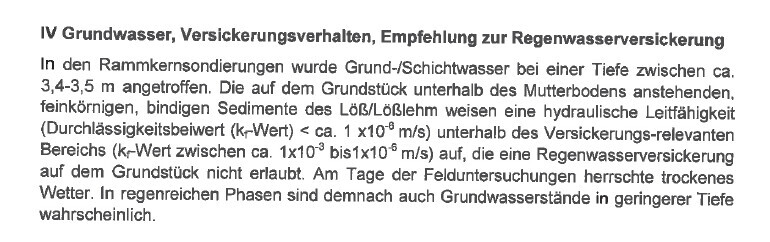
We are facing the following issue with our construction project. According to building regulations, rainwater must be infiltrated on-site or retained within the property. However, according to our soil report, the ground is not suitable for this.
The groundwater level is approximately 3.50 meters (11.5 feet).
Attached is an excerpt from the report.
What options do we have for infiltrating the rainwater? I have already read a lot about soakaway pits, infiltration trenches, and similar solutions, but I am completely unsure.
I look forward to constructive suggestions.

Our municipality also prefers that, whenever possible (depending on the soil report), rainwater should be absorbed on the property.
The municipality follows the principle that water should stay where it falls or be infiltrated into the ground. We have relatively sandy soil here (the report is still pending, but there are some natural "dunes" in the area), and I would also prefer to allow infiltration. In terms of cost, it probably doesn’t make much difference, right? Whether I install a soakaway or lay a second pipe for rainwater (rainwater and sewage are separated), I don’t think it makes a big difference, does it? Additionally, we have about a 30-meter (100-foot) connection run.
From an ecological perspective, I would think infiltration is better, at least if the soil is suitable...
The municipality follows the principle that water should stay where it falls or be infiltrated into the ground. We have relatively sandy soil here (the report is still pending, but there are some natural "dunes" in the area), and I would also prefer to allow infiltration. In terms of cost, it probably doesn’t make much difference, right? Whether I install a soakaway or lay a second pipe for rainwater (rainwater and sewage are separated), I don’t think it makes a big difference, does it? Additionally, we have about a 30-meter (100-foot) connection run.
From an ecological perspective, I would think infiltration is better, at least if the soil is suitable...
 Chriscross28 Sep 2016 12:29
I just received a quote for the drainage system planning services.
I find the price extremely high considering it only covers the planning. What do you think?
Cost: 1650 euros
I find the price extremely high considering it only covers the planning. What do you think?
Cost: 1650 euros
So, we now have our soil report, and infiltration is possible. We have a varying layer of topsoil (0.5m - 1.20m) followed by fine sand down to the borehole depth (2.5m - 6m).
We also already have the calculation for an infiltration trench from our civil engineer and need a suitable infiltration system. The calculation result is a required storage volume of 2.78m³ (98 cubic feet) for the trench. The engineer’s design is based on the DrainMax system (cell structure).
Are there any tips or experience regarding infiltration trenches? Which system would you recommend and why?
Where would you place the trench? Under the parking area or under the terrace? Or buried somewhere in the garden?
I’m leaning towards burying the trench under the parking space/carport. However, this area is only about 13m x 5m (43ft x 16ft) and borders directly on the neighbor’s property.
How would you approach this?
We also already have the calculation for an infiltration trench from our civil engineer and need a suitable infiltration system. The calculation result is a required storage volume of 2.78m³ (98 cubic feet) for the trench. The engineer’s design is based on the DrainMax system (cell structure).
Are there any tips or experience regarding infiltration trenches? Which system would you recommend and why?
Where would you place the trench? Under the parking area or under the terrace? Or buried somewhere in the garden?
I’m leaning towards burying the trench under the parking space/carport. However, this area is only about 13m x 5m (43ft x 16ft) and borders directly on the neighbor’s property.
How would you approach this?
I wouldn’t recommend infiltrating water under the parking space or terrace, as the soil in that area might be more damp (rumor has it). Also, it’s difficult to access later. Is a ventilation or inspection shaft required?
For example, you are often not allowed to build directly next to the neighbor’s property here; the minimum distance is specified by the local authorities (building permit / planning permission).
Are there differences in DrainMax products regarding whether they can support passenger vehicles or trucks? Or even less?
We don’t use DrainMax but Graf, which seems to work on the same principle. The calculation is free of charge, and installation can be done DIY. So far, it has been working perfectly.
For example, you are often not allowed to build directly next to the neighbor’s property here; the minimum distance is specified by the local authorities (building permit / planning permission).
Are there differences in DrainMax products regarding whether they can support passenger vehicles or trucks? Or even less?
We don’t use DrainMax but Graf, which seems to work on the same principle. The calculation is free of charge, and installation can be done DIY. So far, it has been working perfectly.
The gravel infiltration system is designed to last indefinitely and naturally works flawlessly. We have one as well.
The infiltration system must be at least 3 meters (10 feet) away from the property boundary, and normally you should never have to access it again if you clean out any debris beforehand using an inspection chamber. We have a DN400 (16-inch) collection basin directly in front of the infiltration trenches, which is half a meter (20 inches) deeper than the pipe leading to the infiltration trenches. Inside this basin is a perforated bucket, and all the water that flows in initially collects in this basin, along with any heavy particles. Since there are currently no plants around that are tall enough within a hundred meters (330 feet), no leaves or similar debris fall onto our roof and thus nothing ends up in the bucket.
The infiltration trenches can be buried under a paved surface, as they are designed to be fully drivable by trucks depending on the manufacturer. However, if there is ever an issue, accessing them is naturally much more difficult. It also depends on how deep the elements are buried. We have buried ours under the lawn. They are easy to access there and do not disturb anyone. The only restriction is that you cannot plant a large tree on that spot.
The infiltration system must be at least 3 meters (10 feet) away from the property boundary, and normally you should never have to access it again if you clean out any debris beforehand using an inspection chamber. We have a DN400 (16-inch) collection basin directly in front of the infiltration trenches, which is half a meter (20 inches) deeper than the pipe leading to the infiltration trenches. Inside this basin is a perforated bucket, and all the water that flows in initially collects in this basin, along with any heavy particles. Since there are currently no plants around that are tall enough within a hundred meters (330 feet), no leaves or similar debris fall onto our roof and thus nothing ends up in the bucket.
The infiltration trenches can be buried under a paved surface, as they are designed to be fully drivable by trucks depending on the manufacturer. However, if there is ever an issue, accessing them is naturally much more difficult. It also depends on how deep the elements are buried. We have buried ours under the lawn. They are easy to access there and do not disturb anyone. The only restriction is that you cannot plant a large tree on that spot.
Similar topics