
Hello everyone.
We are facing the following issue with our construction project. According to building regulations, rainwater must be infiltrated on-site or retained within the property. However, according to our soil report, the ground is not suitable for this.
The groundwater level is approximately 3.50 meters (11.5 feet).
Attached is an excerpt from the report.
What options do we have for infiltrating the rainwater? I have already read a lot about soakaway pits, infiltration trenches, and similar solutions, but I am completely unsure.
I look forward to constructive suggestions.
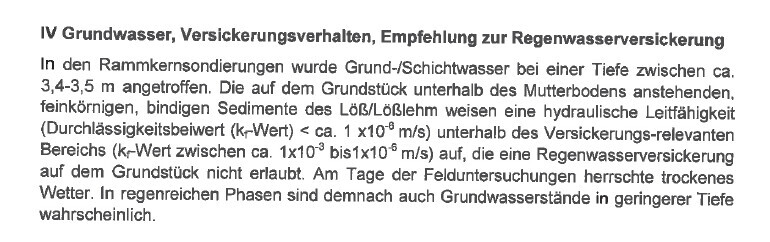
We are facing the following issue with our construction project. According to building regulations, rainwater must be infiltrated on-site or retained within the property. However, according to our soil report, the ground is not suitable for this.
The groundwater level is approximately 3.50 meters (11.5 feet).
Attached is an excerpt from the report.
What options do we have for infiltrating the rainwater? I have already read a lot about soakaway pits, infiltration trenches, and similar solutions, but I am completely unsure.
I look forward to constructive suggestions.
86bibo schrieb:
Usually, a soakaway is combined with a cistern to delay the discharge of water. Part of the cistern serves as an intermediate storage, from which water is slowly released into the soakaway through a flow restrictor.Is this really common?
Why include retention if the soil does not require it? There are certainly soils that allow infiltration.
From my experience, a cistern is considerably more expensive than providing the equivalent volume, for example, with a larger soakaway structure.
 Chriscross15 Sep 2016 10:23
So, I contacted the real estate company that also commissioned a soil survey. They told me that the results from the other soil survey are complete nonsense. Therefore, no additional rainwater infiltration system will be required. I will get this in writing and pass it on to my architect. Then we’ll see how things progress.
B
Bieber081515 Sep 2016 10:30Chriscross schrieb:
So, there would be no need for an additional rainwater infiltration system. And what is supposed to happen with the rainwater?
Chriscross15 Sep 2016 10:32Bieber0815 schrieb:
And what will happen with the rainwater?It infiltrates into the ground. At least, that is what the property appraisal states.

Chriscross schrieb:
So, I got in touch with the real estate company that also commissioned a soil survey. They told me that the results of the other soil survey are complete nonsense. According to them, an additional rainwater infiltration system would not be necessary. I will get this in writing and pass it on to my architect. Then we’ll see how things proceed.What kind of real estate company is this? Are you planning to build with them?
Who will take responsibility if soil survey 1 turns out to be correct and infiltration does not occur?
Who set the requirements regarding infiltration? Probably the local authority. Who will discuss with them whether infiltration, as required, is actually necessary or not?
The local authority will always rely on its survey and insist on it. This could possibly lead to a legal dispute, which would then require a third survey. You should already factor in such costs, since most legal protection insurance policies do not cover construction-related disputes. Even if you sign an appropriate legal protection insurance policy now, it will not cover costs, because the facts of the dispute were already known before the policy was taken out.
B
Bieber081528 Sep 2016 06:48Chriscross schrieb:
So no separate rainwater infiltration system would be necessary. And
Chriscross schrieb:
The water infiltrates into the ground. So either your downspouts have a 60° bend at the bottom and end open just above ground level, allowing the water to splash out and infiltrate, or a structural infiltration system is installed:
- Basin,
- Trenched drainage (soakaway), or
- Shaft.
This structural infiltration system can (but doesn’t have to) be supplemented with a water utilization system (a cistern, possibly with a domestic water pump, if desired...). It could even be designed in such a way that the water utilization system also serves as temporary storage, which then reduces the available volume for use.
Of course, the infiltration system must be properly sized (designed, planned); the basis for this includes impervious surface area, rainfall amounts and frequency (i.e., the region), and soil characteristics.
Similar topics