
Hello everyone.
We are facing the following issue with our construction project. According to building regulations, rainwater must be infiltrated on-site or retained within the property. However, according to our soil report, the ground is not suitable for this.
The groundwater level is approximately 3.50 meters (11.5 feet).
Attached is an excerpt from the report.
What options do we have for infiltrating the rainwater? I have already read a lot about soakaway pits, infiltration trenches, and similar solutions, but I am completely unsure.
I look forward to constructive suggestions.
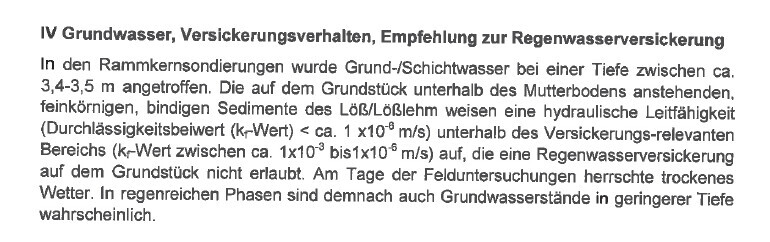
We are facing the following issue with our construction project. According to building regulations, rainwater must be infiltrated on-site or retained within the property. However, according to our soil report, the ground is not suitable for this.
The groundwater level is approximately 3.50 meters (11.5 feet).
Attached is an excerpt from the report.
What options do we have for infiltrating the rainwater? I have already read a lot about soakaway pits, infiltration trenches, and similar solutions, but I am completely unsure.
I look forward to constructive suggestions.
B
Bieber081524 Aug 2016 23:39Payday schrieb:
why should the soakaway only start working once the cistern is full Because I want to use the water from the cistern in the garden. Actually, it is irrelevant for infiltration; the soakaway has to manage that alone, even if the cistern is full and there is heavy rain.
@Payday:
You wrote: "if you add a cistern upstream"
That’s basically what I described, isn’t it? Or am I misunderstanding?
The cistern is used as a "collection tank" (e.g., for irrigation), and any overflow goes into the French drain system for infiltration.
How large is your plot?
If you’ve installed 11 of those units underground, that must be quite a large area.
You wrote: "if you add a cistern upstream"
That’s basically what I described, isn’t it? Or am I misunderstanding?
The cistern is used as a "collection tank" (e.g., for irrigation), and any overflow goes into the French drain system for infiltration.
How large is your plot?
If you’ve installed 11 of those units underground, that must be quite a large area.
also:
these Graf components are 1 meter long (and wide), can store 300 liters (79 gallons), and have a large discharge surface area (completely at the bottom and also on the edges). An advantage of these infiltration trenches would be, for example, that they can be installed very shallow in areas with a high groundwater level (our issue). They can handle up to 0.5 meters (20 inches) of cover and are suitable for heavy vehicles (trucks).
we have 11 units because we adopted the calculation from our house planner based on his usual infiltration system. he calculated 3200 liters (846 gallons) of storage but only 2 square meters (22 square feet) of discharge area (DN 1500 pipe a few meters deep). That wasn’t suitable due to the high groundwater level, so we needed a different solution that the authorities wouldn’t have issues with. So, both the surface area and volume are larger than originally planned. Now our system is probably oversized, as the infiltration area is 10 times larger than required.
The issue here is that the original poster isn’t able to get rid of their water due to poor infiltration. So, having temporary storage is good, so that during heavy rain the water can be held temporarily and then drained gradually through a large infiltration area. The Graf infiltration trenches already provide a certain volume (300 liters (79 gallons) per unit).
Costs for us were:
11 x 50 € for the infiltration trenches = 550 €
DN 400 pipe with concrete block and cover as inspection chamber directly in front of the infiltration trenches, a T-piece, a few connecting pipes about 50 €
Endless excavation work ~ 2000 € by the landscaping contractor
Gravel and geotextile to cover the infiltration trenches (to ensure proper drainage) 500 €
These numbers are roughly from memory, but around 3000 € is about right.
these Graf components are 1 meter long (and wide), can store 300 liters (79 gallons), and have a large discharge surface area (completely at the bottom and also on the edges). An advantage of these infiltration trenches would be, for example, that they can be installed very shallow in areas with a high groundwater level (our issue). They can handle up to 0.5 meters (20 inches) of cover and are suitable for heavy vehicles (trucks).
we have 11 units because we adopted the calculation from our house planner based on his usual infiltration system. he calculated 3200 liters (846 gallons) of storage but only 2 square meters (22 square feet) of discharge area (DN 1500 pipe a few meters deep). That wasn’t suitable due to the high groundwater level, so we needed a different solution that the authorities wouldn’t have issues with. So, both the surface area and volume are larger than originally planned. Now our system is probably oversized, as the infiltration area is 10 times larger than required.
You write: "if you add a cistern beforehand"no, “added beforehand” means the cistern acts as a reserve tank until the infiltration trench has drained the water. Therefore, the connection to the infiltration trench must be at the bottom of the cistern, not at the top. The top is only a temporary storage and certainly useful in summer but, for example, does not improve storage capacity in autumn or winter (because once full, it stays full indefinitely unless you pump it out yourself, which usually doesn’t happen in winter).
That is basically what I wrote. Or am I misunderstanding?
The issue here is that the original poster isn’t able to get rid of their water due to poor infiltration. So, having temporary storage is good, so that during heavy rain the water can be held temporarily and then drained gradually through a large infiltration area. The Graf infiltration trenches already provide a certain volume (300 liters (79 gallons) per unit).
Costs for us were:
11 x 50 € for the infiltration trenches = 550 €
DN 400 pipe with concrete block and cover as inspection chamber directly in front of the infiltration trenches, a T-piece, a few connecting pipes about 50 €
Endless excavation work ~ 2000 € by the landscaping contractor
Gravel and geotextile to cover the infiltration trenches (to ensure proper drainage) 500 €
These numbers are roughly from memory, but around 3000 € is about right.

Payday schrieb:
No, “pre-connected” means that the cistern acts as a reserve tank until the soakaway has drained the water. Therefore, the connection to the soakaway should be at the bottom of the cistern, not at the top. The top part is only a temporary buffer and is certainly useful in summer, but it does not increase storage capacity in autumn or winter (because once it’s full, it stays full until you pump it out yourself, which probably doesn’t happen in winter).
The issue here is that the original poster can’t get rid of her water due to poor infiltration. So, having a buffer tank is good, allowing heavy rainwater to be temporarily stored and then gradually released through a large infiltration area. The soakaway crates from Graf already offer a certain volume (300 liters per unit).
Interesting approach. I had never thought about it that way.
Okay – in our case, retention with an overflow into the sewer system is allowed – so I didn’t need to consider this.
But this explanation should definitely be saved somewhere for future reference. It’s also easy for a non-expert to understand.

Similar topics