
Hello garden enthusiasts,
Last year, I spent time preparing a poor grassland area. About 40m² (430 ft²) was fully dug up, edging stones were installed, and mixed with sand. Now, I want to place an insect hotel in the middle. Unfortunately, I have no experience with this yet. I know there are ready-made hotels available, but some are built completely incorrectly and therefore not used by the insects.
Has anyone here dealt with this before and can share some advice? Or are there websites where especially good information can be found?
Since I’m just starting, I am wondering, for example:
- What is the best orientation to the sun?
- Should I design separate compartments for each type of insect (such as bee section, beetle section, lacewing section, etc.)?
- Can wild bees be housed together with other species? Or do some always need their own separate “home”?
- Where can I order "building materials" affordably?
I appreciate any advice!
Last year, I spent time preparing a poor grassland area. About 40m² (430 ft²) was fully dug up, edging stones were installed, and mixed with sand. Now, I want to place an insect hotel in the middle. Unfortunately, I have no experience with this yet. I know there are ready-made hotels available, but some are built completely incorrectly and therefore not used by the insects.
Has anyone here dealt with this before and can share some advice? Or are there websites where especially good information can be found?
Since I’m just starting, I am wondering, for example:
- What is the best orientation to the sun?
- Should I design separate compartments for each type of insect (such as bee section, beetle section, lacewing section, etc.)?
- Can wild bees be housed together with other species? Or do some always need their own separate “home”?
- Where can I order "building materials" affordably?
I appreciate any advice!

We have a DIY structure built by my father-in-law next to the garage, supported on posts. The back is simply a large wooden board, and the opening faces south. Inside, there are wooden blocks drilled according to the tips mentioned above, with various diameters. It was almost fully occupied in its second year.
What you can skip are bricks and specially designed insect blocks with holes. One costs about 30 EUR, and in our case, only 2 holes are inhabited (we have 2 of those blocks). I can remove the cover and upload a photo when I get the chance...
What you can skip are bricks and specially designed insect blocks with holes. One costs about 30 EUR, and in our case, only 2 holes are inhabited (we have 2 of those blocks). I can remove the cover and upload a photo when I get the chance...

I find these pallet constructions somehow appealing. Would this be a practical idea, or is it just for show?
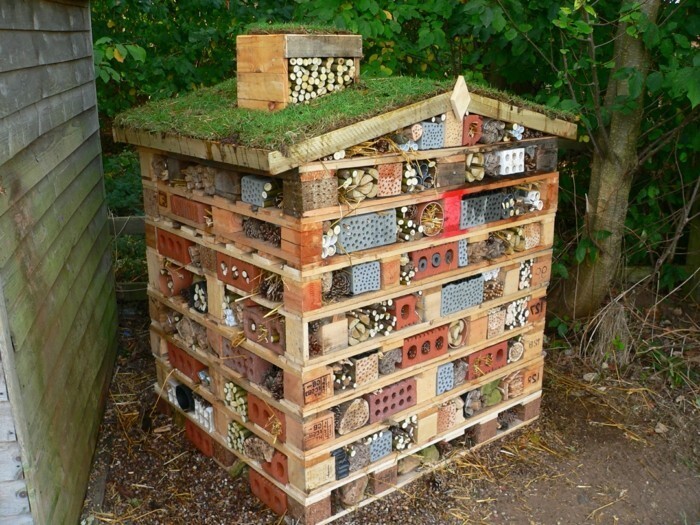
I can replace the wrong stones with the right ones. And you can use small pallets so it doesn’t look too bulky.
I also like this triangle, but it’s not ideal if it’s placed directly on the ground, right? At least that’s how it looks here. You could raise it a bit.
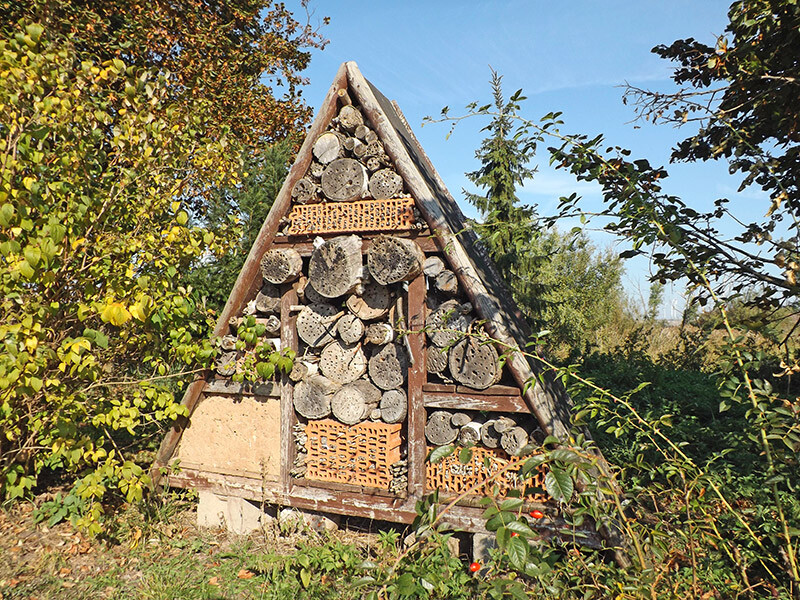
I would really like this wall too:
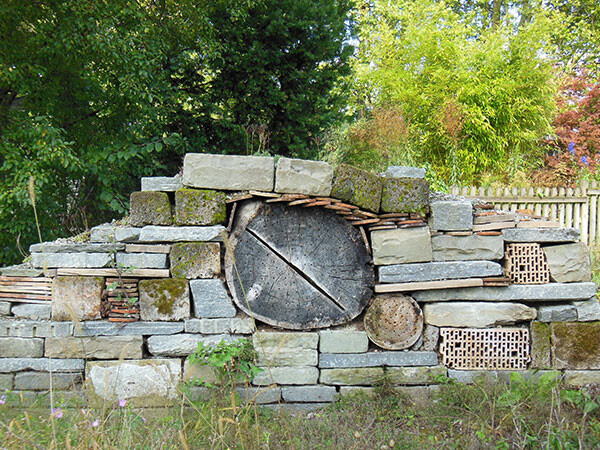
But that’s more for lizards, isn’t it? That will go on the other side of the garden.
I can replace the wrong stones with the right ones. And you can use small pallets so it doesn’t look too bulky.
I also like this triangle, but it’s not ideal if it’s placed directly on the ground, right? At least that’s how it looks here. You could raise it a bit.
I would really like this wall too:
But that’s more for lizards, isn’t it? That will go on the other side of the garden.
A natural stone wall without mortar joints is ideal for lizards, as it is nicely sunny and stays warm inside. Nearby there should be a sandy spot on the ground without vegetation for the eggs.
A natural stone wall with clay mortar joints is suitable for various species of bees, which create their tunnels within it themselves.
The wooden disc is drilled through the end grain and is therefore unsuitable, serving only as decoration.
Of course, pallets can also be used to build something – but the question is: what about the interior? Bees don’t go that deep inside. It is said to be about 10cm (4 inches)…
As the structure stands there, only one side is optimally positioned. It could be turned so that one side faces southeast and another southwest, which would at least give two usable sides. The back side could then be planted. However, it would probably decompose eventually.
And of course, the filling shown in the photo is really poor. The only useful parts in there are these wooden blocks, like the one in the middle at the top under the gable. Everything else is just for show.
In the triangle, I can’t identify the block in the lower left – it might be intended as a clay wall. If it is softer clay, that would be fine.
Everything else is junk for the reasons mentioned in the last post.
It is such a pity, as many people invest a lot of time, money, and effort into things like this that don’t bring any benefit at all.
A natural stone wall with clay mortar joints is suitable for various species of bees, which create their tunnels within it themselves.
The wooden disc is drilled through the end grain and is therefore unsuitable, serving only as decoration.
Of course, pallets can also be used to build something – but the question is: what about the interior? Bees don’t go that deep inside. It is said to be about 10cm (4 inches)…
As the structure stands there, only one side is optimally positioned. It could be turned so that one side faces southeast and another southwest, which would at least give two usable sides. The back side could then be planted. However, it would probably decompose eventually.
And of course, the filling shown in the photo is really poor. The only useful parts in there are these wooden blocks, like the one in the middle at the top under the gable. Everything else is just for show.
In the triangle, I can’t identify the block in the lower left – it might be intended as a clay wall. If it is softer clay, that would be fine.
Everything else is junk for the reasons mentioned in the last post.
It is such a pity, as many people invest a lot of time, money, and effort into things like this that don’t bring any benefit at all.
Müllerin schrieb:
It’s such a shame that many people invest time, money, and effort into things that don’t bring any benefit at all. That’s exactly what I want to avoid.
Palettes aren’t really ideal, I just realized, because I’m terrified of cellar spiders and they tend to live there. I have plenty of experience with that. And it also has to appeal to me a bit, otherwise it’s no fun.
But we saw this cube shape last year on vacation. Someone had built a bee hotel in that shape. It was very successful! All four sides were occupied. It stood in a sunny, open meadow. It was wonderful. Such a buzz!
Okay, I see I need to do more reading first, then draft a design and present it here. Otherwise, it won’t work.
Similar topics