
ᐅ Retaining a 2-meter slope: L-shaped concrete blocks, dry stone wall, or other solutions?
Created on: 22 Apr 2022 15:02
H
hausamfeld hausamfeld22 Apr 2022 15:02
Hello dear house building forum,
we are currently planning the preparation for the foundation slab with our earthworks contractor. Now we also need to decide how to retain the slope behind the house, which drops about 185cm (73 inches).
The setup (which can be seen quite well in the "slope idea" picture) is currently planned as follows: street/sidewalk/5 meters (16 feet) front yard, approximately 11 meters (36 feet) house, 4 meters (13 feet) terrace, and then we have about 10 meters (33 feet) left if we were to retain the whole area directly with L-shaped retaining blocks. These are quite hefty blocks, and 2-meter (6.5 feet) tall L-blocks are apparently very expensive. Including labor and concrete pouring, for the 15 meters (49 feet) wide area, the cost would be around €11,000.
Now the question is, what other options do we have?
Thanks for your help 🙂
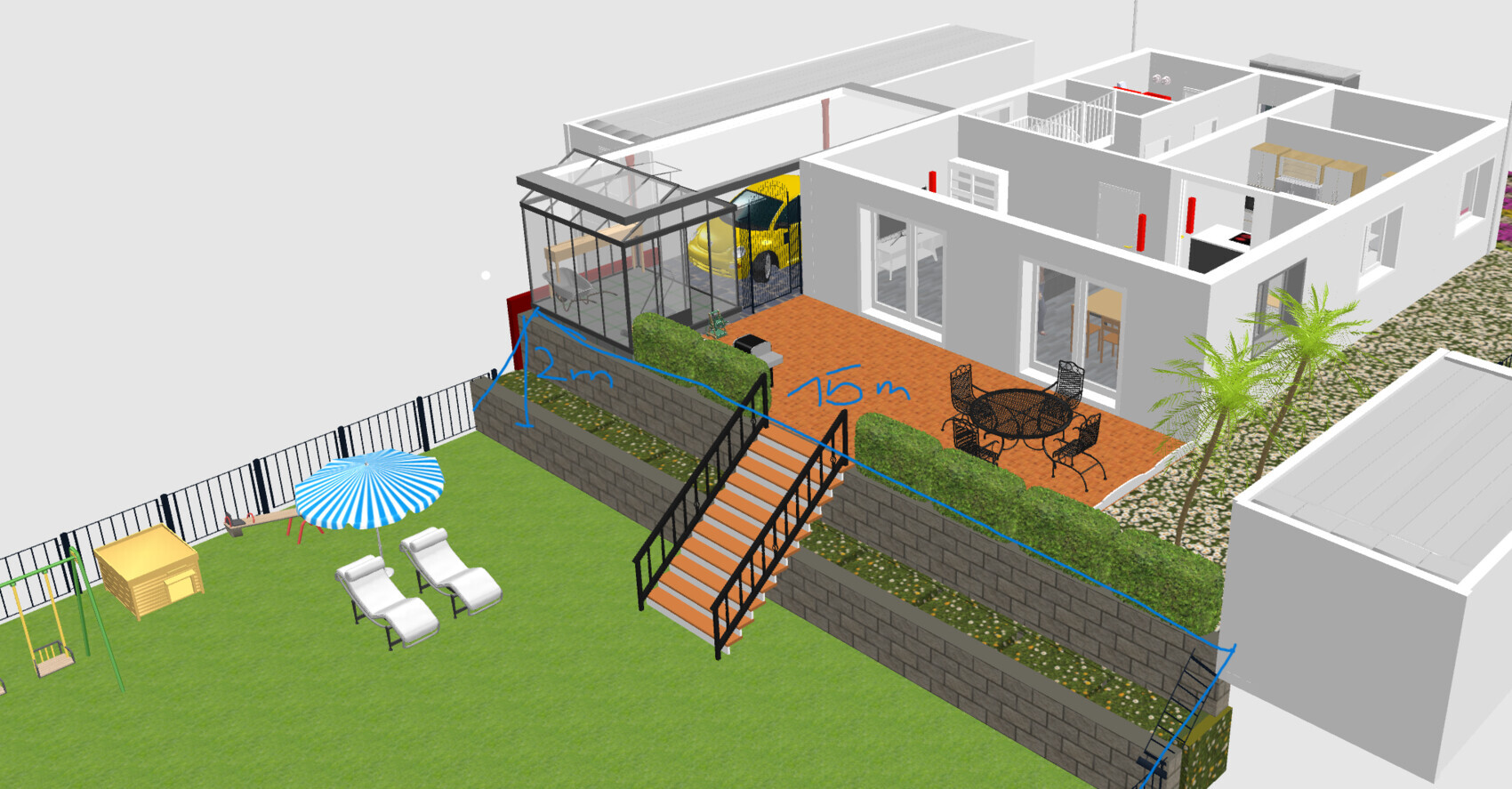
we are currently planning the preparation for the foundation slab with our earthworks contractor. Now we also need to decide how to retain the slope behind the house, which drops about 185cm (73 inches).
The setup (which can be seen quite well in the "slope idea" picture) is currently planned as follows: street/sidewalk/5 meters (16 feet) front yard, approximately 11 meters (36 feet) house, 4 meters (13 feet) terrace, and then we have about 10 meters (33 feet) left if we were to retain the whole area directly with L-shaped retaining blocks. These are quite hefty blocks, and 2-meter (6.5 feet) tall L-blocks are apparently very expensive. Including labor and concrete pouring, for the 15 meters (49 feet) wide area, the cost would be around €11,000.
Now the question is, what other options do we have?
- Letting the slope gently taper off would certainly be the cheapest option, but we would probably lose a lot of usable garden space. I don’t know how steep I can make this slope so that the terrace remains stable on it.
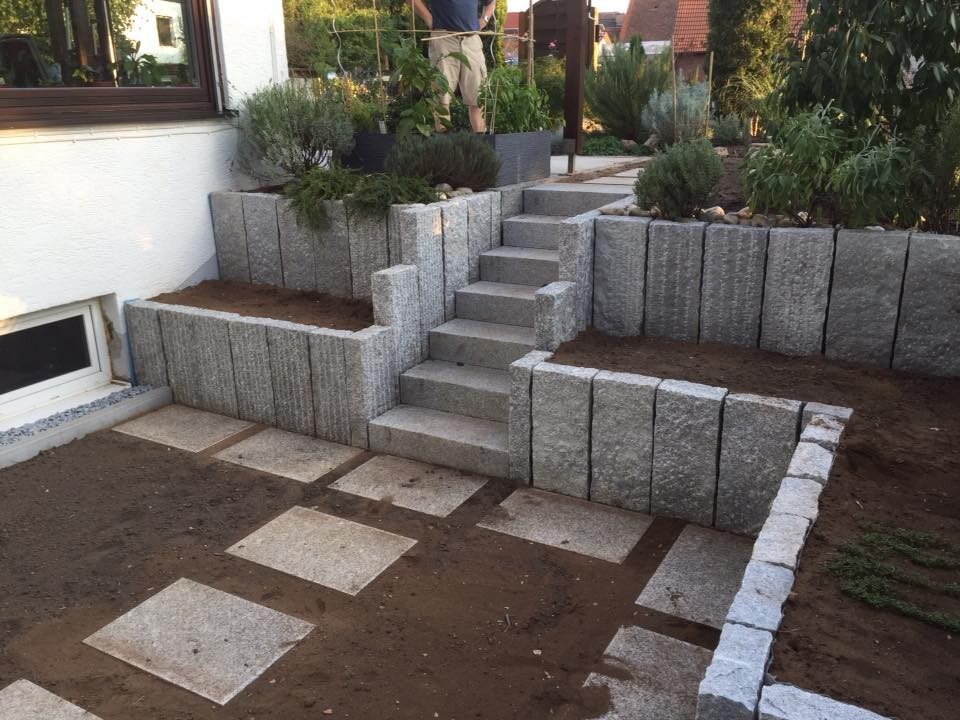
- Use L-shaped retaining blocks but decorate the front with a natural stone raised bed, so we wouldn’t have a two-meter (6.5 feet) concrete wall visible? That would certainly mean additional costs, so €11,000 plus the cost of the raised bed?
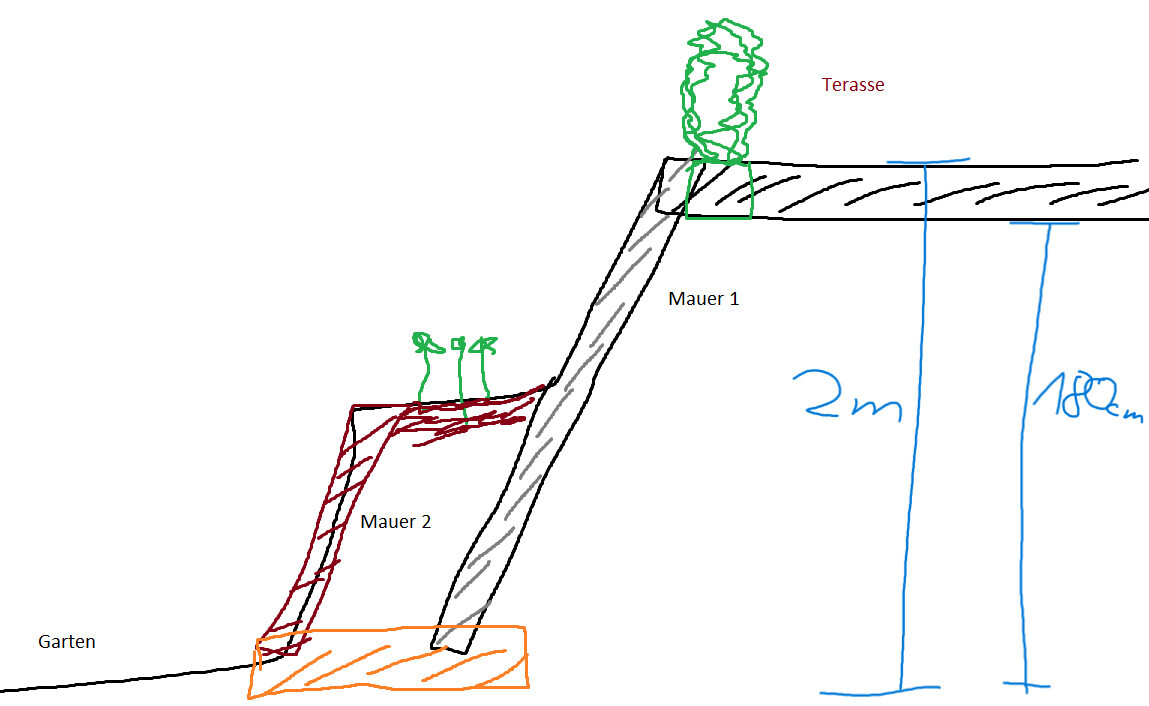
- Dry stone wall (maybe like in the cross-section double wall idea)? I have read different opinions about this; some say dry stone walls over 150cm (59 inches) might no longer be reliably load-bearing or cost-effective, while others suggest concreting this structure. However, I couldn’t find any pricing information on that. Maybe someone here has experience with this.
- Gabions or other options? The classic "flower stones" look too outdated for us, and gabions aren’t exactly the most attractive option either, but possibly if planted with stone plants, they might still be an option?
Thanks for your help 🙂
Why build so close to the property line?
Natural stone is expensive; cast-in-place concrete is probably the most affordable option. You need to decide what works best for your house and your budget.
I definitely wouldn’t recommend a dry-stacked wall. The wall has to support both the terrace and the house, even during heavy rain.
Also, I would suggest building the wall in two or three tiers. This way, the wall can be planted. It’s up to you whether you want to plant perennials just once or create a raised bed with berries and salad, for example.
I would plan for a ramp or slope so you can easily get the lawnmower, wheelbarrow, and even a swing down the incline comfortably.
Natural stone is expensive; cast-in-place concrete is probably the most affordable option. You need to decide what works best for your house and your budget.
I definitely wouldn’t recommend a dry-stacked wall. The wall has to support both the terrace and the house, even during heavy rain.
Also, I would suggest building the wall in two or three tiers. This way, the wall can be planted. It’s up to you whether you want to plant perennials just once or create a raised bed with berries and salad, for example.
I would plan for a ramp or slope so you can easily get the lawnmower, wheelbarrow, and even a swing down the incline comfortably.
hausamfeld24 Apr 2022 12:10haydee schrieb:
Why build so close to the property boundary?Hi haydee, thanks for your reply. What exactly do you mean by "close to the property boundary"?
We have to do something with the slope anyway—what would be your suggestion?
haydee schrieb:
Natural stone is expensive; cast-in-place concrete is probably the most affordable option.
What you choose is up to you. It needs to suit the house and your budget.
I definitely wouldn’t recommend a dry-stone wall. The wall has to support the terrace and the house, even during heavy rain.Cast-in-place concrete would then be similar to L-shaped retaining blocks, just poured on site? That would probably also create a large wall that you approach from the garden side, right?
haydee schrieb:
I would also work in 2 or 3 tiers. This way, the wall can be planted. It’s then up to you whether you want perennial plants or perhaps a raised bed with berries and salad, etc.
I would plan for a ramp or slope so you can easily get the lawn mower, wheelbarrow, and even a swing down.Exactly, we had already planned for 2 tiers, possibly about 90cm (35 inches) high.
Another alternative that came to our mind would be a combination of sloping out and retaining, see attachment.

Maybe a basement level. It is unlikely that the plot is completely flat and then suddenly slopes downward.
What did you submit with the application?
What does the zoning plan / building permit specify?
A structural engineer would not be a luxury.
Has the area for the house and terrace already been filled?
Have load plate tests been carried out to check soil compaction?
How is the terrain in the garden area? Probably not flat either.
Of course, cast-in-place concrete looks nice, as do L-shaped concrete blocks, but it might be more cost-effective. L-shaped blocks and cast-in-place concrete can also be arranged in steps.
With the slope, you have a maintenance issue. Robot mowers cannot handle the incline, and it is not comfortable for people to mow.
What did you submit with the application?
What does the zoning plan / building permit specify?
A structural engineer would not be a luxury.
Has the area for the house and terrace already been filled?
Have load plate tests been carried out to check soil compaction?
How is the terrain in the garden area? Probably not flat either.
Of course, cast-in-place concrete looks nice, as do L-shaped concrete blocks, but it might be more cost-effective. L-shaped blocks and cast-in-place concrete can also be arranged in steps.
With the slope, you have a maintenance issue. Robot mowers cannot handle the incline, and it is not comfortable for people to mow.
Similar topics