
ᐅ Moisture in the attic. Heat is coming from the interior wall.
Created on: 2 Feb 2021 18:22
B
bwradar
Hello,
I wanted to install wooden paneling on my attic (not OSB boards, but boards with ventilation slots).
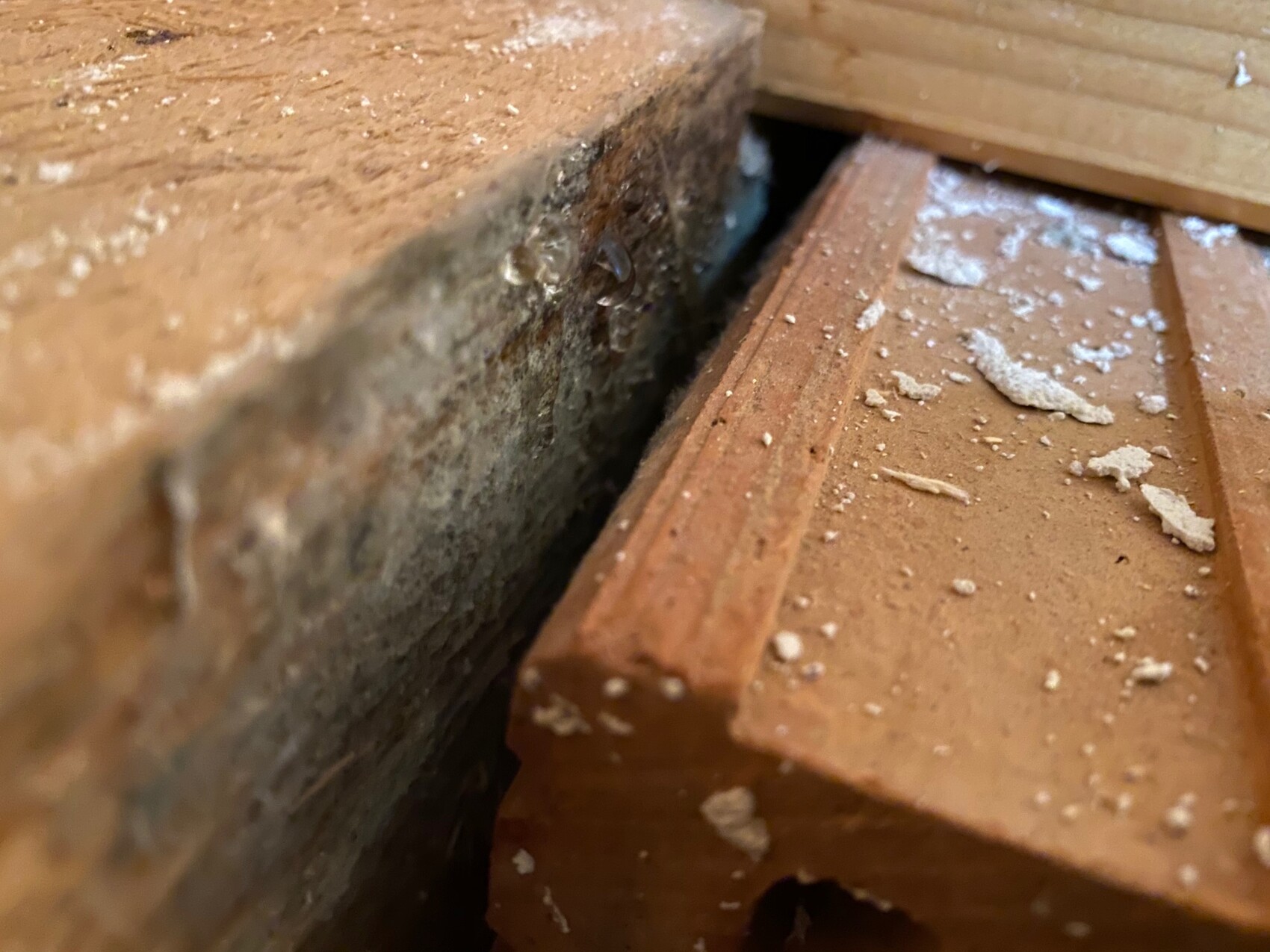
I noticed a spot where condensation is already visible even without the boards installed.
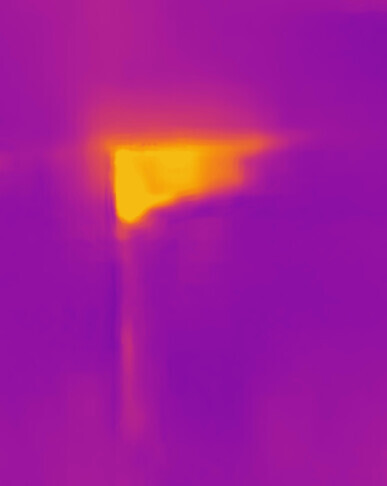
The heat is coming from the interior wall. The surface is not insulated, and the heat radiates in all directions:
Should our construction company have handled these areas differently? In some places, there are only a few centimeters (inches) of clearance upwards.
The house was built to KFW 55 standard. The ceiling is drywall, with a vapor barrier and a thick layer of insulation (wool).
What can I do with the masonry now to prevent the heat transfer?
Otherwise, I can’t panel this area, which is roughly in the middle of the attic.
Thanks in advance for any tips!
bwradar
I wanted to install wooden paneling on my attic (not OSB boards, but boards with ventilation slots).
I noticed a spot where condensation is already visible even without the boards installed.
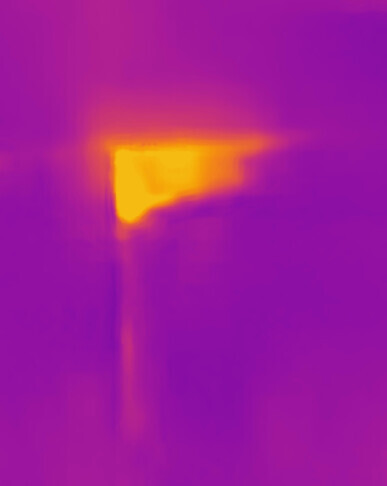
The heat is coming from the interior wall. The surface is not insulated, and the heat radiates in all directions:
Should our construction company have handled these areas differently? In some places, there are only a few centimeters (inches) of clearance upwards.
The house was built to KFW 55 standard. The ceiling is drywall, with a vapor barrier and a thick layer of insulation (wool).
What can I do with the masonry now to prevent the heat transfer?
Otherwise, I can’t panel this area, which is roughly in the middle of the attic.
Thanks in advance for any tips!
bwradar
A warm spot in a cold roof is not a problem; rather, a cold spot in a warm area is.
In other words, condensation or mold can occur at the top of the wall inside the living space.
The cause of moisture there is different: a hole in the vapor retarder, improper connection, or it being completely omitted, a hole in the roof, or other reasons.
In other words, condensation or mold can occur at the top of the wall inside the living space.
The cause of moisture there is different: a hole in the vapor retarder, improper connection, or it being completely omitted, a hole in the roof, or other reasons.
Condensation forms in the gap between the brick and the wood. This is caused by heat and the cold surface of the wood. If the brick is loosely covered with boards, the entire insulation around and above the brick will become wet, which unfortunately almost inevitably leads to mold.
WilderSueden schrieb:
Is that really appropriate for a cold roof?
Since the floor represents the thermal envelope here, there shouldn’t be such a thermal bridge in my understanding. I don’t think it should be like that, of course, but I can’t really judge what was done wrong exactly.
 bauenmk20205 Feb 2021 12:27
Am I correct in understanding that the interior wall (brick) extends up into the cold roof? Aren't interior walls usually below the vapor barrier (membrane)? In our case, the walls reach up just below the vapor barrier membrane / roof beams.
bauenmk20205 Feb 2021 15:00bwradar schrieb:
Yes, that’s how it is. The brick serves as a support for the purlin and unfortunately is not insulated.
That can’t be right, can it? I’m not an expert, but I know a bit. We also have a cold roof. The roof rafters rest on the purlins, which in turn rest on the exterior walls. These walls are made of brick, but due to the loads, there are reinforced concrete ring beams running around the four corners of the house, placed just below the purlins. As far as I understand, the roof therefore doesn’t rest on the interior walls, but on these ring beams. Our roof beams basically form the ceiling of the upper floor. Below the beams, there is a vapor barrier membrane stretched out. This membrane is partially penetrated by empty conduit pipes or ventilation pipes, chimney, etc., and sealed with flexible tape.
Between the individual roof beams, insulation (mineral wool) is packed in. The roof is then finished from below with drywall (gypsum board).
But as I’m writing, I vaguely remember that we have an interior wall in the bathroom that is structurally important. I need to check how it looks in our case. In some areas of the roof, we also added extra mineral wool layers. I think I need to take a closer look and see if the purlin does indeed rest directly on the interior wall there…
Similar topics