
ᐅ Insulation in a Construction Trailer: Vapor Retarder Yes or No?
Created on: 29 Dec 2019 17:28
C
cube_maniac
Hello building community,
I recently acquired a construction trailer and now want to convert it into living space.
To keep it from getting too cold in winter, I plan to insulate the trailer with 5 cm (2 inches) of polystyrene foam. Heating will be provided by a wood stove and an electric frost guard. The trailer has an outer shell made of metal, which acts as an exterior vapor barrier.
Now I am wondering if I should also install a vapor barrier on the inside of the insulation. My concern is that moisture might still accumulate in the cavity and then become trapped.
Does anyone have experience with this kind of wall assembly? What would you recommend?
I recently acquired a construction trailer and now want to convert it into living space.
To keep it from getting too cold in winter, I plan to insulate the trailer with 5 cm (2 inches) of polystyrene foam. Heating will be provided by a wood stove and an electric frost guard. The trailer has an outer shell made of metal, which acts as an exterior vapor barrier.
Now I am wondering if I should also install a vapor barrier on the inside of the insulation. My concern is that moisture might still accumulate in the cavity and then become trapped.
Does anyone have experience with this kind of wall assembly? What would you recommend?
C
cube_maniac30 Dec 2019 09:37Unfortunately, insulating from the outside is not really possible.
Hmm, whether that is allowed? No idea, but honestly, I don’t really care. The trailer is on private property and only occupied by me. If someone gets upset about it, I really don’t understand what’s wrong with people. Nobody is getting hurt here.
Hmm, whether that is allowed? No idea, but honestly, I don’t really care. The trailer is on private property and only occupied by me. If someone gets upset about it, I really don’t understand what’s wrong with people. Nobody is getting hurt here.
H
HilfeHilfe30 Dec 2019 10:18cube_maniac schrieb:
Insulating from the outside is unfortunately not really possible.
Hmm, I don’t know if that’s allowed? Honestly, I don’t really care. The trailer is on private property and only I live there. If someone gets upset about that, I really don’t understand what’s wrong with people. No one is getting harmed. Well, heating a construction trailer with a stove in Germany...
That makes me think of quite a few polluters.
Interior insulation should be possible as long as the space inside remains large enough after installation. However, a word of caution: the caravan will effectively become a thermal enclosure. With polystyrene insulation, you really don’t need a vapor barrier. Polystyrene is impermeable to moisture. This means that with regular heating during outside temperatures below zero and limited forced ventilation (windows open), mold will eventually develop. If coal heating leaves you with no other option, I would recommend installing a stud wall construction (wooden studs with polystyrene insulation in between and gypsum board facing the interior). Good luck.
I would choose PUR, aluminum foil-faced. More expensive than expanded polystyrene, but better in terms of insulation. I would use a vapor barrier and install it very carefully. The rest of the construction is up to you.
Don’t forget the ceiling and the floor. So make sure to fully enclose the whole structure.
Photos would be appreciated. In any case, I find the project interesting.
Don’t forget the ceiling and the floor. So make sure to fully enclose the whole structure.
Photos would be appreciated. In any case, I find the project interesting.
C
cube_maniac2 Jan 2020 16:09Thanks for the responses,
@MacJoshi There is already a timber frame in place. Basically, I wanted to build the wall exactly as you suggested, but on the inside, I plan to use plywood because I prefer the look.
@Joedreck I will consider the PUR foam, but it is about twice as expensive, so I need to see if my budget allows it. Besides the better insulation, does PUR offer any other advantages?
Regarding the vapor barrier, I assume I will manage to seal it completely on the inside. However, I haven’t yet figured out a good way to seal the gap that forms between the metal sheet and the vapor barrier. I’m concerned that moisture might enter the cavity from the outside otherwise.
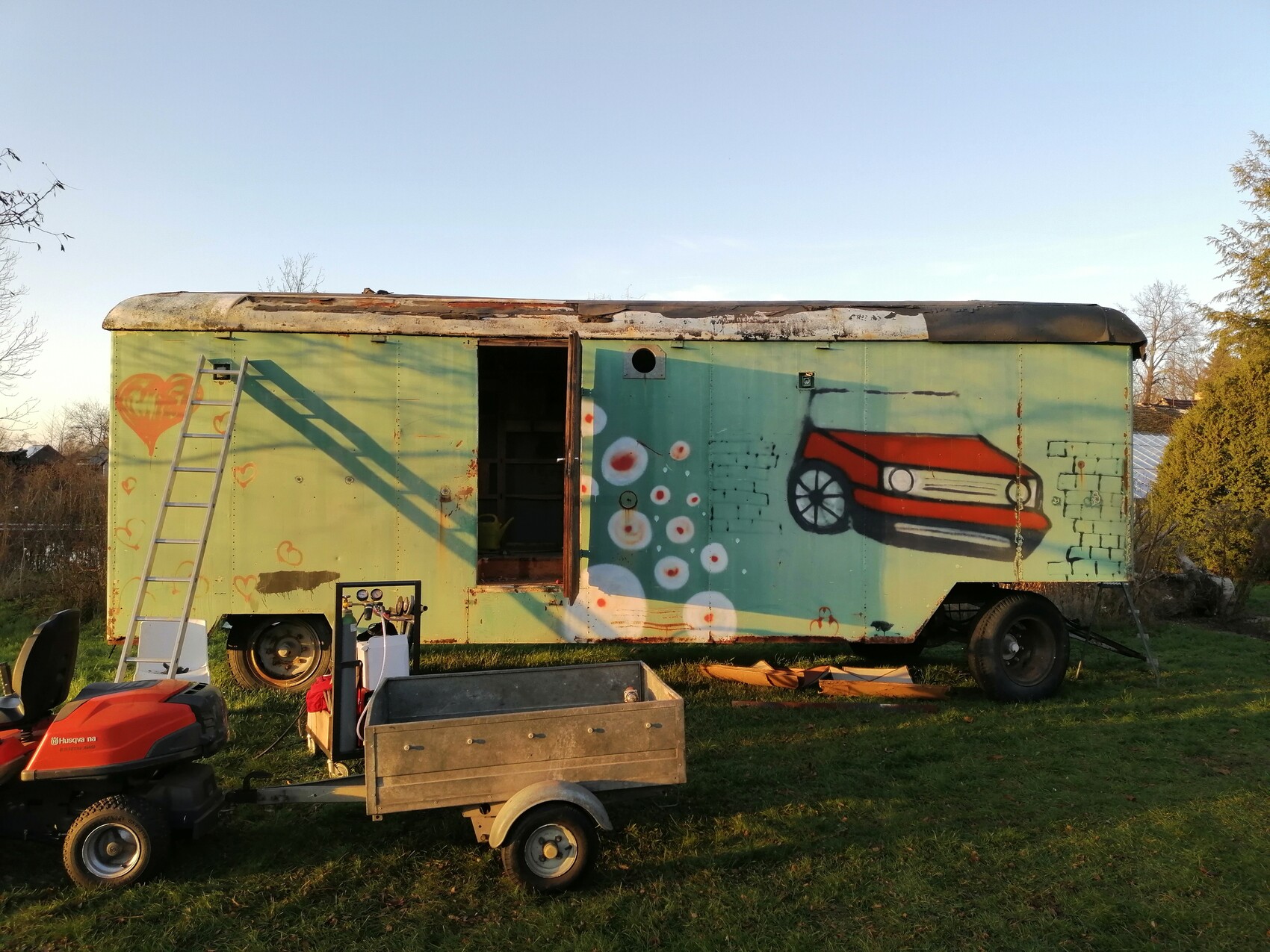
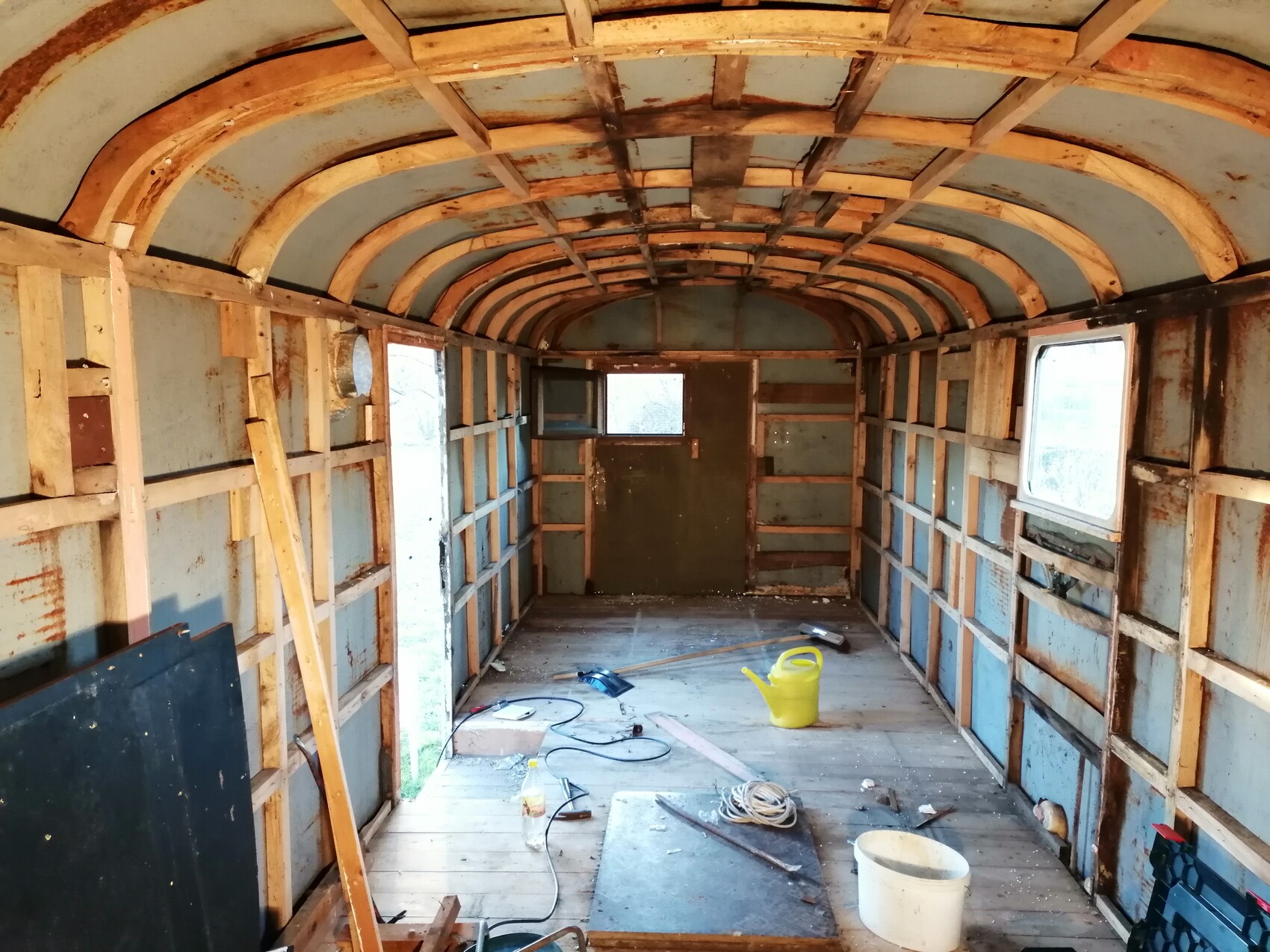
About the pictures: I’m currently in the process of replacing rusty metal sheets and removing the roofing felt from the roof (by the way, any tips on how to do this better than using brute force?). After that, an EPDM roofing membrane will be adhered to the metal roof.
Unfortunately, water has entered the trailer in the past, so some of the battens (all oak, mh) have rotted quite badly and will be replaced.
@MacJoshi There is already a timber frame in place. Basically, I wanted to build the wall exactly as you suggested, but on the inside, I plan to use plywood because I prefer the look.
@Joedreck I will consider the PUR foam, but it is about twice as expensive, so I need to see if my budget allows it. Besides the better insulation, does PUR offer any other advantages?
Regarding the vapor barrier, I assume I will manage to seal it completely on the inside. However, I haven’t yet figured out a good way to seal the gap that forms between the metal sheet and the vapor barrier. I’m concerned that moisture might enter the cavity from the outside otherwise.
About the pictures: I’m currently in the process of replacing rusty metal sheets and removing the roofing felt from the roof (by the way, any tips on how to do this better than using brute force?). After that, an EPDM roofing membrane will be adhered to the metal roof.
Unfortunately, water has entered the trailer in the past, so some of the battens (all oak, mh) have rotted quite badly and will be replaced.
Then immediately check if you can insulate the roof from the outside. Somehow. This is simpler in terms of construction.
Advantage of PUR: thinner thickness, same effect as EPS (expanded polystyrene). So more living space.
Then there is some space left for OSB3 boards on the inside. You can fully line with these. If you manage to make it airtight, it also counts as a vapor barrier.
It must be airtight from the outside. Absolutely. If moisture penetrates from the outside, mold can develop faster than you can imagine.
Advantage of PUR: thinner thickness, same effect as EPS (expanded polystyrene). So more living space.
Then there is some space left for OSB3 boards on the inside. You can fully line with these. If you manage to make it airtight, it also counts as a vapor barrier.
It must be airtight from the outside. Absolutely. If moisture penetrates from the outside, mold can develop faster than you can imagine.
Similar topics