
Hello,
Last year, we bought a bungalow built in 1974.
Before the purchase, we viewed the house four times. At that time, it had been unoccupied for about six months. During the inspections, we thoroughly checked for mold and even removed wallpaper in several places to make sure there was no mold present.
At the time of purchase, the house had double-glazed wooden windows and no significant insulation. Only the flat roof was insulated with 10 cm (4 inches) of polystyrene, which, according to the previous owner, was added in the 2000s.
After buying the house, we took the following measures:
Now to my problem and possible solutions:
For about two months, we have noticed mold forming in the corners of the exterior walls. The walls are painted, no wallpaper.
The strange thing is that there was no mold in these areas before we bought the house.
My questions:
I am very grateful for any kind of response.
Best regards
Julia
Last year, we bought a bungalow built in 1974.
Before the purchase, we viewed the house four times. At that time, it had been unoccupied for about six months. During the inspections, we thoroughly checked for mold and even removed wallpaper in several places to make sure there was no mold present.
At the time of purchase, the house had double-glazed wooden windows and no significant insulation. Only the flat roof was insulated with 10 cm (4 inches) of polystyrene, which, according to the previous owner, was added in the 2000s.
After buying the house, we took the following measures:
- The roof was renovated by adding another layer of 10 cm (4 inches) polystyrene insulation on top of the existing flat roof structure.
- Triple-glazed PVC windows were installed.
- Underfloor heating was installed, and 5 cm (2 inches) of polystyrene insulation was placed under the screed.
- The exterior walls in the ground area (from the concrete slab up to about 0.5 m (1.5 feet) above ground level) were insulated.
Now to my problem and possible solutions:
For about two months, we have noticed mold forming in the corners of the exterior walls. The walls are painted, no wallpaper.
The strange thing is that there was no mold in these areas before we bought the house.
My questions:
- Can this problem be solved by adding external insulation (about 20 cm (8 inches) of polystyrene)?
- What about ventilation? There are ventilation systems that can be installed. Does anyone have experience with them? Are such ventilation systems absolutely necessary?
I am very grateful for any kind of response.
Best regards
Julia
 ateliersiegel3 Jan 2025 17:42
I understand the alarm caused by mold and believe the problem should be taken seriously.
Panic rarely helps, so it’s important to stay calm, but “mold is not something to take lightly.” It usually doesn’t turn into a disaster quickly, but careful attention is necessary.
My wife has asthma triggered by prolonged, undetected exposure to mold. It’s manageable, but of course it’s better to avoid it if possible.
I myself—without being an expert—keep in mind that mold is not easy to eliminate. The first step I would take is to find a qualified professional who can inspect the situation on site and whom I can trust. In my opinion, someone like that is needed because the issue is complex.
I wish you all the best! :-)
Panic rarely helps, so it’s important to stay calm, but “mold is not something to take lightly.” It usually doesn’t turn into a disaster quickly, but careful attention is necessary.
My wife has asthma triggered by prolonged, undetected exposure to mold. It’s manageable, but of course it’s better to avoid it if possible.
I myself—without being an expert—keep in mind that mold is not easy to eliminate. The first step I would take is to find a qualified professional who can inspect the situation on site and whom I can trust. In my opinion, someone like that is needed because the issue is complex.
I wish you all the best! :-)

SoL schrieb:
21°C (70°F) and 60-75% relative humidity indicate incorrect ventilation. As we are currently noticing, with the current temperatures, it is actually very easy to ventilate moisture out of the house. For example, recently it was around 0°C (32°F) and foggy here (so the outside relative humidity was about 100%). At first, we were worried that ventilating would bring moisture into the house because of the fog, but after calculating, we realized that the outside air was still much drier. (0°C (32°F) and 100% relative humidity corresponds to 4.85 g/m^3, which when heated to 20°C (68°F) results in only about 28% relative humidity). Of course, it still takes time for the moisture to leave the walls, and yes, the prerequisite is that the heating is on. But right now, I find it much easier to get moisture out of the house than, for example, during rainy days in autumn.

julia123 schrieb:
First of all, I wish you a happy new year! Good health, success, and above all, no problems with your property :-)Thank you very much, I wish you the same!julia123 schrieb:
I have read that cabinets should not be placed too close to exterior walls to allow air circulation.
Today we sprayed all affected spots on the walls with mold remover, opened all windows, and left the house for three hours.Both of these are very good first aid measures and help improve air circulation.julia123 schrieb:
But my husband says that insulation will solve everything.I agree with your husband!After our renovation (an old building from 1912 with, among other things, new, tighter windows), we also had mold on exterior walls during the first winter; what helped was removing/treating the mold, heating continuously more, and ventilating more often; also monitoring humidity with a hygrometer and ventilating or turning up the thermostat as needed (even if it hurts energy-wise).
The following summer, we had proper insulation installed, and since then we haven’t needed to “overheat”; we now ventilate normally in the mornings with manual cross-ventilation.
I would consider installing an automatic ventilation system nowadays; unfortunately, we had to finance the insulation unexpectedly at a high cost (in addition to our ongoing mortgage).
With the external insulation, the indoor climate in the second winter was much more comfortable than before; lower temperatures felt sufficient, and there was no uncomfortable feeling of sitting next to a cold wall.
Since then, there has been no more mold, so this is definitely something that can be managed.
Hello everyone,
Thank you very much for your responses!
Would you approach it the way I described above?
That is: treating the mold with a remover this winter, living with it for now, and then insulating from summer onwards and waiting to see if mold appears again next winter?
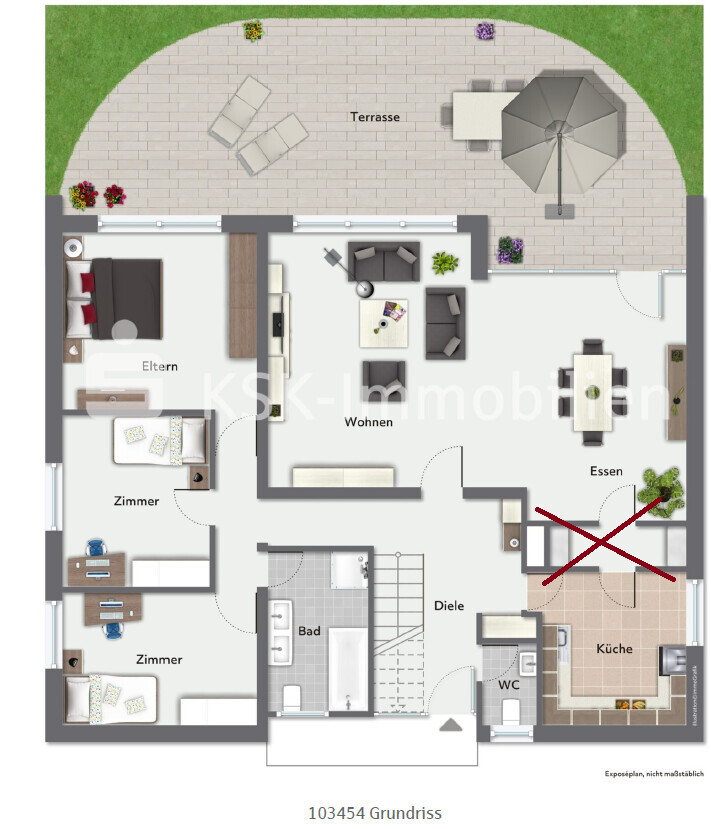
Attached is the floor plan of our house. The two walls between the living/dining room and the kitchen that we removed are marked in red.
I’m interested in learning where exactly decentralized ventilation units should be installed in the house and which models you would recommend.
Does it make sense to not only ventilate occasionally by fully opening windows but also to keep windows tilted open in two rooms to create a cross breeze? Of course, this would only be done when we are not at home, for example while at work.
Thank you in advance for your opinions and advice!
Best regards
Thank you very much for your responses!
Would you approach it the way I described above?
That is: treating the mold with a remover this winter, living with it for now, and then insulating from summer onwards and waiting to see if mold appears again next winter?
Attached is the floor plan of our house. The two walls between the living/dining room and the kitchen that we removed are marked in red.
I’m interested in learning where exactly decentralized ventilation units should be installed in the house and which models you would recommend.
Does it make sense to not only ventilate occasionally by fully opening windows but also to keep windows tilted open in two rooms to create a cross breeze? Of course, this would only be done when we are not at home, for example while at work.
Thank you in advance for your opinions and advice!
Best regards
N
nordanney3 Jan 2025 19:46julia123 schrieb:
So: this winter, fight the mold with remover, accept it for now, and then insulate starting in summer and wait to see if mold appears again next winter? Also increase the heating and ventilate as much as possible. It does cost money, but this is how you get the mold under control after treatment with the remover. Buy a used portable air conditioner (with dehumidifying function) from the book and dry out the place. Costs about a hundred euros.
julia123 schrieb:
Does it make sense not only to ventilate in bursts but also to leave windows tilted open in two rooms to create cross ventilation? Cross ventilation works with windows fully open for 3-5 minutes. That definitely exchanges the air. When you’re not at home, no new humid air gets inside.
julia123 schrieb:
Is that a way to implement the ventilation concept? Yes, with a central system. It doesn’t make sense decentrally because there are no dedicated supply and exhaust rooms. Unless you give up heat recovery—but then you might as well leave the windows tilted and air out the warm air.
I would probably install five decentralized units: living room, kitchen, bedroom, bathroom (maybe only a humidity-controlled exhaust fan here), and child’s room. Possibly one device with higher capacity could cover kitchen and living room.
Once the insulation is installed, it’s more about establishing basic ventilation. If humidity is still too high in autumn despite the fans, you can simply use the air conditioning unit for a few days to fight it and extract moisture from the rooms.
Similar topics