
Hello forum
Here are the key points:
Multi-family house. Built in 1961. Converted attic. Thermal insulation. Above-rafter insulation.
The roof is dry and the roof tiles are old but still watertight.
Now I have received quotes from different roofers mentioning vapor barrier and vapor retarder.
It is not completely clear to me why these are necessary.
I have read that a vapor retarder or vapor barrier is supposed to minimize or prevent moisture entering the thermal insulation.
My question is:
Moisture can also come from the outside air into the thermal insulation.
There are days in winter or summer when the relative humidity is very high.
This humidity also gets into the thermal insulation.
Or am I mistaken?
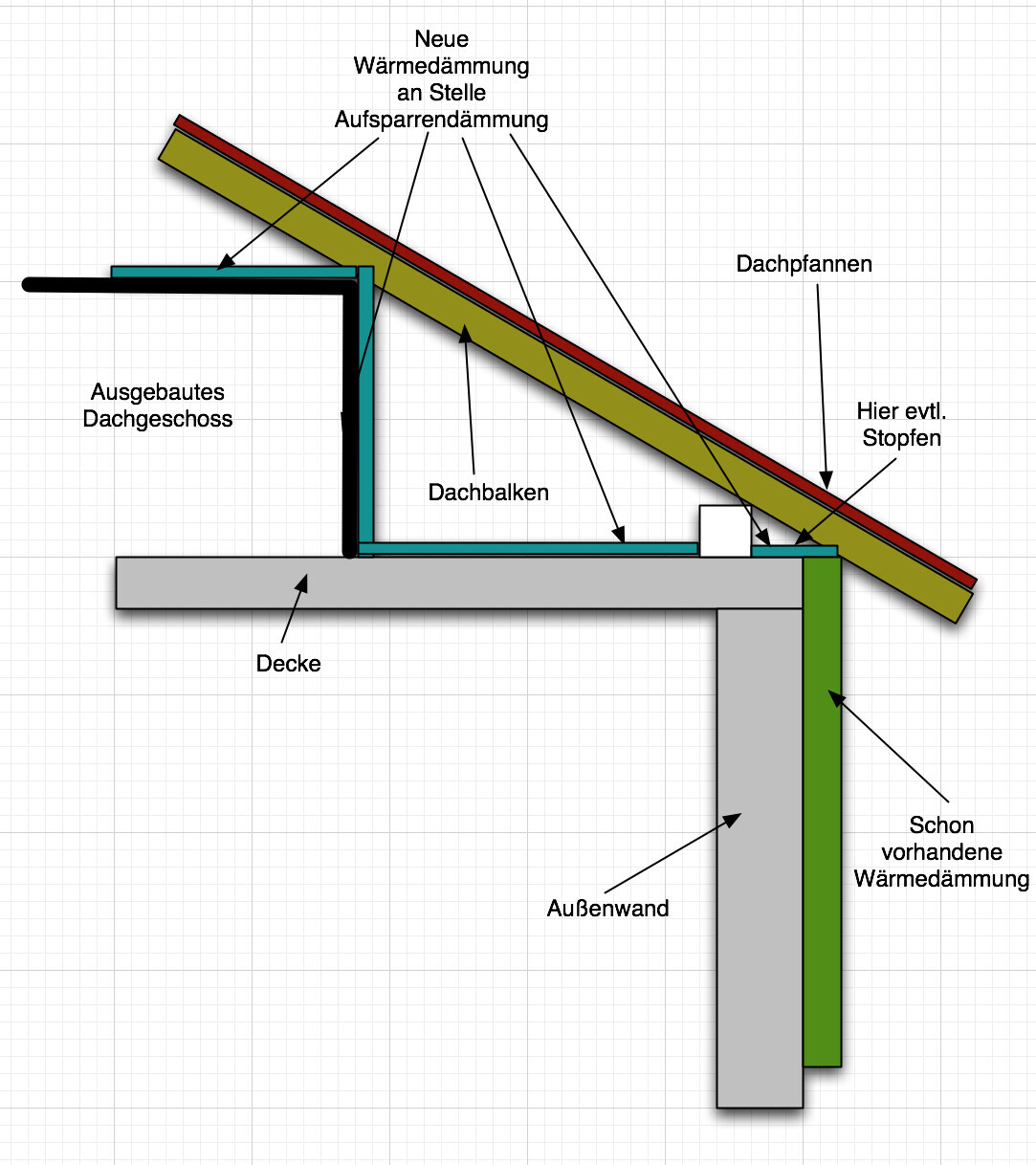
An alternative—which would also be cheaper than above-rafter insulation—would be to insert insulation mats into the space between the roof and attic.
See sketch.
Thank you very much for your feedback.
Jochen
Here are the key points:
Multi-family house. Built in 1961. Converted attic. Thermal insulation. Above-rafter insulation.
The roof is dry and the roof tiles are old but still watertight.
Now I have received quotes from different roofers mentioning vapor barrier and vapor retarder.
It is not completely clear to me why these are necessary.
I have read that a vapor retarder or vapor barrier is supposed to minimize or prevent moisture entering the thermal insulation.
My question is:
Moisture can also come from the outside air into the thermal insulation.
There are days in winter or summer when the relative humidity is very high.
This humidity also gets into the thermal insulation.
Or am I mistaken?
An alternative—which would also be cheaper than above-rafter insulation—would be to insert insulation mats into the space between the roof and attic.
See sketch.
Thank you very much for your feedback.
Jochen
K
Knallkörper26 Sep 2016 14:34Hello,
there is basically no real objection to installing a large vapor barrier on the inside of the rafters. This is practically feasible as long as it is accessible. However, the vapor barrier does not necessarily have to be attached directly under the rafters or insulation. It can also be part of the "wall construction" in the sloped roof area of the converted attic space.
there is basically no real objection to installing a large vapor barrier on the inside of the rafters. This is practically feasible as long as it is accessible. However, the vapor barrier does not necessarily have to be attached directly under the rafters or insulation. It can also be part of the "wall construction" in the sloped roof area of the converted attic space.
Knallkörper schrieb:
Hello,
there is actually no real objection to installing a vapor barrier extensively on the interior side of the rafters. It is practically feasible as long as you can access the area. However, the vapor barrier does not necessarily have to be bonded directly under the rafters or insulation. It can also be part of the "wall assembly" within the sloped roof area in the finished part of the attic.Thank you for the feedback.
Unfortunately, my question is still not answered.
It is said that the vapor barrier / vapor retarder is intended to prevent moisture from the living spaces below from entering the thermal insulation.
However, fundamentally, even with a vapor barrier / vapor retarder, moisture still accumulates at the top of the roof. What happens to that moisture?
What about moisture that enters the thermal insulation from outside through the roof surface?
That moisture is removed by "ventilation" within the insulation layer.
So why is it not possible to allow moisture from the living spaces to enter the insulation and ventilate the insulation layer?
Jochen
K
Knallkörper26 Sep 2016 15:37spassig schrieb:
It is said that the vapor barrier / vapor retarder is supposed to prevent moisture from below (living spaces) from reaching the thermal insulation.
Basically, even with a vapor barrier / vapor retarder, there can still be moisture in the roof above.No, that is actually not correct. I wrote that the insulation needs to be ventilated if moisture from below (the living space) can enter. Moisture from above, meaning from the roof, must never reach the insulation. This is ensured by the roofing underlayment. If you don’t have one, it will be difficult.
spassig schrieb:
So why can’t moisture from the living space enter the thermal insulation and the insulation be ventilated?You can. However, the ventilation must be adequate, and I believe that with your proposed design (installation at the wall and floor with a 90° angle) this will not be possible; instead, you should consider insulating between the rafters.
Knallkörper schrieb:
No, that’s not quite correct. I said that the insulation needs to be ventilated if moisture can enter from below (from the living area). From above, meaning from the roof, moisture must never reach the insulation. That’s what the underlay membrane is for. If you don’t have one, it will be difficult. Thanks for the clarification. I checked the roofer’s offer and I see “laminated vapor-permeable underlay membrane” above the thermal insulation.
(It might also be “laminated aluminum foil,” not sure.)
Knallkörper schrieb:
You can do that. But the ventilation must be “sufficient,” and I believe that with the design you sketched (installation on wall and floor at a 90° angle), that won’t be possible; instead, you should insulate between the rafters.OK, understood. I’ll discuss this with the planner.
The crucial point is:
The house to be renovated, built in 1961, had no problems for about 45 years.
The issues started after unsuitable renovation work around 2007.
Jochen
K
Knallkörper26 Sep 2016 16:05spassig schrieb:
I see a “laminated vapor-permeable underlay membrane” above the insulation.
(It might also be “aluminized laminated,” maybe?As far as I know, there is no aluminized laminated vapor-permeable underlay membrane, so I would assume the following: This underlay membrane is laminated onto the insulation.
Okay, then laminated. I should have figured that out myself since aluminum can’t be vapor-permeable.
Another question.
The two membranes, the vapor barrier below the insulation and the breather membrane above the insulation, need to be sealed together somehow and also sealed against the external environment.
How and with what is this done?
Jochen
Another question.
The two membranes, the vapor barrier below the insulation and the breather membrane above the insulation, need to be sealed together somehow and also sealed against the external environment.
How and with what is this done?
Jochen
Similar topics