
Hello everyone,
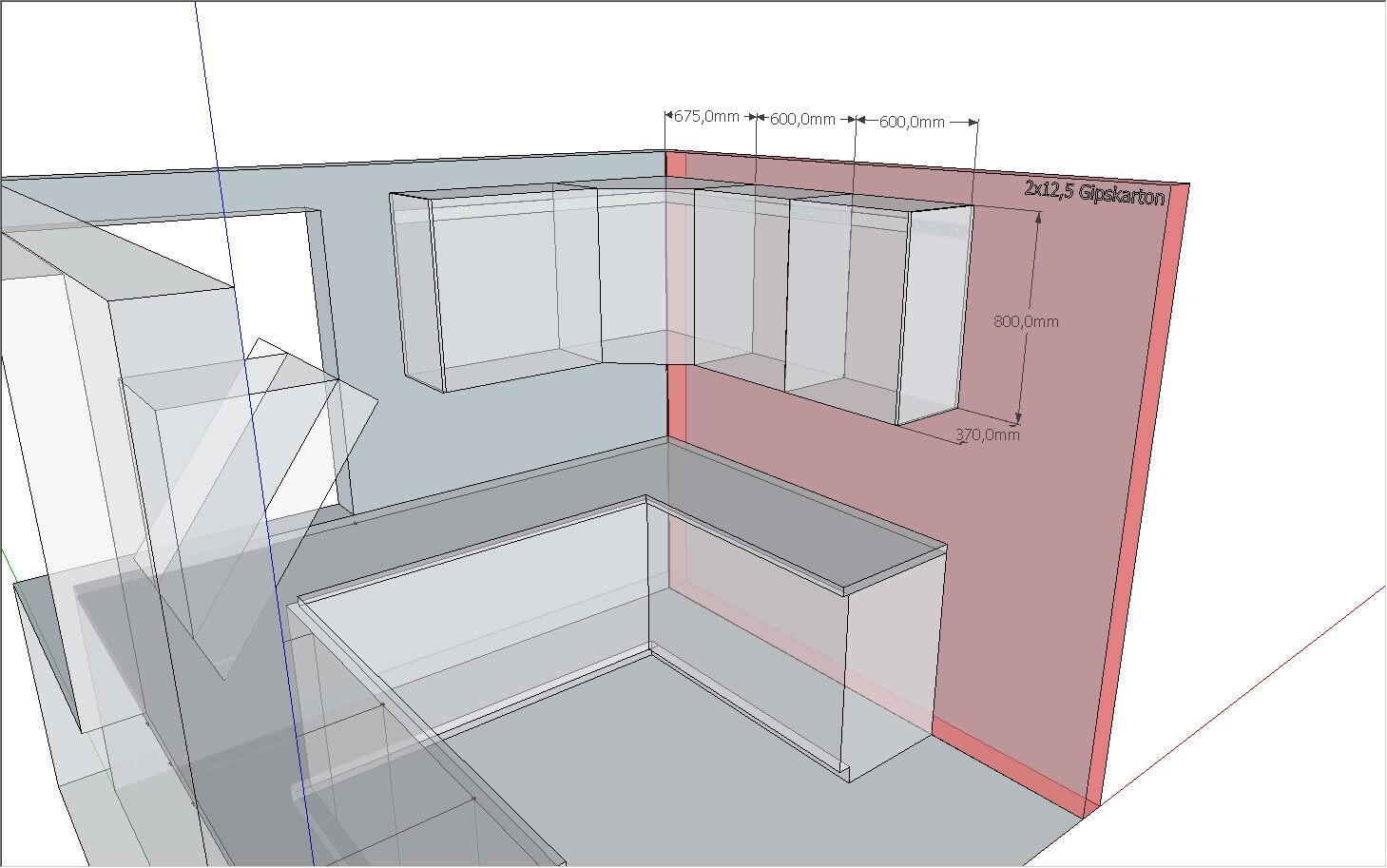
since the installation of the Ikea kitchen in our new build is coming up soon, I have been wondering for several days whether I can mount the wall cabinets on a double-layer gypsum board wall with metal studs. The kitchen has a U-shape, and only one leg of the U is made of gypsum board; the rest is masonry. The cabinets on the drywall wall have a total length of about 1.90m (6 feet 3 inches) and will be hung on a continuous rail. For mounting the rail, I would use metal cavity anchors like the Knauf Hartmut and install around 10 anchors for the 1.9m (6 feet 3 inches) rail.
However, since I have read different specifications regarding the maximum loads or have not fully understood them, I am asking my question here again. According to Knauf, each anchor can support about 55kg (121 pounds). But then I also read that for gypsum boards, a maximum load of 70kg per running meter (45 pounds per foot) is generally allowed. That would be about 140kg (309 pounds) for my kitchen, whereas the anchors would hold 550kg (1,213 pounds).
I also cannot estimate how heavy a fully loaded kitchen cabinet can be (80cm (31 inches) high, 60cm (24 inches) wide). The empty cabinet already weighs around 30kg (66 pounds). If I convert the 70kg per running meter to 60cm (24 inches) width, I get a maximum load of 42kg (93 pounds) for the 60cm (24 inches) wide cabinet. That seems very low to me!
As a backup solution, I had considered attaching metal rails to the back of the cabinets and securing these with an angle bracket to the concrete ceiling. Since the cabinets are quite tall and the gap to the ceiling is about 10-15cm (4-6 inches), this should be barely visible. If necessary, I could also add a front cover panel.
What do you think, is it sufficient to mount the cabinets only with a rail on the wall?
I have attached a 3D graphic to make the situation clearer:
Rear view of the gypsum board wall:
Thanks and best regards,
Sam
since the installation of the Ikea kitchen in our new build is coming up soon, I have been wondering for several days whether I can mount the wall cabinets on a double-layer gypsum board wall with metal studs. The kitchen has a U-shape, and only one leg of the U is made of gypsum board; the rest is masonry. The cabinets on the drywall wall have a total length of about 1.90m (6 feet 3 inches) and will be hung on a continuous rail. For mounting the rail, I would use metal cavity anchors like the Knauf Hartmut and install around 10 anchors for the 1.9m (6 feet 3 inches) rail.
However, since I have read different specifications regarding the maximum loads or have not fully understood them, I am asking my question here again. According to Knauf, each anchor can support about 55kg (121 pounds). But then I also read that for gypsum boards, a maximum load of 70kg per running meter (45 pounds per foot) is generally allowed. That would be about 140kg (309 pounds) for my kitchen, whereas the anchors would hold 550kg (1,213 pounds).
I also cannot estimate how heavy a fully loaded kitchen cabinet can be (80cm (31 inches) high, 60cm (24 inches) wide). The empty cabinet already weighs around 30kg (66 pounds). If I convert the 70kg per running meter to 60cm (24 inches) width, I get a maximum load of 42kg (93 pounds) for the 60cm (24 inches) wide cabinet. That seems very low to me!
As a backup solution, I had considered attaching metal rails to the back of the cabinets and securing these with an angle bracket to the concrete ceiling. Since the cabinets are quite tall and the gap to the ceiling is about 10-15cm (4-6 inches), this should be barely visible. If necessary, I could also add a front cover panel.
What do you think, is it sufficient to mount the cabinets only with a rail on the wall?
I have attached a 3D graphic to make the situation clearer:
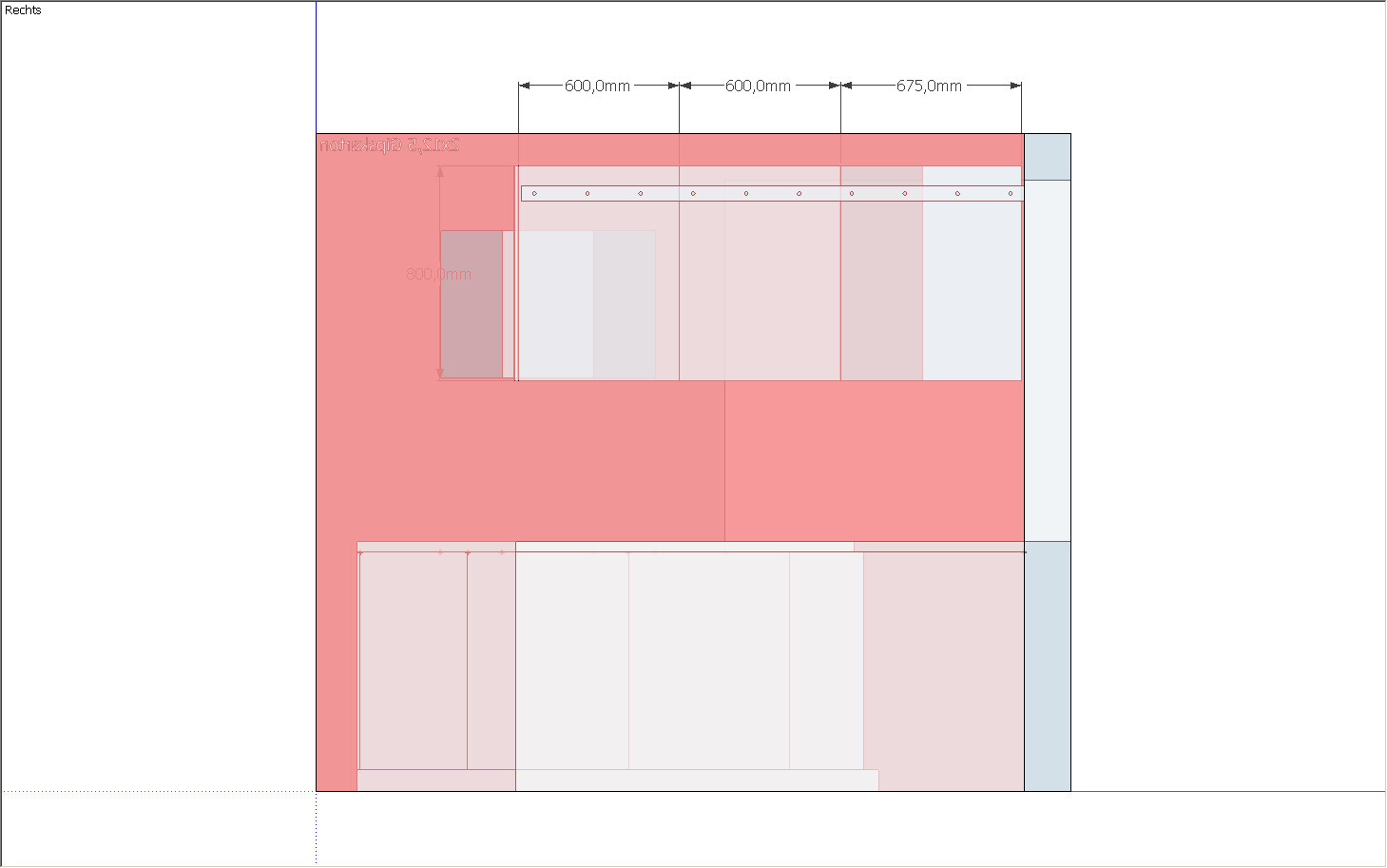
Rear view of the gypsum board wall:
Thanks and best regards,
Sam
C
Caspar202018 May 2016 16:02If it’s one layer of OSB and one layer of gypsum plasterboard, then standard spax screws are sufficient.
So the question is, what do you mean by a double-layered gypsum plasterboard wall?
samfisher schrieb:
double-layered gypsum plasterboard wall
So the question is, what do you mean by a double-layered gypsum plasterboard wall?

S
samfisher18 May 2016 16:28Yes, that's right. According to the current status, the wall is covered with two layers of 12.5mm (0.5 inch) gypsum plasterboard.
I had also seen the HM anchors, but eventually chose the even stronger Knauf or Tox anchors. However, I’m not worried about the anchors failing, but rather about the gypsum plasterboard wall itself not being able to support the load. Looking at your diagram, for a wall cabinet 40cm (16 inches) deep, that means a load depth of 20cm (8 inches) and about 85kg/m (57 lbs/ft). So for my 2m (6.5 ft) cabinets, that would be around 170kg (375 lbs) total.
In theory, wouldn’t it also be possible to secure the mounting rail for the kitchen cabinets not only to the anchors but also directly into the metal stud with an appropriate screw? I can still see the filled screw holes for the plasterboard at the moment...
I had also seen the HM anchors, but eventually chose the even stronger Knauf or Tox anchors. However, I’m not worried about the anchors failing, but rather about the gypsum plasterboard wall itself not being able to support the load. Looking at your diagram, for a wall cabinet 40cm (16 inches) deep, that means a load depth of 20cm (8 inches) and about 85kg/m (57 lbs/ft). So for my 2m (6.5 ft) cabinets, that would be around 170kg (375 lbs) total.
In theory, wouldn’t it also be possible to secure the mounting rail for the kitchen cabinets not only to the anchors but also directly into the metal stud with an appropriate screw? I can still see the filled screw holes for the plasterboard at the moment...

samfisher schrieb:
Wouldn't it theoretically be possible to secure the mounting rail for the kitchen cabinets not only with the wall plugs but also directly into the metal stud using an appropriate screw? I can still see the filled screw holes from the drywall panels...In our previous apartment, the wall was made of natural stone with a drywall mounted in front of it.
I doubt the kitchen installers were able to anchor a wall plug into the natural stone, so the cabinets were likely hanging on the drywall and, at best, the plaster. However, the cabinets were not quite as tall.
Therefore, I think a double-layer backing should be quite stable, and if you manage to hit the stud with the screw, that certainly can’t hurt.
Similar topics