
Hello,
I have a question regarding my rental apartments.
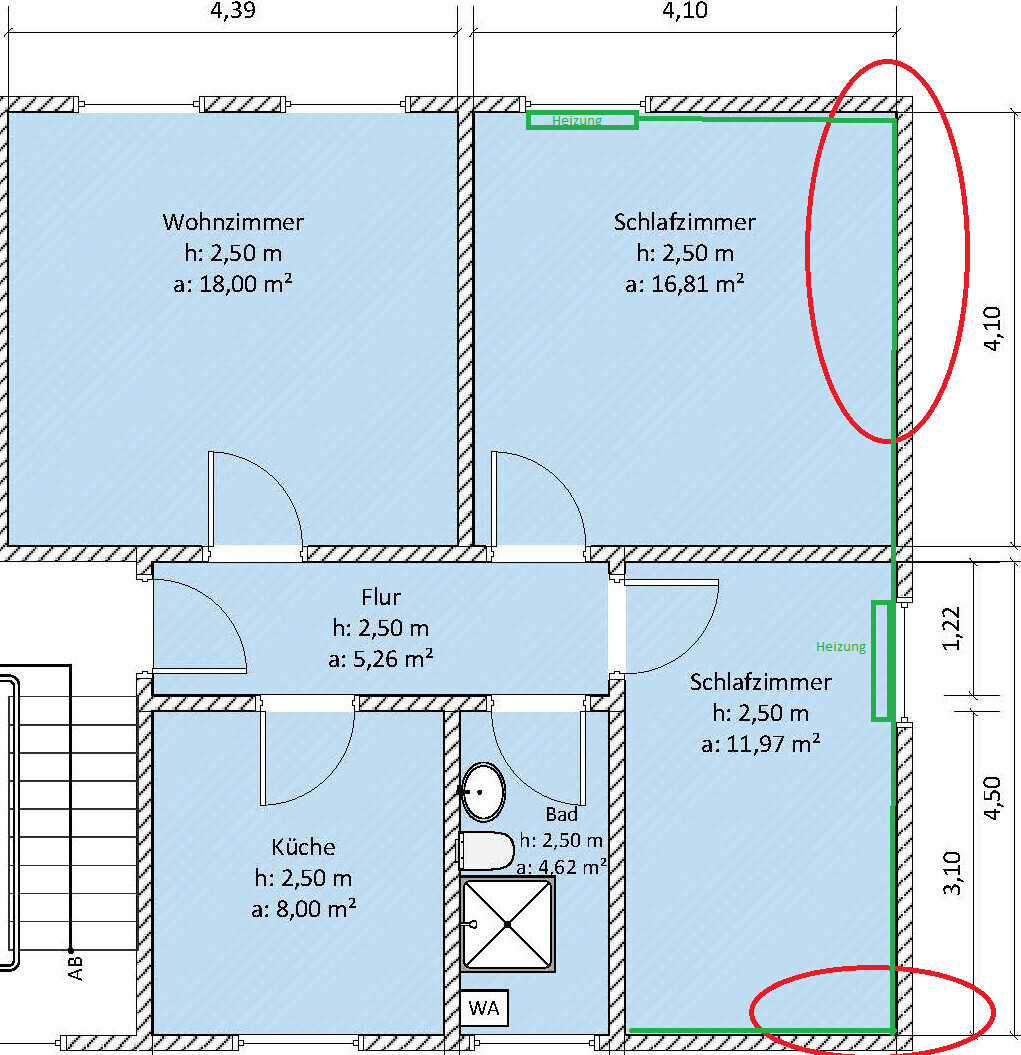
In the rental units, I occasionally find mold spots at the locations circled in red in the picture for some tenants. Several apartments across multiple buildings face this issue, with about 4 out of 12 currently affected.
The exterior wall is a 30cm (12 inches) clay wall, plastered on the outside and painted 5 years ago. There is no additional insulation.
As shown in the picture, the construction promotes mold growth because the windows and doors face each other, and there is no air circulation in the rear corners.
From what I have read, the high indoor humidity caused by activities like sleeping, combined with warm air from heating and the cold exterior walls, causes condensation, leading to mold formation.
Regarding my idea:
Would it be beneficial to install an interior stud wall with insulation, a vapor barrier, and plasterboard on the exterior walls?
My hope is that the heating pipes running between the exterior wall and the new stud wall (shown in green in the picture) would create a warm insulating layer.
This could reduce mold growth and slightly lower heating costs. Given the room layout, I probably won’t be able to completely eliminate the problem if tenants ventilate or heat incorrectly. However, I want to at least ensure that normal ventilation and heating are sufficient.
A full exterior wall insulation is currently not possible for economic reasons.
I have a question regarding my rental apartments.
In the rental units, I occasionally find mold spots at the locations circled in red in the picture for some tenants. Several apartments across multiple buildings face this issue, with about 4 out of 12 currently affected.
The exterior wall is a 30cm (12 inches) clay wall, plastered on the outside and painted 5 years ago. There is no additional insulation.
As shown in the picture, the construction promotes mold growth because the windows and doors face each other, and there is no air circulation in the rear corners.
From what I have read, the high indoor humidity caused by activities like sleeping, combined with warm air from heating and the cold exterior walls, causes condensation, leading to mold formation.
Regarding my idea:
Would it be beneficial to install an interior stud wall with insulation, a vapor barrier, and plasterboard on the exterior walls?
My hope is that the heating pipes running between the exterior wall and the new stud wall (shown in green in the picture) would create a warm insulating layer.
This could reduce mold growth and slightly lower heating costs. Given the room layout, I probably won’t be able to completely eliminate the problem if tenants ventilate or heat incorrectly. However, I want to at least ensure that normal ventilation and heating are sufficient.
A full exterior wall insulation is currently not possible for economic reasons.
Specki schrieb:
The apartment is going to be rented out as a shared flat. All the fans run through a central control unit. I can install that outside the apartment ^^"Sorry, I don’t know why the fans keep breaking."N
nordanney6 May 2020 20:40Specki schrieb:
As I said, we manage it well, but we also do intensive ventilation 2-3 times a day. I can't expect a tenant to do the same.Unfortunately, that is the risk you take as a landlord. The only solution is a reasonable cooperation. As a landlord, you (unfortunately) have very limited rights. And Tassimat was also explaining what can happen. By controlling the central unit in that way with the tenant, it’s as if you enter their apartment five times a day to ventilate—using your own apartment key, which you are not legally allowed to have.That wasn’t entirely serious about installing the control unit outside the apartment.
And yes, having a reasonable cooperation between parties involved is the most important thing.
But if there is a ventilation system, the chance of mold and related problems is lower. And if mold still occurs, you can check whether the system is running.
With a system, the likelihood that everything will be fine is quite high, I would say. Without a system, mold is very likely to develop.
Or am I mistaken?
If so, what could I do better?
And yes, having a reasonable cooperation between parties involved is the most important thing.
But if there is a ventilation system, the chance of mold and related problems is lower. And if mold still occurs, you can check whether the system is running.
With a system, the likelihood that everything will be fine is quite high, I would say. Without a system, mold is very likely to develop.
Or am I mistaken?
If so, what could I do better?
K
kasimir_827 May 2020 10:08Do you have examples of this type of residential ventilation system? Will I probably need to install it in every room?
How loud is such a system, and doesn’t having a hole to the outside cause heat loss?
How loud is such a system, and doesn’t having a hole to the outside cause heat loss?
I have focused on the system from the company Südwind.
It is beneficial in every "relevant" room.
I install it everywhere except in the pantry and the hallway with the dining area.
The noise level is listed in the datasheet, but I cannot comment on it from personal experience.
The system has a quite high heat recovery rate. So, I believe in the end, not much more heat will be lost compared to regular ventilation.
It is beneficial in every "relevant" room.
I install it everywhere except in the pantry and the hallway with the dining area.
The noise level is listed in the datasheet, but I cannot comment on it from personal experience.
The system has a quite high heat recovery rate. So, I believe in the end, not much more heat will be lost compared to regular ventilation.
K
knalltüte9 May 2020 22:52Specki schrieb:
... south wind ... The system has a fairly high heat recovery rate. So, I think in the end, not much more heat will be lost compared to normal ventilation.Estimated to result in less heat loss than "normal ventilation." According to Südwind, 93% recovery rate
=> approximately 7% loss (similar to controlled residential ventilation with a cross-flow heat exchanger).
But is the wall structure really just a "30cm (12 inch) clay wall" and nothing else?
(except plaster on the outside and wallpaper/paint on the inside)
Year of construction?
I have an old house myself (~270 years) with various traditional materials. I have learned that the house should not be too airtight. Otherwise, building damage due to moisture/water will occur.
The shift of the dew point with internal insulation has already been mentioned. That would be very dangerous if not done correctly!
Presumably, a partial renovation (windows?) has already taken place here, which may have caused the problem in the first place?
Here: consult a professional, carry out proper follow-up renovations.
Half measures usually don't pay off. Also consider the tax implications (again, ask a professional).
Perhaps it is still worthwhile?
Similar topics