
Hello,
I have a question regarding my rental apartments.
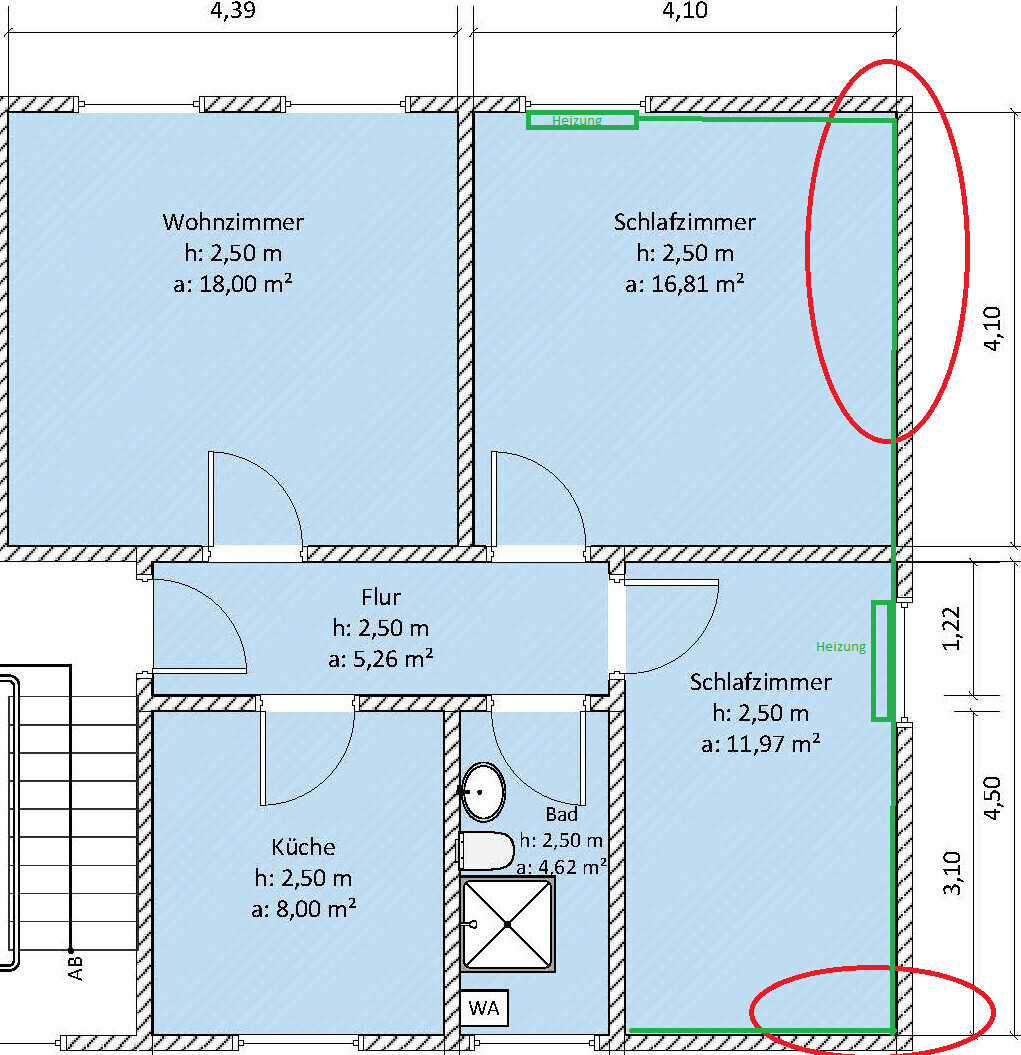
In the rental units, I occasionally find mold spots at the locations circled in red in the picture for some tenants. Several apartments across multiple buildings face this issue, with about 4 out of 12 currently affected.
The exterior wall is a 30cm (12 inches) clay wall, plastered on the outside and painted 5 years ago. There is no additional insulation.
As shown in the picture, the construction promotes mold growth because the windows and doors face each other, and there is no air circulation in the rear corners.
From what I have read, the high indoor humidity caused by activities like sleeping, combined with warm air from heating and the cold exterior walls, causes condensation, leading to mold formation.
Regarding my idea:
Would it be beneficial to install an interior stud wall with insulation, a vapor barrier, and plasterboard on the exterior walls?
My hope is that the heating pipes running between the exterior wall and the new stud wall (shown in green in the picture) would create a warm insulating layer.
This could reduce mold growth and slightly lower heating costs. Given the room layout, I probably won’t be able to completely eliminate the problem if tenants ventilate or heat incorrectly. However, I want to at least ensure that normal ventilation and heating are sufficient.
A full exterior wall insulation is currently not possible for economic reasons.
I have a question regarding my rental apartments.
In the rental units, I occasionally find mold spots at the locations circled in red in the picture for some tenants. Several apartments across multiple buildings face this issue, with about 4 out of 12 currently affected.
The exterior wall is a 30cm (12 inches) clay wall, plastered on the outside and painted 5 years ago. There is no additional insulation.
As shown in the picture, the construction promotes mold growth because the windows and doors face each other, and there is no air circulation in the rear corners.
From what I have read, the high indoor humidity caused by activities like sleeping, combined with warm air from heating and the cold exterior walls, causes condensation, leading to mold formation.
Regarding my idea:
Would it be beneficial to install an interior stud wall with insulation, a vapor barrier, and plasterboard on the exterior walls?
My hope is that the heating pipes running between the exterior wall and the new stud wall (shown in green in the picture) would create a warm insulating layer.
This could reduce mold growth and slightly lower heating costs. Given the room layout, I probably won’t be able to completely eliminate the problem if tenants ventilate or heat incorrectly. However, I want to at least ensure that normal ventilation and heating are sufficient.
A full exterior wall insulation is currently not possible for economic reasons.
N
nordanney6 May 2020 16:27Specki schrieb:
Install a decentralized ventilation system? Too expensive (even if tax-deductible). The tenant should just ventilate more instead.
As an owner-occupier, I would of course have a different opinion.
nordanney schrieb:
Too expensive (even though it is tax-deductible). The tenant should just ventilate more instead.
As an owner-occupier, I would of course have a different opinion.Interestingly, it is exactly the opposite for us now.
We are installing the system in the rented apartment, not in our own.
We have the problem under control by ventilating a lot. The landlord probably won’t be motivated to ventilate enough to prevent mold. And that will only cause trouble. That’s why we are installing a ventilation system and calling it a day.
N
nordanney6 May 2020 20:22Specki schrieb:
It will be included in the lease agreement that the system must be running. That’s a very delicate matter. Who pays for the electricity? You’d be imposing additional costs on the tenant.
And what if the system runs at “1” but that’s not enough? Does it have to operate 24 hours a day?
This should be agreed upon with the tenant. Forced requirements usually have no legal standing.
Specki schrieb:
The tenant knows this in advance and has to accept it or not rent a room in the apartment. There are many things tenants say “Sure” to but are not legally bound to comply with.
Ok, so what should be done in such a case?
I know that if you don’t ventilate very consistently, mold will quickly appear in the corners.
As I said, we manage it well, but we also ventilate thoroughly 2-3 times a day. I can’t expect a tenant to do that as well.
The apartment will be rented out as a shared flat. All the fans are controlled by a central control unit. I can install that outside the apartment ^^
I know that if you don’t ventilate very consistently, mold will quickly appear in the corners.
As I said, we manage it well, but we also ventilate thoroughly 2-3 times a day. I can’t expect a tenant to do that as well.
The apartment will be rented out as a shared flat. All the fans are controlled by a central control unit. I can install that outside the apartment ^^
Similar topics