
Hello everyone,
we have built a single-family house and have installed a heat pump (Nibe) with underfloor heating, among other things. Since we are currently gaining our first experience with this technology, I have a question about the flow temperature.
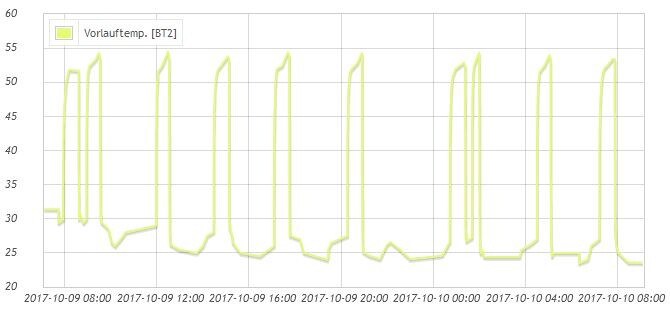
I have noticed that we repeatedly experience short-term increases in the flow temperature. Over 24 hours, there are cyclical rises (about 10 times) up to a temperature of 50°C (122°F), even though the current outdoor temperature is 12/13°C (54/55°F) and the flow temperature specified by the heating curve is 26°C (79°F). Of course, this leads to corresponding electricity consumption. Is this normal? I can hardly imagine that...
we have built a single-family house and have installed a heat pump (Nibe) with underfloor heating, among other things. Since we are currently gaining our first experience with this technology, I have a question about the flow temperature.
I have noticed that we repeatedly experience short-term increases in the flow temperature. Over 24 hours, there are cyclical rises (about 10 times) up to a temperature of 50°C (122°F), even though the current outdoor temperature is 12/13°C (54/55°F) and the flow temperature specified by the heating curve is 26°C (79°F). Of course, this leads to corresponding electricity consumption. Is this normal? I can hardly imagine that...
Have you properly configured the heat pump otherwise? Was a hydraulic balancing carried out, and was the heating curve adjusted accordingly? This is crucial for the heat pump.
I hope 30°C (86°F) supply temperature at 10°C (50°F) above zero is not for a new building and that it is connected to radiators?
I hope 30°C (86°F) supply temperature at 10°C (50°F) above zero is not for a new building and that it is connected to radiators?


Alex85 schrieb:
I also doubt the values from the BT2 sensor. Just look at the rapid increase and subsequent drop in the measurements. That has nothing to do with water temperatures, which don’t behave so “digital.” That’s exactly how the temperature readings for flow and return look for us. When hot water is supplied, the temperatures briefly jump from the current level up to around 50°C (122°F) and then quickly drop again.I think I can solve the problem. For us, it seems to be related to the hot water system. I completely turned it off last night. And as you can see, those spikes are no longer present. However, they occur more frequently in the early morning hours now. Whether this is better in terms of electricity consumption? I’m currently doubtful...
You can check this at the electric meter, or do you only have one?
Watch the compressor starts carefully. The goal is to have as few as possible with as long a runtime as possible.
Otherwise, try to heat the hot water tank only 1-2 times. Especially if no one is home during the day. Does anyone shower at night?
Shift work or something like that?
Watch the compressor starts carefully. The goal is to have as few as possible with as long a runtime as possible.
Otherwise, try to heat the hot water tank only 1-2 times. Especially if no one is home during the day. Does anyone shower at night?
Shift work or something like that?
Similar topics