
Hello everyone,
we have built a single-family house and have installed a heat pump (Nibe) with underfloor heating, among other things. Since we are currently gaining our first experience with this technology, I have a question about the flow temperature.
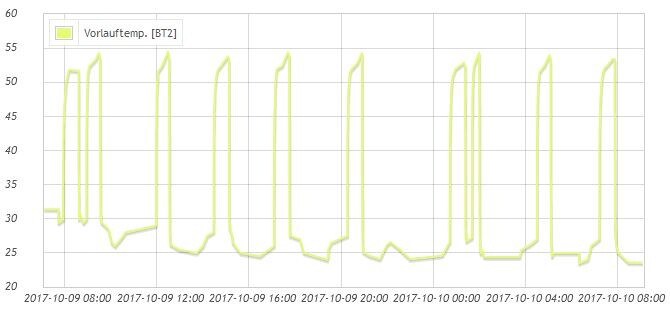
I have noticed that we repeatedly experience short-term increases in the flow temperature. Over 24 hours, there are cyclical rises (about 10 times) up to a temperature of 50°C (122°F), even though the current outdoor temperature is 12/13°C (54/55°F) and the flow temperature specified by the heating curve is 26°C (79°F). Of course, this leads to corresponding electricity consumption. Is this normal? I can hardly imagine that...
we have built a single-family house and have installed a heat pump (Nibe) with underfloor heating, among other things. Since we are currently gaining our first experience with this technology, I have a question about the flow temperature.
I have noticed that we repeatedly experience short-term increases in the flow temperature. Over 24 hours, there are cyclical rises (about 10 times) up to a temperature of 50°C (122°F), even though the current outdoor temperature is 12/13°C (54/55°F) and the flow temperature specified by the heating curve is 26°C (79°F). Of course, this leads to corresponding electricity consumption. Is this normal? I can hardly imagine that...
In any case, frequent hot water heating is quite costly. Another possibility is that a valve might not close properly, allowing some heat from the hot water system to enter the heating circuit. This was the case for us with a new heating system due to a manufacturing defect in the valve. The customer service replaced it, and then everything was fine. You should keep an eye on whether the supply line temperature increases during hot water heating, and possibly measure it yourself. For us, the temperature was also noticeably high at the heating circuit manifold.
Otherwise, I also find the supply temperature of 10°C (50°F) overall too high; for us, it is about 22°C (72°F).
Otherwise, I also find the supply temperature of 10°C (50°F) overall too high; for us, it is about 22°C (72°F).