
ᐅ Heat pump is not compatible with a hydronic (water-heated) fireplace.
Created on: 20 Oct 2023 18:54
J
Jessica388J
Jessica38820 Oct 2023 18:54Hello everyone,
I hope someone here can help us because our heating engineer doesn’t seem to be able to…
Key data
New build 2022 with 250 m² (2,691 ft²)
Heat pump Viessmann Vitocal 200-A
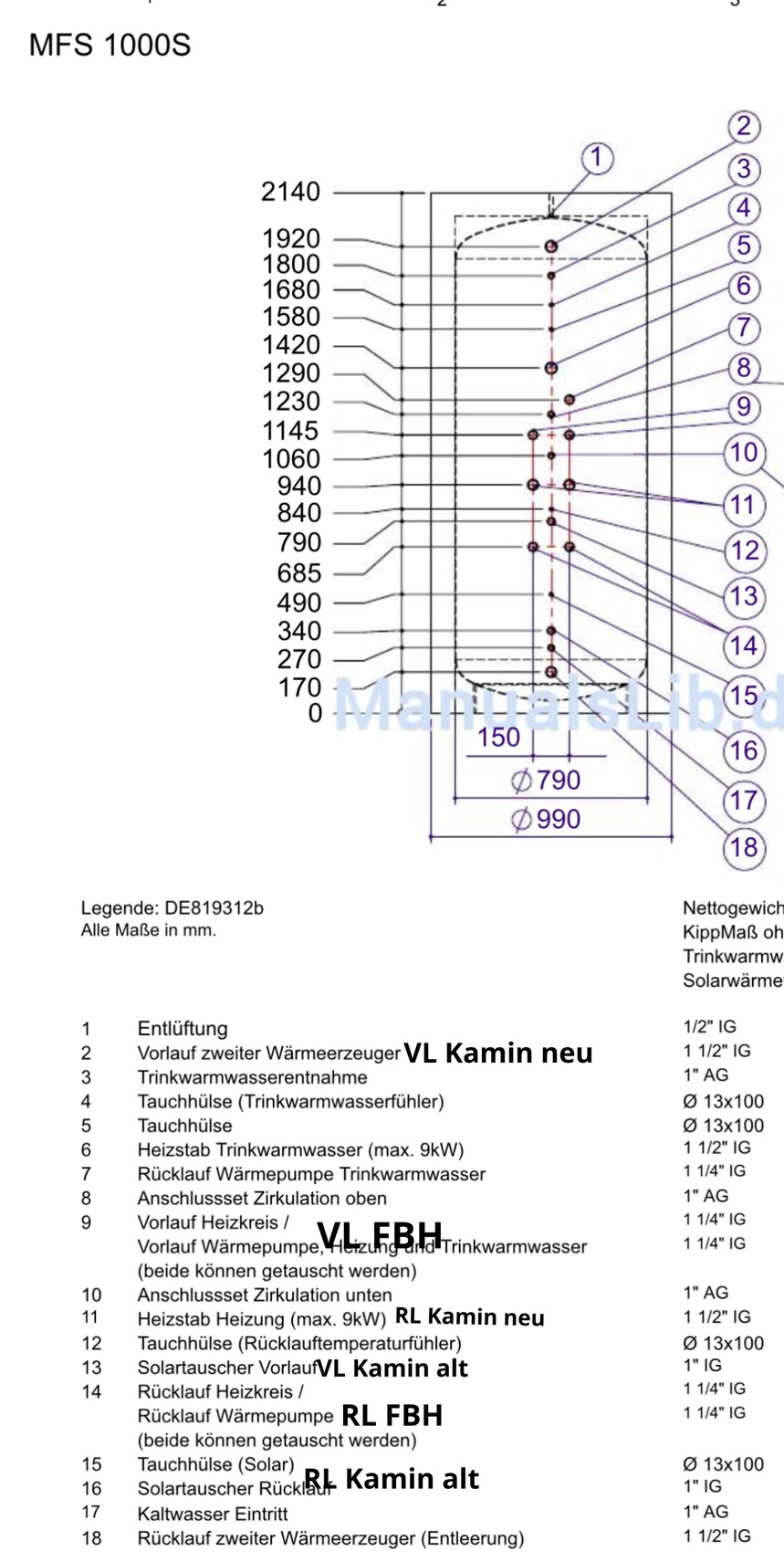
Multifunction storage tank MFS1000S
Water-heated stove with heating capacity on the water side of 8 kW
Photovoltaic system
Electric heating element
I am attaching the schematic of the storage tank layout.
The stove was initially connected under “old” and now it has been modified.
Everything works fine as long as the underfloor heating is off.
When the underfloor heating is on, our hot water temperature doesn’t exceed about 55°C (131°F).
When the underfloor heating is off, the temperature ranges between 65–75°C (149–167°F), either via the electric heating element during sunshine or by stoking the stove.
Now, however, this energy seems to be wasted. It can’t be that the underfloor heating requires 70°C (158°F) supply temperature to achieve a flow temperature of 35°C (95°F), right? The return water is only slightly cooler. So the water should only need to be heated by a maximum of 5°C (9°F).
We assume either a) something is still connected incorrectly, or b) the cold water from the underfloor heating causes such circulation that the hot water cools down within minutes.
What can be done about this?
Has anyone experienced similar problems?
Normally, we should almost run without electric power, but currently the heat pump switches on almost every hour to heat hot water…
I hope someone here can help us because our heating engineer doesn’t seem to be able to…
Key data
New build 2022 with 250 m² (2,691 ft²)
Heat pump Viessmann Vitocal 200-A
Multifunction storage tank MFS1000S
Water-heated stove with heating capacity on the water side of 8 kW
Photovoltaic system
Electric heating element
I am attaching the schematic of the storage tank layout.
The stove was initially connected under “old” and now it has been modified.
Everything works fine as long as the underfloor heating is off.
When the underfloor heating is on, our hot water temperature doesn’t exceed about 55°C (131°F).
When the underfloor heating is off, the temperature ranges between 65–75°C (149–167°F), either via the electric heating element during sunshine or by stoking the stove.
Now, however, this energy seems to be wasted. It can’t be that the underfloor heating requires 70°C (158°F) supply temperature to achieve a flow temperature of 35°C (95°F), right? The return water is only slightly cooler. So the water should only need to be heated by a maximum of 5°C (9°F).
We assume either a) something is still connected incorrectly, or b) the cold water from the underfloor heating causes such circulation that the hot water cools down within minutes.
What can be done about this?
Has anyone experienced similar problems?
Normally, we should almost run without electric power, but currently the heat pump switches on almost every hour to heat hot water…
R
RotorMotor20 Oct 2023 19:24What exactly is your problem?
Is there a real issue, or is it just that you can't imagine how many tons of screed could cool down such a small storage so quickly?
How is the heating loop connected? Is there a mixing valve and a dedicated pump?
Is there a real issue, or is it just that you can't imagine how many tons of screed could cool down such a small storage so quickly?
How is the heating loop connected? Is there a mixing valve and a dedicated pump?
J
Jessica38820 Oct 2023 19:31RotorMotor schrieb:
What exactly is your problem?
Is there a real issue, or is it just that you can’t imagine how many tons of screed can’t cool down such a small tank quickly?
How is the heating circuit connected? Is there a mixing valve and a dedicated pump? Yes, we probably can’t imagine it.
Because if I have 75 degrees and the underfloor heating only loses about 5 degrees, it should only have to make up for that, right?
Sorry if I’m asking a silly question, I am an industrial clerk and have no expertise in this area.
I don’t know what you mean by “how the heating circuit is connected.”
Here is another picture. We have one pump for the underfloor heating and one for the stove.
R
RotorMotor20 Oct 2023 19:49Jessica388 schrieb:
Yes, we probably can’t really imagine it.
Because if I have 75 degrees and the underfloor heating only loses about 5 degrees, it just needs to compensate for that loss, right? Can you find it easier to imagine if you think of taking 5 times 5 degrees from the storage tank?
In other words, with each full cycle through the screed, 5 degrees are missing in the tank.
Of course, this is not a stepwise process but a continuous one, yet heat is constantly transferred from the storage tank to the screed.
1 ton of water storage to 30 tons of screed.
That means roughly (simplified), if I cool down the storage tank by 30 degrees, the screed has only become about 1 degree warmer.
B
Buchsbaum20 Oct 2023 22:17I’m not an expert, but I’ll try to explain. Please don’t take it too seriously. I don’t have much knowledge about heat pump systems.
You have a buffer tank with an electric heating element, a supply and return line for the wood stove, and a supply and return line for the heat pump.
You draw your domestic hot water from part of the buffer tank. The hot water temperature should be at least 55°C (131°F), preferably 65°C (149°F).
When do you heat with the wood stove? Surely not when the outside temperature is 20°C (68°F). But what if, like today, there is no sunshine and the photovoltaic output is almost zero?
Theoretically, everything sounds good. I would have installed the domestic hot water system and the heat pump separately. Technically, your domestic hot water is functioning like a tankless water heater. So today your hot water is generated electrically. I assume the heat pump is trying to contribute to the hot water production as well.
I think there are issues with the control system, priority switching, and so on.
Your buffer tank consists of three parts: the heating water storage, the solar heat exchanger, and the domestic hot water heat exchanger.
It’s surprising that your domestic hot water heat exchanger only has a volume of 56 liters (15 gallons). The solar heat exchanger only holds 17 liters (4.5 gallons). You said two heating elements are installed, each with 9 kW. So when your hot water is heated on demand, your electricity meter runs at 18 kW. You must have a cheap electricity provider, or you shower very little.
The wood stove only heats the heating circuit. The heat pump supply line will always keep the water at about 35°C (95°F) supply temperature. You have 250 square meters (2,690 square feet) of living space. The water will cool down by much more than just 5 degrees. When I heat with a 50°C (122°F) supply, about 20°C (68°F) return arrives at the oil boiler. After all, the heat has to come from somewhere inside the house, and underfloor heating is basically a large heat exchanger as well.
An 8 kW heating output from the wood stove, including water heating, is quite low.
At least you were smart enough to have a wood stove installed. Many people don’t have that. When I come home frozen from skiing in winter, I want to sit by a warm stove or at least a hot radiator—not in a minimally heated house. People get older. I’m old enough to decide how I want to heat. I don’t need any green moralists telling me to save the planet with my heating system while you fly somewhere for 50 euros. No, thank you.
You have a buffer tank with an electric heating element, a supply and return line for the wood stove, and a supply and return line for the heat pump.
You draw your domestic hot water from part of the buffer tank. The hot water temperature should be at least 55°C (131°F), preferably 65°C (149°F).
When do you heat with the wood stove? Surely not when the outside temperature is 20°C (68°F). But what if, like today, there is no sunshine and the photovoltaic output is almost zero?
Theoretically, everything sounds good. I would have installed the domestic hot water system and the heat pump separately. Technically, your domestic hot water is functioning like a tankless water heater. So today your hot water is generated electrically. I assume the heat pump is trying to contribute to the hot water production as well.
I think there are issues with the control system, priority switching, and so on.
Your buffer tank consists of three parts: the heating water storage, the solar heat exchanger, and the domestic hot water heat exchanger.
It’s surprising that your domestic hot water heat exchanger only has a volume of 56 liters (15 gallons). The solar heat exchanger only holds 17 liters (4.5 gallons). You said two heating elements are installed, each with 9 kW. So when your hot water is heated on demand, your electricity meter runs at 18 kW. You must have a cheap electricity provider, or you shower very little.
The wood stove only heats the heating circuit. The heat pump supply line will always keep the water at about 35°C (95°F) supply temperature. You have 250 square meters (2,690 square feet) of living space. The water will cool down by much more than just 5 degrees. When I heat with a 50°C (122°F) supply, about 20°C (68°F) return arrives at the oil boiler. After all, the heat has to come from somewhere inside the house, and underfloor heating is basically a large heat exchanger as well.
An 8 kW heating output from the wood stove, including water heating, is quite low.
At least you were smart enough to have a wood stove installed. Many people don’t have that. When I come home frozen from skiing in winter, I want to sit by a warm stove or at least a hot radiator—not in a minimally heated house. People get older. I’m old enough to decide how I want to heat. I don’t need any green moralists telling me to save the planet with my heating system while you fly somewhere for 50 euros. No, thank you.
J
Jessica38821 Oct 2023 08:40Buchsbaum schrieb:
I’m not an expert, but I’ll try to explain. Please don’t take this too seriously. I don’t have much knowledge about heat pumps.
You have a buffer tank with an electric heating element, a supply and return for the wood stove, and a supply and return for the heat pump.
You draw your domestic hot water from part of the buffer tank. The hot water should be at least 55°C (131°F), preferably 65°C (149°F).
When do you run the wood stove? Surely not at 20°C (68°F) outdoor temperature. What happens when, like today, there’s no sun and the photovoltaic output is almost zero?
Exactly. We set it to 55°C (131°F), but would like the hot water to be even warmer. As mentioned, this also works well as long as the underfloor heating is off. I don’t stoke the stove at 20°C (68°F), but I do at lower temperatures to save electricity… that’s the idea.
In theory, everything sounds good. I would have installed the domestic hot water production and the heat pump separately. Technically, your hot water system works like an instantaneous water heater. Currently, your hot water is generated electrically. I assume the heat pump tries to generate the hot water as well.
The heat pump does produce the hot water with heat, which is why it runs constantly and consumes a lot of electricity.
I think there are issues with the control system and priority switching.
Your buffer tank consists of three parts: the heating water storage, the solar heat exchanger, and the domestic hot water heat exchanger.
It’s surprising that your domestic hot water heat exchanger only has a volume of 56 liters (15 gallons). The solar heat exchanger has only 17 liters (4.5 gallons) capacity. Two heating rods of 9 kW each should be installed, so when you heat the water on demand, the electric meter runs at 18 kW. You must have a cheap electricity supplier, or you don’t shower much.
The 56 liters (15 gallons) also surprised me, but it would be much more…
The wood stove will only heat the heating circuit. The heat pump’s supply will always keep the water at 35°C (95°F). You have 250 square meters (2,700 square feet) of living space. The water will cool down more than just 5 degrees. When I heat at 50°C (122°F) supply temperature, about 20 degrees return temperature reach the oil boiler. Heat has to come from somewhere in the house, and underfloor heating is just a large heat exchanger.
At the moment, it runs in at 35°C (95°F) and returns at 30-32°C (86-90°F). I don’t understand this because, as you say, it needs to heat a lot. I’m also someone who likes it warm—living room at 23°C (73°F) and bathroom warmer.
At least you were smart enough to have a wood stove installed. Many don’t have one. When I come home from skiing in winter, freezing cold, I want to sit by a warm stove or at least a hot radiator, not in a minimally heated house. People get older—I’m old enough to decide how I want to heat. I don’t need green moralists who say you can fly somewhere for 50 euros but expect me to save the climate with my heating system. No thanks. Yes, you are right. We also suspect we were badly advised. Initially, we wanted a wood chip heating system, but eventually, as a woman, I saw the disadvantages on my own… because both would have run at high temperatures, we don’t believe we would have these problems.
Similar topics