
The attentive user knows that I am not only referring to my gas price increase. See https://www.hausbau-forum.de/threads/gaspreiserhoehung-zum-1-1-2022.41836/
The switch was successfully completed on 01.01.22 (January 1, 2022). Tomorrow, the direct debit authorization will be signed and sent.
But today we received an email from the old supplier: they are terminating our contract as of 02.12.2031 (December 2, 2031) and stopping the supply immediately.
We hereby terminate the existing gas supply contract between us as of 02.12.2021 (December 2, 2021). On this date, we have stopped the supply of gas.
If you have received a price change from us with effect after 02.12.2021 (December 2, 2021), please consider it invalid.
As you may have seen in the media coverage, we have been facing an unprecedented price explosion at the European energy trading markets for several weeks, caused by an extraordinary combination of various factors.
The situation on the European natural gas market is particularly drastic. Recently, the gas prices for deliveries during the upcoming winter period have spiked by more than 400% on the procurement markets at peak levels.
😱 From now on, we are insured by law... uh... forcibly supplied — basic supply and legally guaranteed.
The switch was successfully completed on 01.01.22 (January 1, 2022). Tomorrow, the direct debit authorization will be signed and sent.
But today we received an email from the old supplier: they are terminating our contract as of 02.12.2031 (December 2, 2031) and stopping the supply immediately.
We hereby terminate the existing gas supply contract between us as of 02.12.2021 (December 2, 2021). On this date, we have stopped the supply of gas.
If you have received a price change from us with effect after 02.12.2021 (December 2, 2021), please consider it invalid.
As you may have seen in the media coverage, we have been facing an unprecedented price explosion at the European energy trading markets for several weeks, caused by an extraordinary combination of various factors.
The situation on the European natural gas market is particularly drastic. Recently, the gas prices for deliveries during the upcoming winter period have spiked by more than 400% on the procurement markets at peak levels.
😱 From now on, we are insured by law... uh... forcibly supplied — basic supply and legally guaranteed.
Benutzer200 schrieb:
Good choice! With prices like these, a second meter for heat pump electricity isn’t worth it.In my research over the past weeks, the difference between heat pump electricity and household electricity rates has narrowed a bit. In my region, for new contracts, it’s around 6 cents (30 vs. 36 cents per kWh).However, there are still tariffs where the fixed charge is 45-70 € per year (gross). So, having a separate meter becomes worthwhile starting from about 750-1200 kWh per year.
kati1337 schrieb:
We have the same, but in winter it feels like a drop in the ocean.
In good winter months, we get 10% from the photovoltaic system and 90% from the grid, and in worse months sometimes only 6/94.
Overall, about 14% of the energy for the air-to-water heat pump comes from the photovoltaic system, but this also depends on the summer months and the energy management, which uses any photovoltaic surplus to further heat the domestic hot water.
We benefit much more from the photovoltaic system in summer when it can be used to run the air conditioning.
Of course, this might look different if you have a significantly larger photovoltaic installation. Our first half winter (and spring 2021) for evaluation is almost over. I will report. For November to January it’s probably not very helpful, but in February (when I still had to wait a few weeks for the electrician sick with C19) there were 2 weeks of nice sunshine. Also, in December there were 5 days with 14-19 kWh, where a few kWh were already used by the heat pump. Of course, this is only a small share of the demand. March/April and September/October are definitely better in that regard.
Addendum on the costs. You can already see this fairly well here. The heat pump is used for both heating and hot water. Since the photovoltaic system supply does not have a separate meter for the heat pump, I have to calculate its consumption separately. Currently, there may still be an error of 5-10% due to de-icing with and without a heating element.


4lpha0ne schrieb:
Additional note on costs. Here you can already get a rough idea. The heat pump is used for heating and domestic hot water. Since the photovoltaic system supply doesn’t register a separate meter for the heat pump, I have to calculate its consumption separately. There may currently be a 5-10% error due to defrosting with and without a heating element.[ATTACH alt="1640878090841.png"]68250[/ATTACH]I’ve also attached a screenshot of our data. January has to be excluded since our smart home manager (SHM) was only installed at the end of the month. Even a few sunny days in winter usually don’t cause significant increases; in our case, the share of photovoltaic energy for the heat pump during winter months ranges between 6-10%. Over the whole year (see screenshot), we average about 14%, but that’s because in summer we use the SHM to deliberately convert photovoltaic power into hot water instead of feeding it back to the grid. We currently have only 4.55 kWp (kilowatt peak) installed. How much photovoltaic capacity do you have?
kati1337 schrieb:
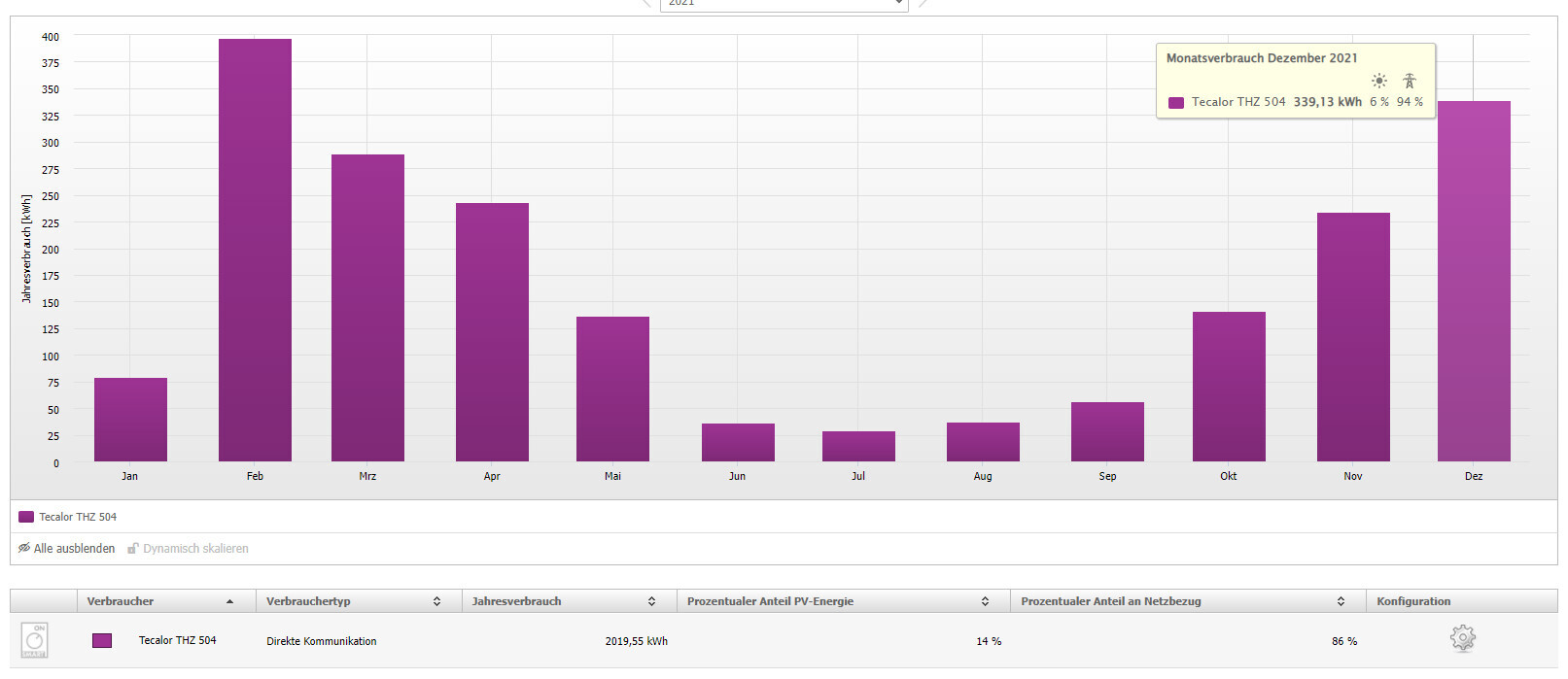
I've attached a screenshot of our data as well. January has to be excluded since our smart home manager (SHM) was only installed at the end of the month. A few sunny days in the winter months usually don’t cause big changes; for us, the share of photovoltaic energy for the heat pump during winter fluctuates between 6-10%. The annual average is 14%, as shown in the screenshot, but this is because in summer we deliberately use the SHM to convert photovoltaic electricity into hot water instead of feeding it into the grid.
We currently have only 4.55 kWp. How much photovoltaic capacity do you have? Thanks! Our values are roughly 1.5 times higher than these. Yes, it doesn’t make much difference in winter. Most of the photovoltaic coverage for the heat pump is for domestic hot water production and the transitional seasons. I still need to correct my December values, as I can see. Otherwise, you can clearly see the electricity savings for the heat pump (light brown in the upper section for the 20 ct/kWh tariff).
Our system is 6.6 kWp facing south-southwest with a 38° roof pitch (which is good for winter sun, where 4.2 kW are still achievable).
kati1337 schrieb:
We currently have only 4.55 kWp (kilowatt-peak). How much photovoltaic capacity do you have? 4lpha0ne schrieb:
Our system has 6.6 kWp facing south-southwest with a 38° roof pitch (which is good for winter sun, where up to 4.2 kW are still achievable). As far as I know, there are many threads here dealing with electricity consumption for alternative heating systems (air source heat pumps and the like) that are just waiting for energy curves or the efficiency of photovoltaic systems and similar to be shared.
This topic can then continue with gas prices if there is interest, right?
Similar topics