
ᐅ Should the photovoltaic system be taken into account when sizing the heat pump or not?
Created on: 28 Sep 2023 21:34
R
RadfahrerR
Radfahrer28 Sep 2023 21:34Hello,
I am considering installing a photovoltaic system.
Currently, my household electricity consumption is about 3800 kWh per year.
Additionally, I have a heat pump with a consumption of around 2900 kWh per year.
Now, I am unsure whether it makes sense to size the photovoltaic system larger to cover the heat pump since heating is mostly needed during the darker months.
In summer, there is probably excess electricity available, which could be used for water heating.
It should also be taken into account that the heat pump usually runs at night in winter and consumes about 3.3 kW.
For water heating only in summer, I would have the option to choose the operating times freely.
However, the air-source pump then requires 5 kW.
Unfortunately, my roof areas are not optimal.
It is a one-story house with a hip roof at 18° (18°) pitch, and the large surface faces almost north.
Three surfaces facing south or west would be sufficient for nearly 10 kWp.
What would you advise me?
I am considering installing a photovoltaic system.
Currently, my household electricity consumption is about 3800 kWh per year.
Additionally, I have a heat pump with a consumption of around 2900 kWh per year.
Now, I am unsure whether it makes sense to size the photovoltaic system larger to cover the heat pump since heating is mostly needed during the darker months.
In summer, there is probably excess electricity available, which could be used for water heating.
It should also be taken into account that the heat pump usually runs at night in winter and consumes about 3.3 kW.
For water heating only in summer, I would have the option to choose the operating times freely.
However, the air-source pump then requires 5 kW.
Unfortunately, my roof areas are not optimal.
It is a one-story house with a hip roof at 18° (18°) pitch, and the large surface faces almost north.
Three surfaces facing south or west would be sufficient for nearly 10 kWp.
What would you advise me?

X
xMisterDx28 Sep 2023 23:14Tolentino schrieb:
Photovoltaics should always be as large as possible. Maximize the system! Up to 25° roof pitch even on the north side!
Skip the battery storage.This makes sense if you have the cash to spend without needing a loan.
If you have to take out a personal loan with 5 or 6% interest, or even higher depending on your credit score, it’s better to install only the photovoltaic system you actually need for your roof...
R
RotorMotor29 Sep 2023 06:57I would recommend entering the data into PVGIS to see which area yields what amount of output.
If you have difficulties with this, add information such as orientation and location, and we can help.
But at 10 degrees Celsius (50°F), usually going full scale makes sense!
Have you already obtained any quotes?
If you have difficulties with this, add information such as orientation and location, and we can help.
But at 10 degrees Celsius (50°F), usually going full scale makes sense!
Have you already obtained any quotes?

In winter, you will appreciate every kWh that comes from the roof. These are lean times... You can then shift the hot water production to the brighter periods.
Therefore, I also recommend installing as much as possible. I wouldn’t even consider 10 kWp (kilowatt peak) to be a lot. The additional cost is manageable anyway if the crew is already on the roof and the scaffolding is in place.
Therefore, I also recommend installing as much as possible. I wouldn’t even consider 10 kWp (kilowatt peak) to be a lot. The additional cost is manageable anyway if the crew is already on the roof and the scaffolding is in place.

I also recommend fully utilizing the roof space. I would skip the battery storage, but install as many solar panels on the roof as possible. Although the feed-in tariff is not very high, it ultimately helps pay for the system. We have a 12.45 kWh system and fed over 400 kWh back into the grid in just one month.
Ideally, you should raise your self-consumption as much as reasonably possible. Schedule appliances like the washing machine, dryer, dishwasher, etc., during daylight hours. You get a feel for it over time.
It is often said that photovoltaics and heat pumps do not complement each other well, but what people forget is that in Germany, heating is needed not just in winter. We have three seasons with heating periods. Just two days ago, we woke the heat pump from its summer mode. In autumn and spring, the synergy between heat pumps and photovoltaics is excellent. In winter, the solar energy from the roof won’t be sufficient, that’s clear—but it is still better than buying everything from the grid.
We have had heat pumps and photovoltaics in two houses: in the first, only a very small solar system, and in the new one, as large a system as possible. We really regretted having only a small system in the first house.
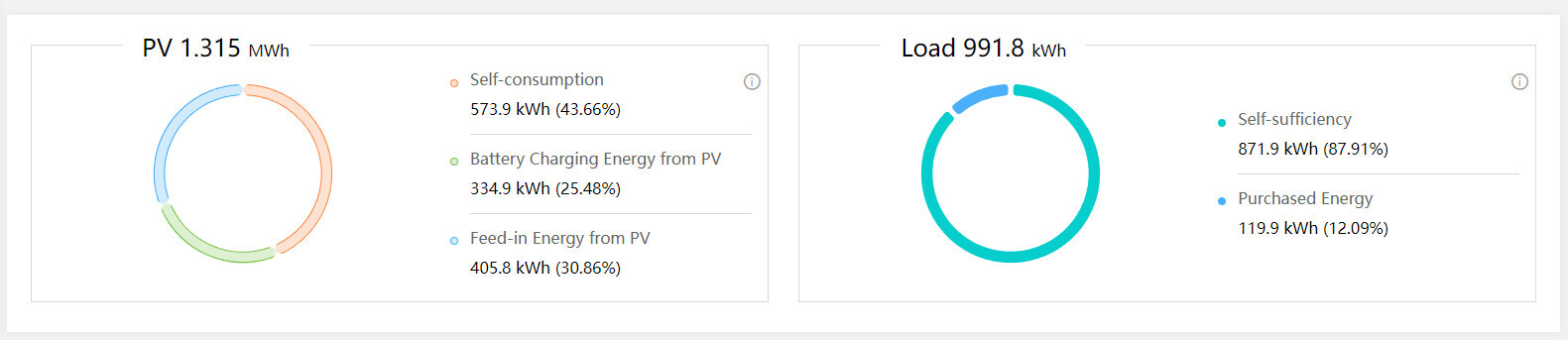
Here is our monthly overview (this may not be representative for others, as we consume a lot of electricity—household, car, and heat pump).
Ideally, you should raise your self-consumption as much as reasonably possible. Schedule appliances like the washing machine, dryer, dishwasher, etc., during daylight hours. You get a feel for it over time.
It is often said that photovoltaics and heat pumps do not complement each other well, but what people forget is that in Germany, heating is needed not just in winter. We have three seasons with heating periods. Just two days ago, we woke the heat pump from its summer mode. In autumn and spring, the synergy between heat pumps and photovoltaics is excellent. In winter, the solar energy from the roof won’t be sufficient, that’s clear—but it is still better than buying everything from the grid.
We have had heat pumps and photovoltaics in two houses: in the first, only a very small solar system, and in the new one, as large a system as possible. We really regretted having only a small system in the first house.
Here is our monthly overview (this may not be representative for others, as we consume a lot of electricity—household, car, and heat pump).
Similar topics