
Hello everyone,
I understand that getting a clear answer on a forum and thus a remote diagnosis regarding a dirty/discolored facade is difficult, but maybe with your help I can make some progress.
We are already involved in a legal dispute with the construction company over some other defects (the base “iscoming loose,” soaking wet external claddings, etc.). Our lawyer advised us to repaint the facade at our own expense, as only a complex and costly laboratory analysis can really clarify the cause.
We will have a master painter come to take a look, maybe he can identify the cause.
Facts:
Facade construction:
(I hope this is all correct!)
At first I suspected the barge flashing; by now I think it is a combination of the facade paint and the metal flashing. The facade beneath the gutter is also dirty; where there is a roof overhang, there is no discoloration.
I have a few theories but will keep them to myself for now; however, I do have two questions already:
I will, of course, also post photos of the facade here.
Thanks very much in advance for hopefully some answers!
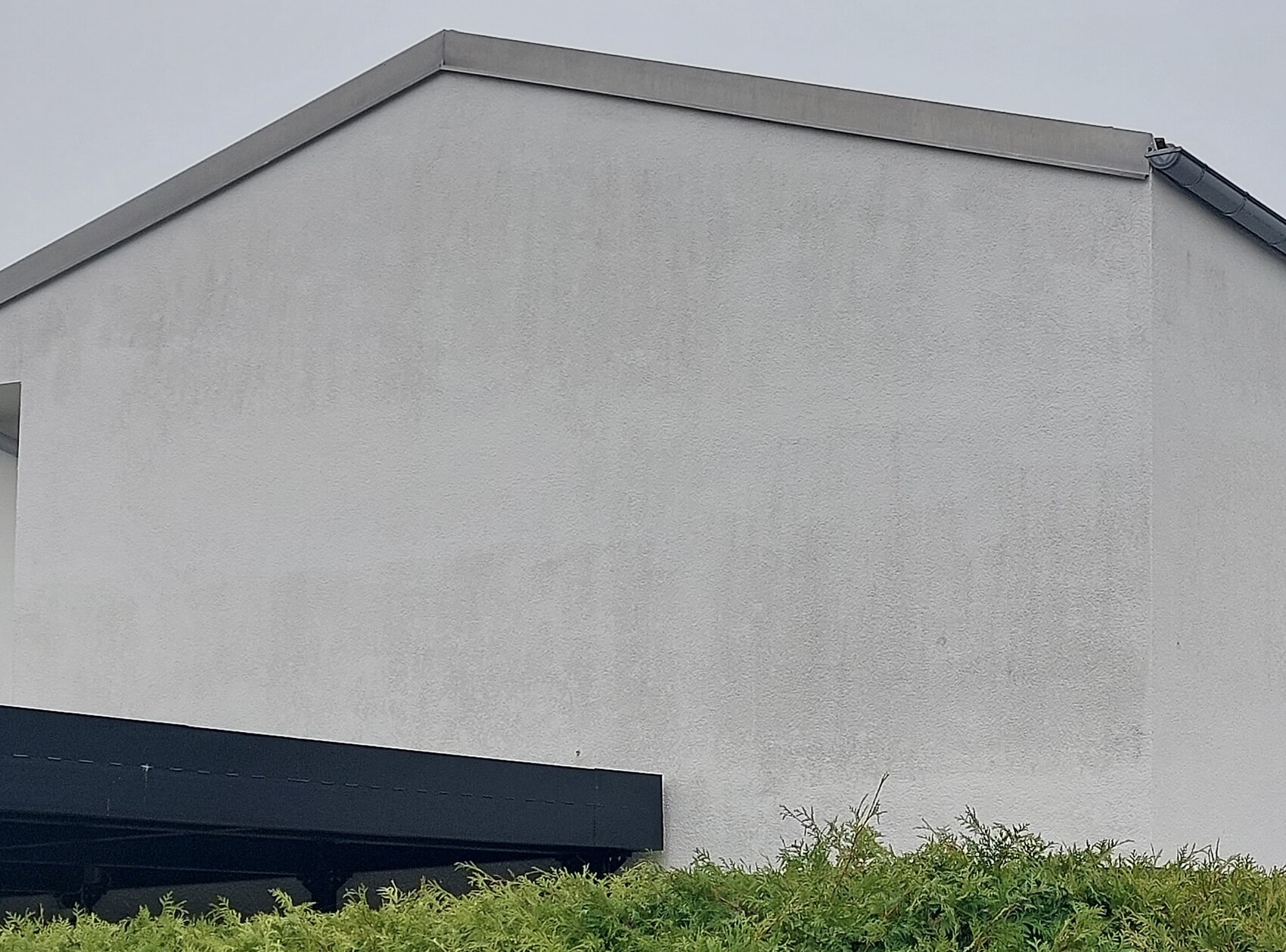
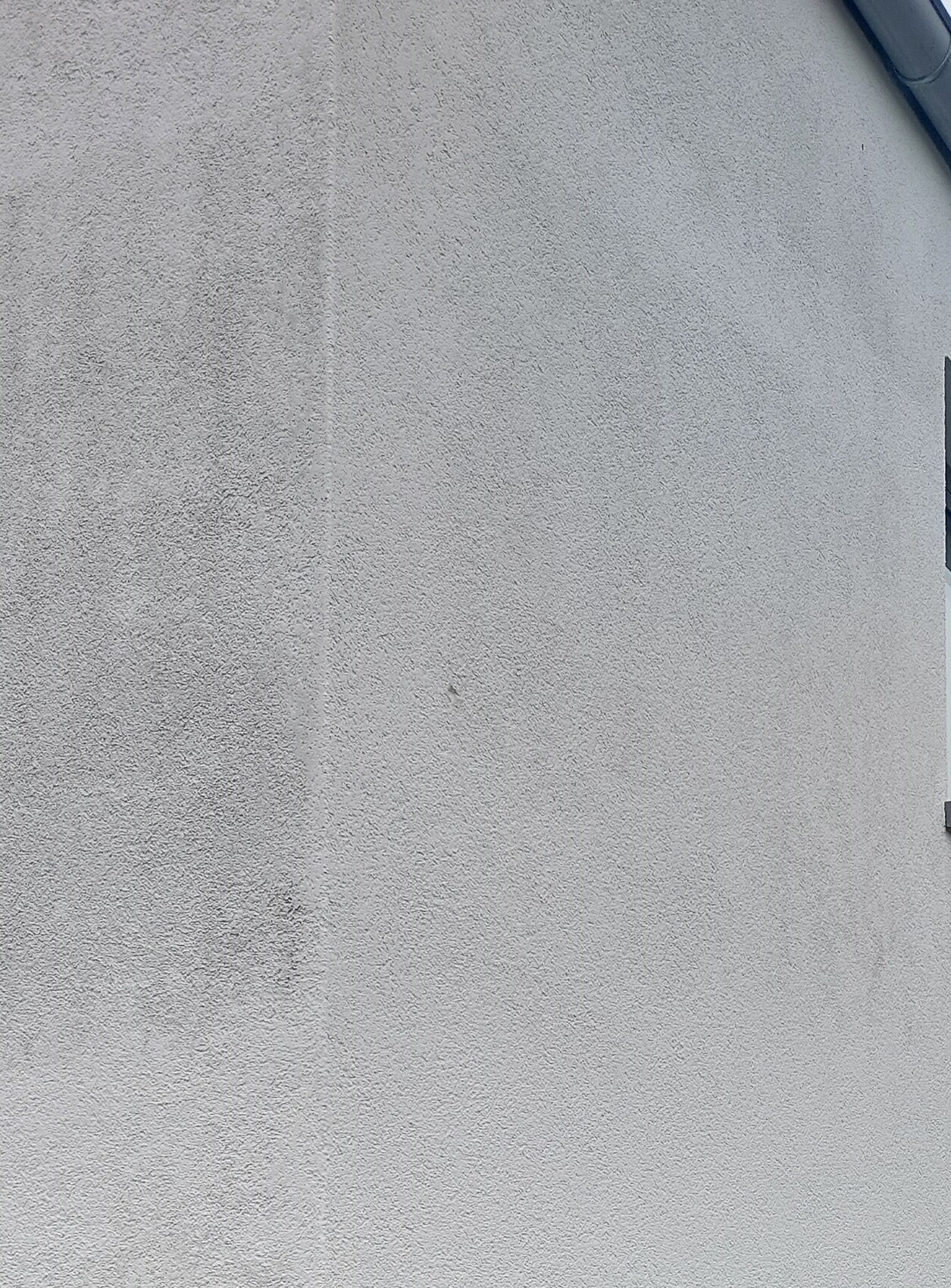

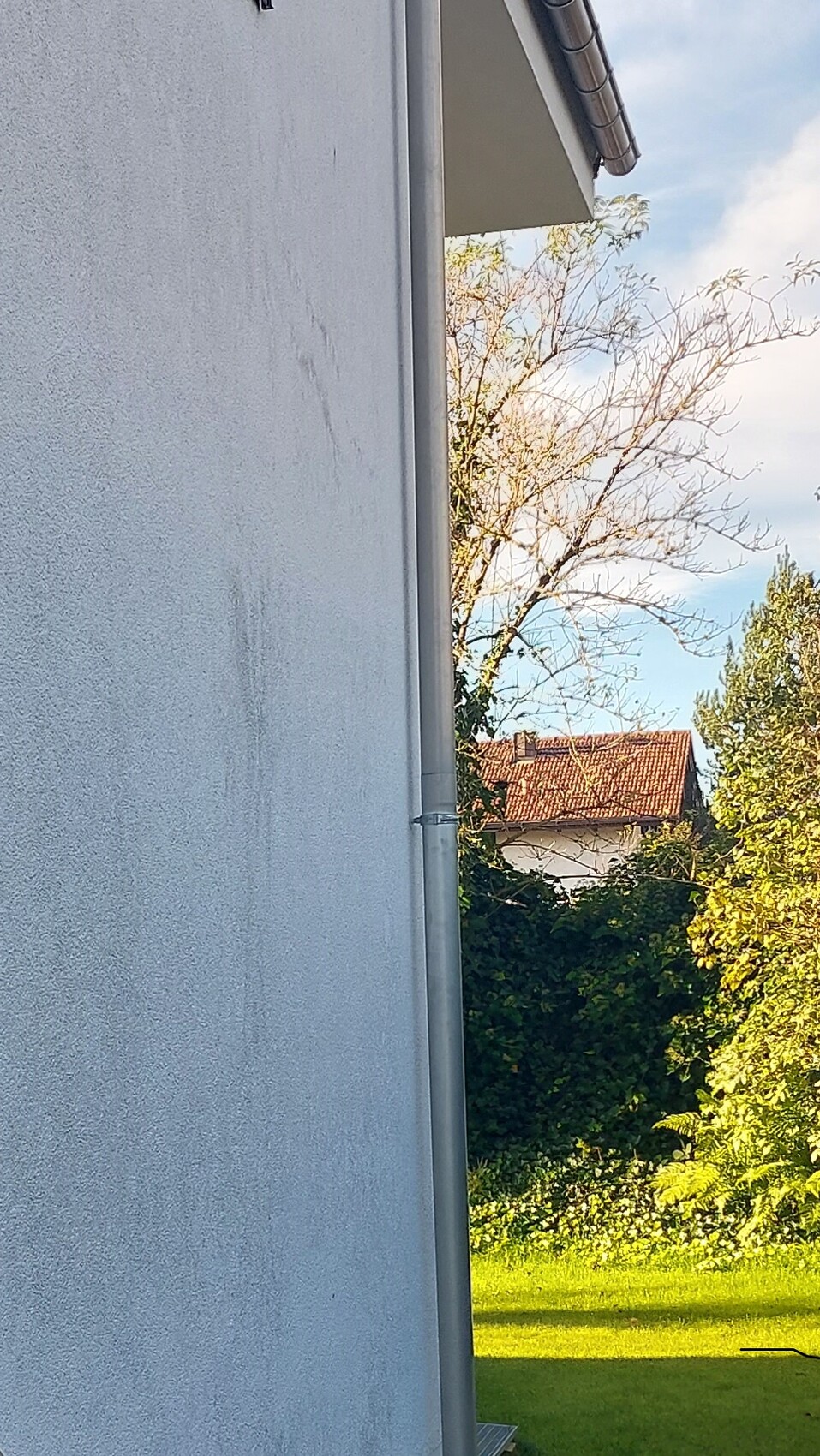
I understand that getting a clear answer on a forum and thus a remote diagnosis regarding a dirty/discolored facade is difficult, but maybe with your help I can make some progress.
We are already involved in a legal dispute with the construction company over some other defects (the base “iscoming loose,” soaking wet external claddings, etc.). Our lawyer advised us to repaint the facade at our own expense, as only a complex and costly laboratory analysis can really clarify the cause.
We will have a master painter come to take a look, maybe he can identify the cause.
Facts:
- Single-family house
- Facade painted 4 years ago, nighttime temperatures were around freezing, according to the construction company, it was painted three times
- Partially no roof overhang
- Barge flashing
Facade construction:
- Insulation material: mineral wool
- Base coat: water-repellent reinforcement mortar
- Top coat: water-absorbent plaster
- Silicate paint: hydroactive (biocide-free)
(I hope this is all correct!)
At first I suspected the barge flashing; by now I think it is a combination of the facade paint and the metal flashing. The facade beneath the gutter is also dirty; where there is a roof overhang, there is no discoloration.
I have a few theories but will keep them to myself for now; however, I do have two questions already:
- When you rub your hand over the silicate paint, it powders off finely, very finely. Is this normal?
- I don’t trust the construction company at all and also don’t believe they actually painted it three times. Is there a simple way to verify this? How does multiple coats affect the quality or performance (for any function) of facade paint, aside from coverage?
I will, of course, also post photos of the facade here.
Thanks very much in advance for hopefully some answers!

N
nordanney11 Dec 2024 11:51alive&kicking schrieb:
For this reason, we also chose silicate paint, as it has a high pH value, is nutrient-free or low in nutrients, and naturally free of biocides. If I remember correctly, we also selected it because it is often used on old buildings, such as churches, etc.Yes. However, when dealing with algae growth, you should keep in mind that the old masonry on the exterior wall is significantly warmer than an external thermal insulation composite system (ETICS) because the wall is heated from the inside, so moisture on the outside dries very quickly. Your exterior wall is very cold and stays damp for a long time. That is why many ETICS facades become "dirty" and turn green after a relatively short period.
I have seen this myself in an exposed location after just 1.5 years, also due to the lack of an eave.
A
alive&kicking11 Dec 2024 12:16Hello and thank you!
@ Tolentino
It is a system from the manufacturer Gima, which was offered to us upon request.
@ nordanney
At first, I could understand what you meant, but when I think about it, a field chapel or even a church is not really heated.
But be that as it may. Maybe we made a mistake in the selection. How can this be corrected? Somehow, I’m not very keen on repainting every three years. Of course, roof overhang! We don’t have one now (and for other reasons, I would never do it like this again).
Still, why have large (geometric) areas on the façade remained almost clean?
@ Tolentino
It is a system from the manufacturer Gima, which was offered to us upon request.
@ nordanney
At first, I could understand what you meant, but when I think about it, a field chapel or even a church is not really heated.
But be that as it may. Maybe we made a mistake in the selection. How can this be corrected? Somehow, I’m not very keen on repainting every three years. Of course, roof overhang! We don’t have one now (and for other reasons, I would never do it like this again).
Still, why have large (geometric) areas on the façade remained almost clean?
N
nordanney11 Dec 2024 12:48alive&kicking schrieb:
maybe we made a mistake in the selection.Basically not.alive&kicking schrieb:
Still 🙂, why did large (geometric) areas on the facade remain almost clean?Lucky during application. Incorrect temperatures can, for example, cause blisters.alive&kicking schrieb:
thinking about it, I wonder, a field chapel or even a church isn’t really heated.Partly different materials and partly just a few degrees warmer. In the past, pure silicate paint was also used. In your case—I’d bet on a dispersion paint.A
alive&kicking11 Dec 2024 13:12So, the application process is actually quite demanding, as I have read?
"Mineral facade paint according to DIN 18363 section 2.4" is stated on the manufacturer's website, and the composition:
potassium water glass, polymer dispersion, titanium dioxide,
fillers, water, polysiloxane,
film-forming auxiliaries, additives
"Mineral facade paint according to DIN 18363 section 2.4" is stated on the manufacturer's website, and the composition:
potassium water glass, polymer dispersion, titanium dioxide,
fillers, water, polysiloxane,
film-forming auxiliaries, additives
N
nordanney11 Dec 2024 13:18alive&kicking schrieb:
So, the application is actually as demanding as I've read?For pure silicate paint, yes; your paint definitely not. Just roll it on like any standard emulsion paint. Maybe the temperatures were off, though.Similar topics