
Hello everyone,
I understand that getting a clear answer on a forum and thus a remote diagnosis regarding a dirty/discolored facade is difficult, but maybe with your help I can make some progress.
We are already involved in a legal dispute with the construction company over some other defects (the base “iscoming loose,” soaking wet external claddings, etc.). Our lawyer advised us to repaint the facade at our own expense, as only a complex and costly laboratory analysis can really clarify the cause.
We will have a master painter come to take a look, maybe he can identify the cause.
Facts:
Facade construction:
(I hope this is all correct!)
At first I suspected the barge flashing; by now I think it is a combination of the facade paint and the metal flashing. The facade beneath the gutter is also dirty; where there is a roof overhang, there is no discoloration.
I have a few theories but will keep them to myself for now; however, I do have two questions already:
I will, of course, also post photos of the facade here.
Thanks very much in advance for hopefully some answers!
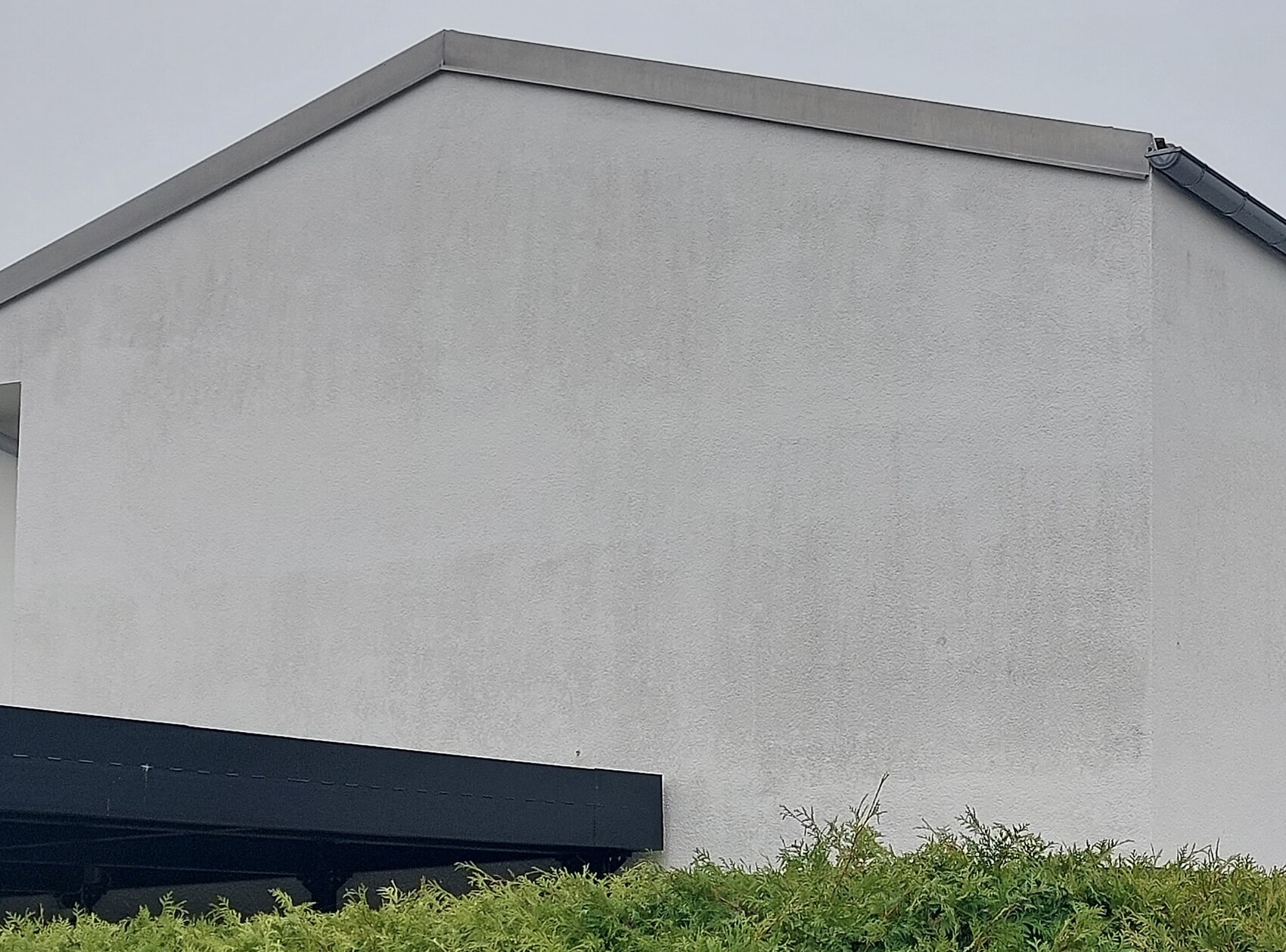
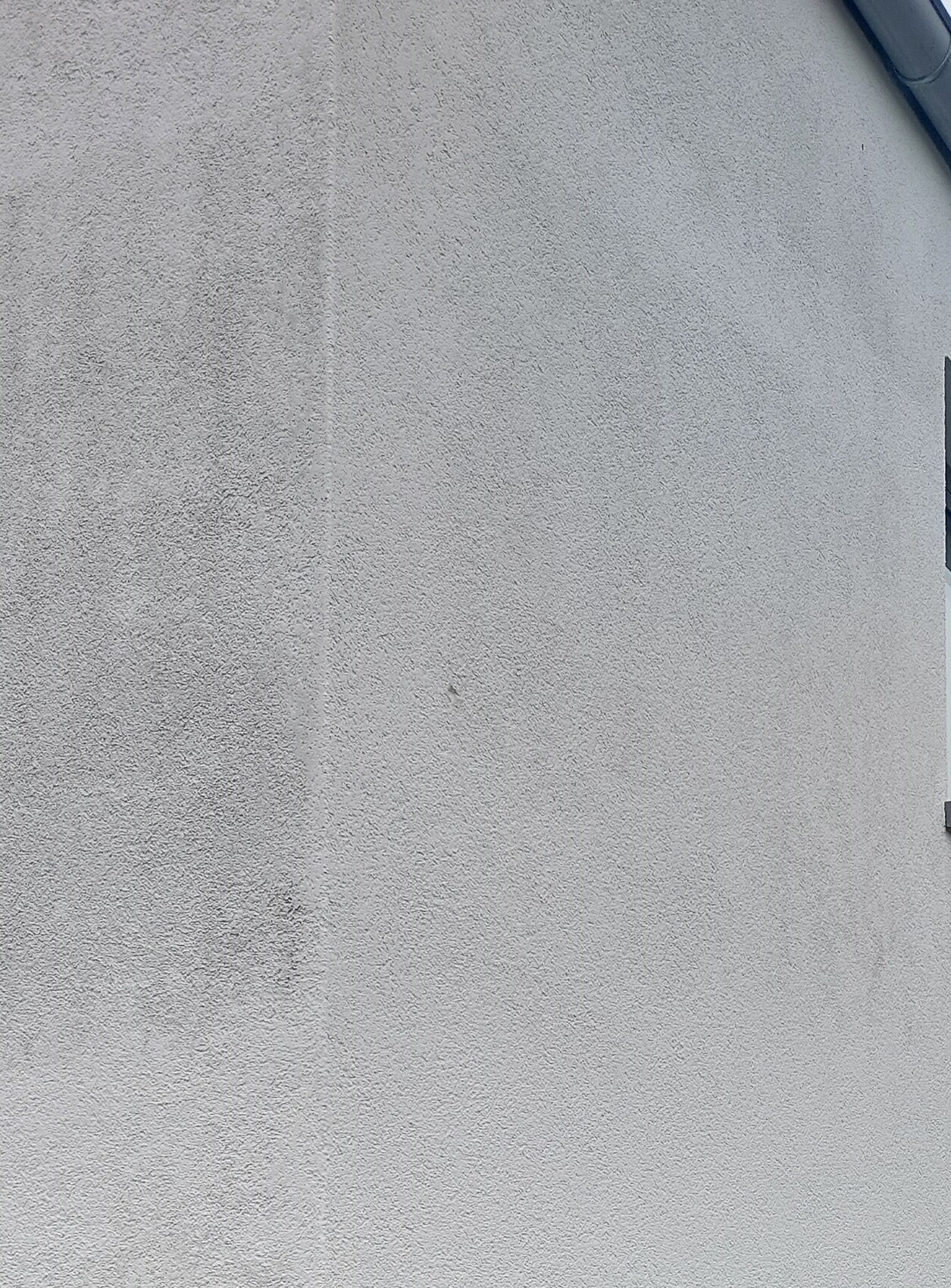

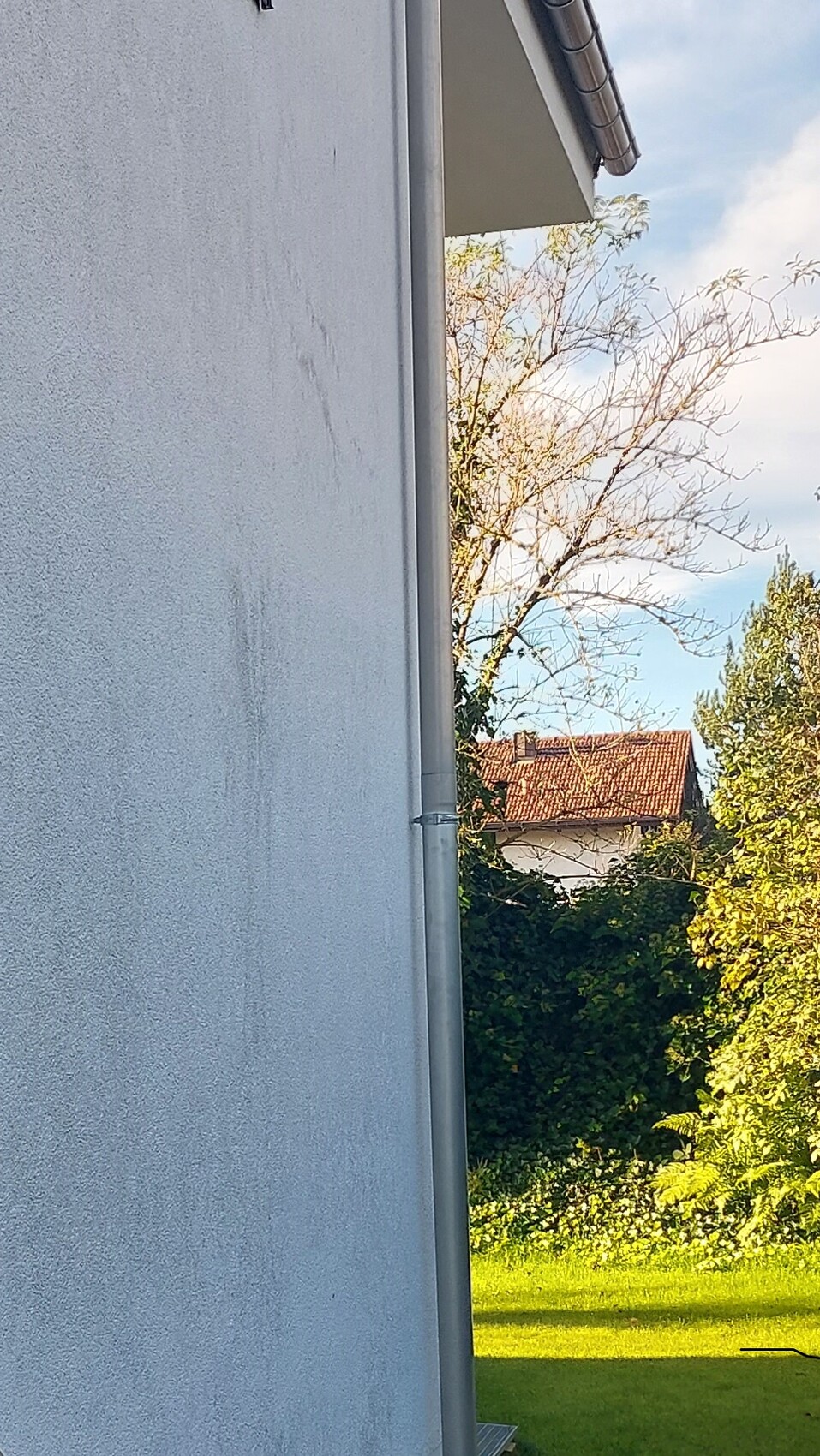
I understand that getting a clear answer on a forum and thus a remote diagnosis regarding a dirty/discolored facade is difficult, but maybe with your help I can make some progress.
We are already involved in a legal dispute with the construction company over some other defects (the base “iscoming loose,” soaking wet external claddings, etc.). Our lawyer advised us to repaint the facade at our own expense, as only a complex and costly laboratory analysis can really clarify the cause.
We will have a master painter come to take a look, maybe he can identify the cause.
Facts:
- Single-family house
- Facade painted 4 years ago, nighttime temperatures were around freezing, according to the construction company, it was painted three times
- Partially no roof overhang
- Barge flashing
Facade construction:
- Insulation material: mineral wool
- Base coat: water-repellent reinforcement mortar
- Top coat: water-absorbent plaster
- Silicate paint: hydroactive (biocide-free)
(I hope this is all correct!)
At first I suspected the barge flashing; by now I think it is a combination of the facade paint and the metal flashing. The facade beneath the gutter is also dirty; where there is a roof overhang, there is no discoloration.
I have a few theories but will keep them to myself for now; however, I do have two questions already:
- When you rub your hand over the silicate paint, it powders off finely, very finely. Is this normal?
- I don’t trust the construction company at all and also don’t believe they actually painted it three times. Is there a simple way to verify this? How does multiple coats affect the quality or performance (for any function) of facade paint, aside from coverage?
I will, of course, also post photos of the facade here.
Thanks very much in advance for hopefully some answers!
A
alive&kicking11 Dec 2024 13:29Ok, thanks. Now I also understand that there are differences.
How and with what should I correct it? I have also read about a water-repellent coating.
Really appreciate your effort and time!!!
How and with what should I correct it? I have also read about a water-repellent coating.
Really appreciate your effort and time!!!
A
alive&kicking4 Jun 2025 11:04Half a year later...
An expert with his own laboratory examined three core drill samples and reached the following conclusion:
According to the expert, the applied plaster system does not meet the specifications outlined in the contract documents. These require a (high-quality) medium- to thick-layered plaster system with a total thickness of 15–18mm (about 0.6–0.7 inches), including a 10mm (0.4 inches) topcoat. Instead, a rather thin-layered plaster system with thicknesses ranging from 4.5 to 11mm (0.18 to 0.43 inches) was applied. The thickness of plaster layers significantly affects resistance to fungi and algae; the facade shows significant microbiological infestation.
Furthermore, a plaster system with different functional properties was used. The specification called for a 10mm (0.4 inches) water-absorbing topcoat, but a water-repellent one was applied. The expert explained the difference by stating that the dew point of the specified system lies within the plaster, whereas in the system used, it is located at the outer surface. "We ordered a Porsche, but got an Opel."
Additionally, the high-quality paint applied (silicate with colloidal silica) is not compatible with this plaster system; its only function in this context is adhesion.
When asked about restoration options, the expert—who formerly worked in a plaster system development department—could not suggest any solution.
Well (or not so well)... we will now report this defect to our lawyer.
What restoration options do you see?
Best regards and have a nice day!!
An expert with his own laboratory examined three core drill samples and reached the following conclusion:
According to the expert, the applied plaster system does not meet the specifications outlined in the contract documents. These require a (high-quality) medium- to thick-layered plaster system with a total thickness of 15–18mm (about 0.6–0.7 inches), including a 10mm (0.4 inches) topcoat. Instead, a rather thin-layered plaster system with thicknesses ranging from 4.5 to 11mm (0.18 to 0.43 inches) was applied. The thickness of plaster layers significantly affects resistance to fungi and algae; the facade shows significant microbiological infestation.
Furthermore, a plaster system with different functional properties was used. The specification called for a 10mm (0.4 inches) water-absorbing topcoat, but a water-repellent one was applied. The expert explained the difference by stating that the dew point of the specified system lies within the plaster, whereas in the system used, it is located at the outer surface. "We ordered a Porsche, but got an Opel."
Additionally, the high-quality paint applied (silicate with colloidal silica) is not compatible with this plaster system; its only function in this context is adhesion.
When asked about restoration options, the expert—who formerly worked in a plaster system development department—could not suggest any solution.
Well (or not so well)... we will now report this defect to our lawyer.
What restoration options do you see?
Best regards and have a nice day!!
N
nordanney4 Jun 2025 11:20alive&kicking schrieb:
What renovation option do you see?Option. Singular, not plural. Remove the render and redo it.W
wiltshire4 Jun 2025 11:54alive&kicking schrieb:
What renovation options do you see? One of my colleagues in voluntary work often says: "A dog can have both lice and fleas at the same time."
What I mean is this: poor workmanship is one issue (lice), but white plaster, even if applied perfectly, is not suitable for every situation (fleas).
The Koll music school in Kaarst had the same problem. Several times. Ultimately, they solved it with a large-scale graffiti. Now no infestations are visible, and it has looked good for years.

I had problems with algae and similar substances (mostly greenish but also dark/black) around a ventilation outlet. I sprayed Geiger 09 on it. After that, you could practically watch the algae and such disappear. It has been over a year now, and nothing has come back so far. However, it is not exactly environmentally friendly and discolors various materials – you have to be very careful to apply it only where it is intended. I assume that other products with similar ingredients would work just as well, but I only know this one.
As a long-term solution, this is probably not suitable for you. But at least you could use it as a relatively inexpensive way to check whether algae and similar issues are part of the problem and factor that into your choice of a new solution.
As a long-term solution, this is probably not suitable for you. But at least you could use it as a relatively inexpensive way to check whether algae and similar issues are part of the problem and factor that into your choice of a new solution.