
Hello everyone,
This is my first post in the forum. I have mostly been reading as a guest in the past to gather information on various topics. Now, I’m hoping to get some feedback because I’m really unsure.
We moved into our new end-of-terrace house near Singen (Htw) at the end of February and are mostly satisfied. However, I’m concerned about the electrical installation:
In our electrical panel, we have three fuses, and I have had to replace one of them several times (two were 10 A fuses, which were replaced by 16 A fuses, and one was a 16 A fuse). This past weekend, for the first time, a 16 A fuse blew, so nothing worked anymore. Unfortunately, I don’t know when it happened because we only noticed it in the morning while showering—no hot water, since the heat pump had no power.
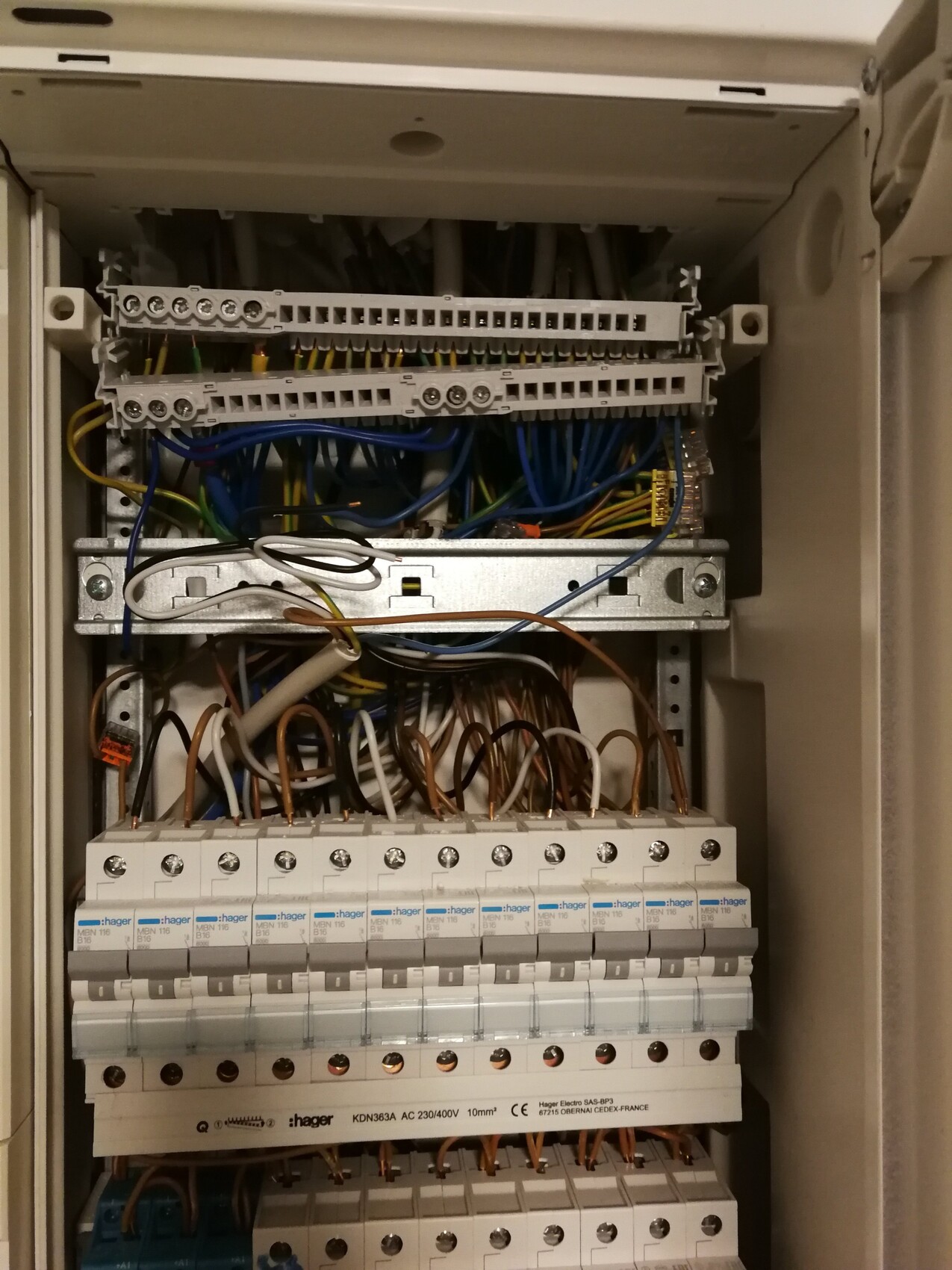
I then looked into the distribution box and removed the cover behind the fuses. You can see the result in the attachment.
What do you think? Is this common or is it poor workmanship? I have no knowledge of electrical work, and the local electrician only said the measurements are all good and that everything else is just cosmetic... is he right?
Thanks in advance for your feedback, I hope you can help me a bit.
Best regards,
SimKN
This is my first post in the forum. I have mostly been reading as a guest in the past to gather information on various topics. Now, I’m hoping to get some feedback because I’m really unsure.
We moved into our new end-of-terrace house near Singen (Htw) at the end of February and are mostly satisfied. However, I’m concerned about the electrical installation:
In our electrical panel, we have three fuses, and I have had to replace one of them several times (two were 10 A fuses, which were replaced by 16 A fuses, and one was a 16 A fuse). This past weekend, for the first time, a 16 A fuse blew, so nothing worked anymore. Unfortunately, I don’t know when it happened because we only noticed it in the morning while showering—no hot water, since the heat pump had no power.
I then looked into the distribution box and removed the cover behind the fuses. You can see the result in the attachment.
What do you think? Is this common or is it poor workmanship? I have no knowledge of electrical work, and the local electrician only said the measurements are all good and that everything else is just cosmetic... is he right?
Thanks in advance for your feedback, I hope you can help me a bit.
Best regards,
SimKN
There is an SLS fuse in the cabinet in front of the meter. Unfortunately, the picture is too small to identify what type it is. There should be at least two RCDs installed; I only see one. Normally, these fuses are used ONLY for the heat pump circuit, which means that a distribution should actually take place BEFORE the fuse.
I would suggest contacting the local electrical trade association to find an expert to inspect this. The distribution board is an absolute mess!!
I would suggest contacting the local electrical trade association to find an expert to inspect this. The distribution board is an absolute mess!!
B
Bieber081524 Apr 2018 08:42SimKN schrieb:
I listed for him everything that is (at least) not in order. I would be cautious and avoid getting caught up in minor details. You could initially reject the electrical trade as defective in general ("Due to the multitude of obvious defects ..."). Then someone with expertise should quickly assess the situation.
To be very clear: it is not your responsibility, and you clearly do not have the expertise (I don’t either, this is not a criticism or anything), to list each individual defect or even define the necessary measures to rectify them. Nobody else here in the forum can do that comprehensively through remote diagnosis either. Your "developer" will not take on this task either. You need to take care of it yourself. My advice: get an expert who can inspect the electrical work, provide an assessment, and advise on how to proceed.
C
Caspar202024 Apr 2018 08:52SimKN schrieb:
But in terms of safety, I don’t need to worry that all of this will "blow out" eventually, right?With your main fuses (the 3x 16A), especially if they are old-style cartridge fuses, they will blow quite regularly.
As @Tom1607 mentioned, it’s not clear how the RCD (the one under the meter) is rated.
However, the main distribution boards (DBs) I have seen recently in my area usually have a 63A main breaker as the main fuse, and it’s also a circuit breaker. Only the RCD in our installations is typically a fuse.
Thanks for the tip; that also seems to be the best approach to me.
I have now scheduled an appointment with the builder to discuss the next steps. But it was also important to me that my "impression" as a layperson was confirmed and that quite a few things appear to be problematic.
I have now scheduled an appointment with the builder to discuss the next steps. But it was also important to me that my "impression" as a layperson was confirmed and that quite a few things appear to be problematic.
H
HilfeHilfe24 Apr 2018 11:57Well, if the property burns down because of that...
The insurance will definitely take a closer look.
The insurance will definitely take a closer look.
In my opinion, this can only proceed with experts (appointed by @SimKN). Besides all the technical errors, they urgently need to check whether the TAB are being followed. TAB stands for Technical Connection Conditions (from the network operator), which specify the generally applicable regulations.
By the way... the cabinet is small, but it is by no means fully loaded to its limit. There is plenty of room to wire it properly. Even if no one notices right away, this should be done.
By the way... the cabinet is small, but it is by no means fully loaded to its limit. There is plenty of room to wire it properly. Even if no one notices right away, this should be done.
Similar topics