
Hello everyone,
This is my first post in the forum. I have mostly been reading as a guest in the past to gather information on various topics. Now, I’m hoping to get some feedback because I’m really unsure.
We moved into our new end-of-terrace house near Singen (Htw) at the end of February and are mostly satisfied. However, I’m concerned about the electrical installation:
In our electrical panel, we have three fuses, and I have had to replace one of them several times (two were 10 A fuses, which were replaced by 16 A fuses, and one was a 16 A fuse). This past weekend, for the first time, a 16 A fuse blew, so nothing worked anymore. Unfortunately, I don’t know when it happened because we only noticed it in the morning while showering—no hot water, since the heat pump had no power.
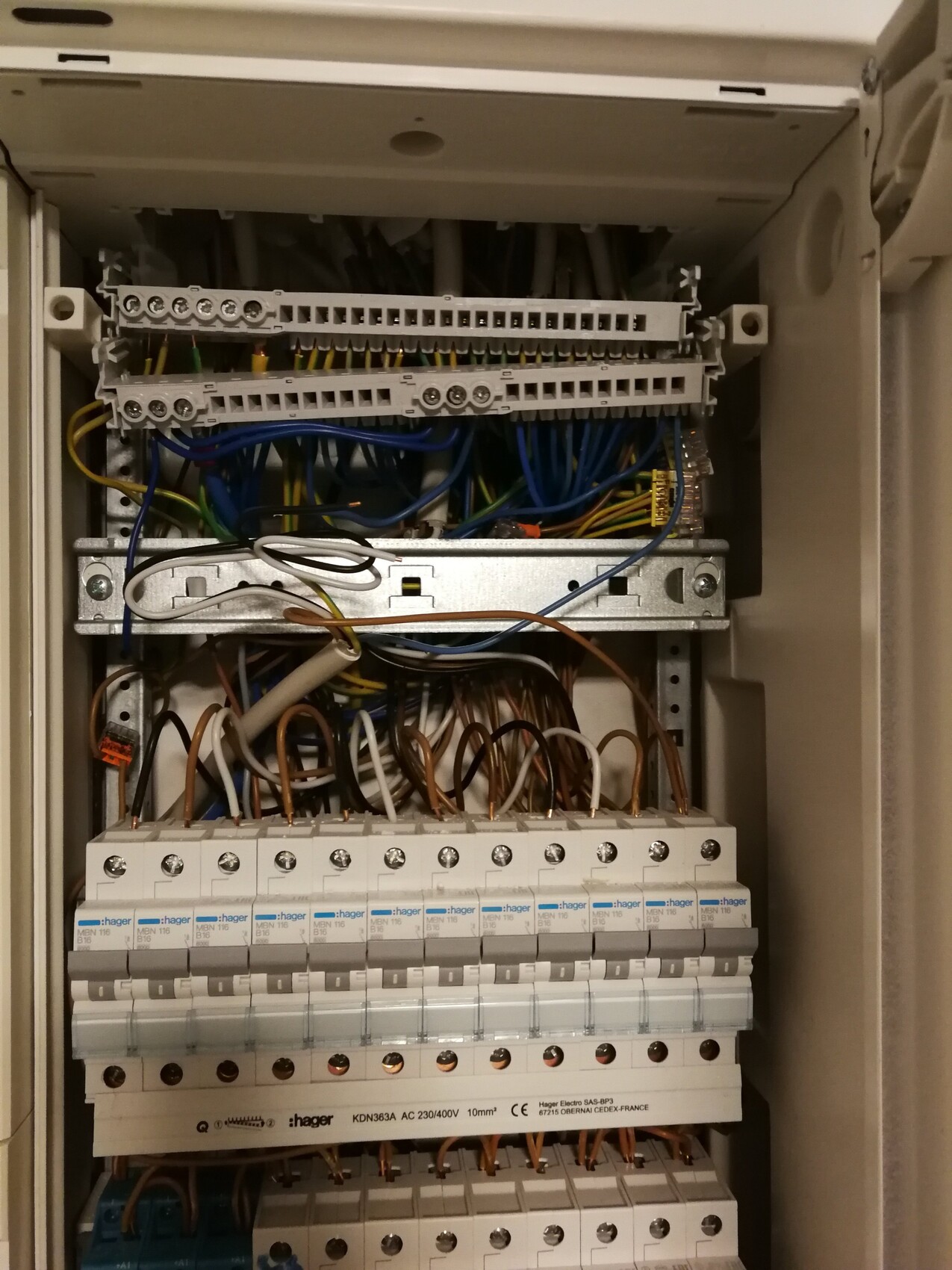
I then looked into the distribution box and removed the cover behind the fuses. You can see the result in the attachment.
What do you think? Is this common or is it poor workmanship? I have no knowledge of electrical work, and the local electrician only said the measurements are all good and that everything else is just cosmetic... is he right?
Thanks in advance for your feedback, I hope you can help me a bit.
Best regards,
SimKN
This is my first post in the forum. I have mostly been reading as a guest in the past to gather information on various topics. Now, I’m hoping to get some feedback because I’m really unsure.
We moved into our new end-of-terrace house near Singen (Htw) at the end of February and are mostly satisfied. However, I’m concerned about the electrical installation:
In our electrical panel, we have three fuses, and I have had to replace one of them several times (two were 10 A fuses, which were replaced by 16 A fuses, and one was a 16 A fuse). This past weekend, for the first time, a 16 A fuse blew, so nothing worked anymore. Unfortunately, I don’t know when it happened because we only noticed it in the morning while showering—no hot water, since the heat pump had no power.
I then looked into the distribution box and removed the cover behind the fuses. You can see the result in the attachment.
What do you think? Is this common or is it poor workmanship? I have no knowledge of electrical work, and the local electrician only said the measurements are all good and that everything else is just cosmetic... is he right?
Thanks in advance for your feedback, I hope you can help me a bit.
Best regards,
SimKN
K
Knallkörper23 Apr 2018 14:45Oh yes: The installation is not done properly. There are unused wires hanging loosely, which is not permitted. They must either be connected to terminal blocks or to Wago connectors. However, the Wago connectors must not be loose – this is not allowed in a distribution panel. That is the second improper aspect visible in the photo.
Furthermore:
-Electrical equipment must be arranged so that their operational use, inspection, maintenance, testing, and access to detachable connections are easily possible.
-All electrical equipment must be accessible for testing.
-The assignment of conductors introduced from outside to their circuits must be clearly and permanently identifiable.
I would say the main issue is the distribution cabinet being too small.
Furthermore:
-Electrical equipment must be arranged so that their operational use, inspection, maintenance, testing, and access to detachable connections are easily possible.
-All electrical equipment must be accessible for testing.
-The assignment of conductors introduced from outside to their circuits must be clearly and permanently identifiable.
I would say the main issue is the distribution cabinet being too small.
C
Caspar202023 Apr 2018 14:49Mycraft schrieb:
Well, that’s not exactly ideal. WAGO terminal blocks really shouldn’t be used inside the distribution board.According to WAGO, they are allowed inside if the correct WAGO mounting adapter is used; but obviously not like in the picture.
There is also some concern about the exposed two wires (though you see that more often than you’d think, of course only if they are not connected on the other side).
“It is recommended to provide additional conductors for maintenance purposes. If spare conductors are intended, they must be connected to spare terminals or be separated in such a way that contact with live parts is prevented.”SimKN schrieb:
In our electrical cabinet, we have three fuses, two of which I have had to replace from time to time (two 10 A fuses that were replaced by 16 A fuses, and one 16 A fuse). This past weekend, for the first time, a 16 A fuse blew, so everything stopped working… Unfortunately, I don’t know exactly when this happened since we only noticed it in the morning while showering, because there was no hot water as the heat pump also had no power.But here you are being unclear. First, the fuses don’t appear in the picture, and second, it’s not clear who raised the fuse ratings from 10 A to 16 A (without authorization?). Also, what is the purpose of these fuses?
Do you have a 3-pole circuit breaker (with 63 A or similar) in the panel? Or only these fuses?
Additionally, how many RCD / GFCI circuits are installed?
K
Knallkörper23 Apr 2018 15:18The more you look at the photo, the more mistakes you will notice:
On your circuit breakers, there are sometimes three wires connected to one output. A maximum of two wires is allowed.
On your circuit breakers, there are sometimes three wires connected to one output. A maximum of two wires is allowed.
Hello,
the electrician said he accidentally installed two 10A fuses, and I should simply use 16A instead.
As a layperson, I don’t really understand the purpose of the fuses; I only know that if one trips, neither my heat pump nor my major electrical appliances work...
As far as I know, a residual current device (RCD) is installed.
I’ll take another photo of the entire panel this evening; maybe that will help.
Is there any way to have an independent expert take another look, or do you think that would make sense?
Measurements were taken on Saturday, and the technician said that everything was fine according to the measurements.
the electrician said he accidentally installed two 10A fuses, and I should simply use 16A instead.
As a layperson, I don’t really understand the purpose of the fuses; I only know that if one trips, neither my heat pump nor my major electrical appliances work...
As far as I know, a residual current device (RCD) is installed.
I’ll take another photo of the entire panel this evening; maybe that will help.
Is there any way to have an independent expert take another look, or do you think that would make sense?
Measurements were taken on Saturday, and the technician said that everything was fine according to the measurements.
B
Bieber081523 Apr 2018 16:48SimKN schrieb:
The electrician said he accidentally installed two 10A fuses and that I should just use 16A ones.,No, he should come and fix his work properly.K
Knallkörper23 Apr 2018 17:19This is already a violation if he asks you to replace a 10A fuse with a 16A one. You are not a certified electrician. What if the wiring is not rated for that current load?
Apparently, there are several issues here, and if I were you, I would insist on a 100% code-compliant installation.
Apparently, there are several issues here, and if I were you, I would insist on a 100% code-compliant installation.