
Hi everyone,
what are the advantages and disadvantages of a single-family house?
Option 1:
Heating: Air-to-water heat pump with underfloor heating
Hot water: Air-to-water heat pump
Option 2:
Heating: Air-to-air heat pump (multi-split)
Hot water: Solar thermal system plus a small gas boiler for extended bad weather
what are the advantages and disadvantages of a single-family house?
Option 1:
Heating: Air-to-water heat pump with underfloor heating
Hot water: Air-to-water heat pump
Option 2:
Heating: Air-to-air heat pump (multi-split)
Hot water: Solar thermal system plus a small gas boiler for extended bad weather
W
WilderSueden8 Aug 2023 20:40Alessandro schrieb:
you’re talking about a completely different system ;-)Then clearly define your system instead of just linking a promotional chart in #13 😉 The Proxon and similar systems are now standard offerings from many prefabricated house manufacturers because they require little effort. And if the customer doesn’t want it, they often sell underfloor heating and heat pumps as expensive upgrades.
Nice discussion, but I would appreciate it if someone could say:
The house xyz requires x kWh of electricity per year for heating with an air-to-air heat pump / x kWh of electricity per year for heating with an air-to-water heat pump and underfloor heating.
What is the difference in size? Are we talking about 5% less due to a complex underfloor heating system, or more like 10% or higher? Compared to a modern split air conditioner, for example Panasonic Etherea.
The house xyz requires x kWh of electricity per year for heating with an air-to-air heat pump / x kWh of electricity per year for heating with an air-to-water heat pump and underfloor heating.
What is the difference in size? Are we talking about 5% less due to a complex underfloor heating system, or more like 10% or higher? Compared to a modern split air conditioner, for example Panasonic Etherea.

No one can give you an exact answer to that, as there are countless factors involved. Even how well your heating system is adjusted can have a significant impact on energy consumption. How warm you like it indoors and how cold it is outside also play a major role. Any general statement about electricity consumption would be nonsense.
H
HeimatBauer11 Aug 2023 08:34Just imagine: the heating engineer installs a perfectly matched air-to-water heat pump, and the owner immediately sets the flow temperature to 60°C (140°F) because they heard somewhere that something strange happens in the pipes below that. It’s obvious that the electricity costs will skyrocket. This applies equally to any other system concept.
That doesn’t make sense. Just because a floor heating system is modern and well insulated doesn’t mean biological life is prevented.
Let me summarize:
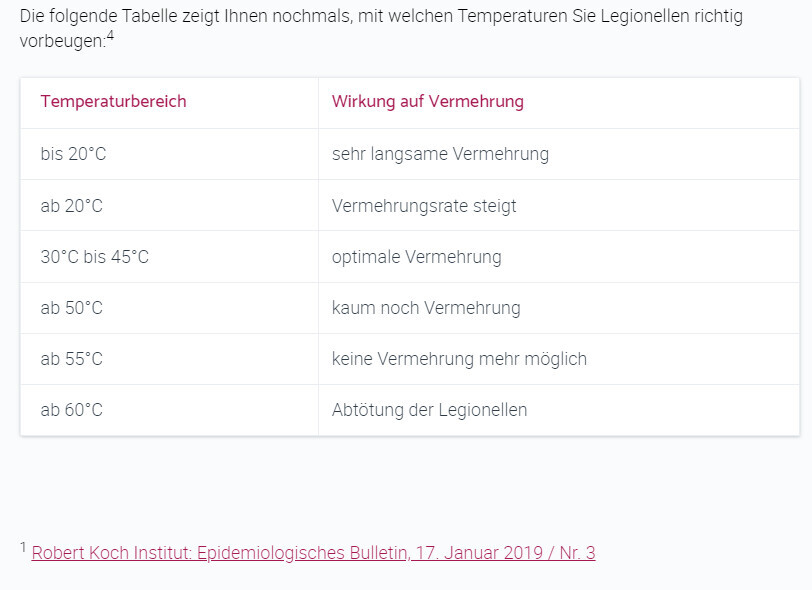
Drinking water can and does contain microorganisms. In public networks, because the temperature is below 20°C (68°F), their growth remains low and not problematic.
Heating the water storage to 60°C (140°F) prevents growth.
Heating the water storage to 70°C (158°F) kills the microorganisms.
Raising the temperature to 60°C (140°F) only every few days is nonsense—it only temporarily reduces Legionella growth. You need to reach 70°C (158°F) to kill them.
If you do not maintain 60°C (140°F) as a standard and do not regularly heat to 70°C (158°F), the water must be kept as cold as possible, but you still have to accept the risk.
This issue is what kills the air-source heat pump in winter. In winter, it’s hardly possible to reach 50°C (122°F) with a solar system. Without gas or other backup heating for the solar storage, it becomes a breeding ground after a few winter months. Since, as we know, 60°C (140°F) would be too much for the air-source heat pump, why use it to heat domestic hot water at all?
Let me summarize:
Drinking water can and does contain microorganisms. In public networks, because the temperature is below 20°C (68°F), their growth remains low and not problematic.
Heating the water storage to 60°C (140°F) prevents growth.
Heating the water storage to 70°C (158°F) kills the microorganisms.
Raising the temperature to 60°C (140°F) only every few days is nonsense—it only temporarily reduces Legionella growth. You need to reach 70°C (158°F) to kill them.
If you do not maintain 60°C (140°F) as a standard and do not regularly heat to 70°C (158°F), the water must be kept as cold as possible, but you still have to accept the risk.
This issue is what kills the air-source heat pump in winter. In winter, it’s hardly possible to reach 50°C (122°F) with a solar system. Without gas or other backup heating for the solar storage, it becomes a breeding ground after a few winter months. Since, as we know, 60°C (140°F) would be too much for the air-source heat pump, why use it to heat domestic hot water at all?
K
KarstenausNRW11 Aug 2023 09:51Let’s summarize:
Legionella bacteria in single-family homes are generally not a problem in practice, regardless of the water temperature. Why? Because Legionella live in stagnant water. In a typical single-family home, water is regularly used; after returning from a vacation, it is advisable to run a few liters of water if in doubt.
If you use water regularly, there is no need to worry about Legionella growth.
Every modern air-to-water heat pump can produce hot water at 60 degrees Celsius (140°F); in winter (down to -15 degrees Celsius (5°F)) temperatures should not fall below 55 degrees Celsius (131°F). When using the electric heating element for a Legionella prevention cycle, the temperature always reaches 60 degrees Celsius (140°F).
By the way, the conclusion of the Federal Environment Agency (UBA) analysis should not be overlooked:

And it’s also worth considering the details more carefully:
Legionella bacteria in single-family homes are generally not a problem in practice, regardless of the water temperature. Why? Because Legionella live in stagnant water. In a typical single-family home, water is regularly used; after returning from a vacation, it is advisable to run a few liters of water if in doubt.
If you use water regularly, there is no need to worry about Legionella growth.
Every modern air-to-water heat pump can produce hot water at 60 degrees Celsius (140°F); in winter (down to -15 degrees Celsius (5°F)) temperatures should not fall below 55 degrees Celsius (131°F). When using the electric heating element for a Legionella prevention cycle, the temperature always reaches 60 degrees Celsius (140°F).
By the way, the conclusion of the Federal Environment Agency (UBA) analysis should not be overlooked:
And it’s also worth considering the details more carefully:
Similar topics