
Hello! I would like to briefly introduce myself and my project and look forward to a productive exchange!
I am 42 years old and have inherited a house in a suburb. The house has been vacant for about 10 years. It was built in 1973, has approximately 105 sqm (1130 sq ft) of living space, and a small garden. I have already brought it back to a “shell condition” myself. However, my DIY skills and available time outside of work for further own work are unfortunately quite limited.
The house is fully basemented, but the basement is quite damp. There is one more floor with sloping ceilings. The attic is not usable or accessible due to these slopes. The house has never been renovated since construction and is in a correspondingly poor condition. All windows have roller shutter boxes without insulation. The walls are not insulated, and the roof hardly is either. The roof itself also needs renovation. There is an old oil heating system and no gas connection.
There is no gas connection available on the street either.
The building’s core is in good condition (no damages).
I have consulted an energy advisor who recommends renovation to an energy standard equivalent to KfW House 85.
The scope of work includes insulating the basement ceiling, roof, and exterior walls; new windows; a new roof; pellet heating with solar thermal, and possibly photovoltaic (south-facing roof 40°, approx. 80 sqm (860 sq ft) area).
He based his calculations on an energy cost of about 2700 euros per year. According to this, the renovation costs he calculated should be amortized within about 20 years. The renovation costs are “only” 48,000 euros.
Currently, I would receive 120,000 euros from KfW at 0.75% interest plus 33,000–36,000 euros repayment subsidy, as well as up to 30,000 euros in subsidies from BAFA for the new heating system.
With a contractor, the preliminary (verbal) quote for the complete renovation is around 180,000 euros, which also includes bathrooms, windows, flooring, etc.
What are your thoughts? Do you have any comments – things I might be overlooking?
I am somewhat uncertain about the pellet heating as the contractor has never installed one but seemed confident that it can be done properly.
The location is ideal for me regarding family and work, so it is very important for me to be able to settle here.
Best regards!
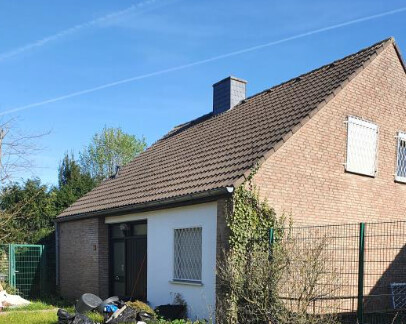
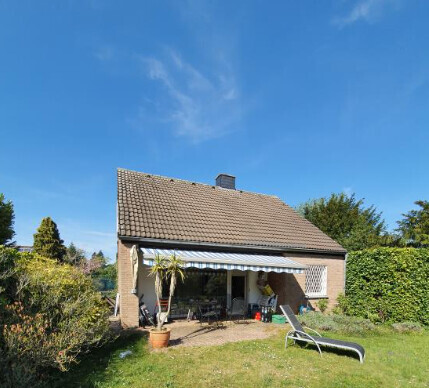
I am 42 years old and have inherited a house in a suburb. The house has been vacant for about 10 years. It was built in 1973, has approximately 105 sqm (1130 sq ft) of living space, and a small garden. I have already brought it back to a “shell condition” myself. However, my DIY skills and available time outside of work for further own work are unfortunately quite limited.
The house is fully basemented, but the basement is quite damp. There is one more floor with sloping ceilings. The attic is not usable or accessible due to these slopes. The house has never been renovated since construction and is in a correspondingly poor condition. All windows have roller shutter boxes without insulation. The walls are not insulated, and the roof hardly is either. The roof itself also needs renovation. There is an old oil heating system and no gas connection.
There is no gas connection available on the street either.
The building’s core is in good condition (no damages).
I have consulted an energy advisor who recommends renovation to an energy standard equivalent to KfW House 85.
The scope of work includes insulating the basement ceiling, roof, and exterior walls; new windows; a new roof; pellet heating with solar thermal, and possibly photovoltaic (south-facing roof 40°, approx. 80 sqm (860 sq ft) area).
He based his calculations on an energy cost of about 2700 euros per year. According to this, the renovation costs he calculated should be amortized within about 20 years. The renovation costs are “only” 48,000 euros.
Currently, I would receive 120,000 euros from KfW at 0.75% interest plus 33,000–36,000 euros repayment subsidy, as well as up to 30,000 euros in subsidies from BAFA for the new heating system.
With a contractor, the preliminary (verbal) quote for the complete renovation is around 180,000 euros, which also includes bathrooms, windows, flooring, etc.
What are your thoughts? Do you have any comments – things I might be overlooking?
I am somewhat uncertain about the pellet heating as the contractor has never installed one but seemed confident that it can be done properly.
The location is ideal for me regarding family and work, so it is very important for me to be able to settle here.
Best regards!
A few thoughts:
There simply isn’t enough space for pellets storage in a 100m² (1,076 sq ft) house. So that option is out.
Maybe it would make sense to increase the living area with dormer windows or an extension?
Actually, everything needs to be new. If an external wall insulation is added, the roof will have to be replaced as well, since there is no overhang on all sides.
Off the top of my head, I would estimate a full renovation cost of around 1000–1500 €/m² (approx. $93–140 per sq ft). However, I don’t really know enough about the house or the personal expectations for the final result.
There simply isn’t enough space for pellets storage in a 100m² (1,076 sq ft) house. So that option is out.
Maybe it would make sense to increase the living area with dormer windows or an extension?
Actually, everything needs to be new. If an external wall insulation is added, the roof will have to be replaced as well, since there is no overhang on all sides.
Off the top of my head, I would estimate a full renovation cost of around 1000–1500 €/m² (approx. $93–140 per sq ft). However, I don’t really know enough about the house or the personal expectations for the final result.
Thank you for the comments. I have another question regarding exterior wall insulation: Several acquaintances have told me that applying this to "old masonry" can cause severe mold problems. Insulation is supposedly only suitable for newer buildings (with fewer thermal bridges through concrete slabs, etc.). How should these statements be viewed? Isn’t mold growth ultimately dependent on ventilation? A central ventilation system does not seem possible in this house. Therefore, I was considering decentralized automated ventilation on the ground floor and upper floor. Does anyone have experience with this? Thanks and best regards!
Similar topics